

If there is one notion carried throughout the Internet, it’s that people want to let you know when they are dissatisfied with you – much more so than people do when they are face to face with an issue. There’s something about being allowed to hide behind the computer screen. YouTube is no different. It greatly upset users this week when it announced it would be permanently eliminating the YouTube dislike button – or rather the dislike counts. Your opinion will still be tallied, but the dislike button counts on YouTube will no longer be displayed.
YouTube Announces Change to YouTube Dislike Counts
Everyone should have been forewarned earlier this year when YouTube “experimented” with the dislike button count. The purpose was to see if this would help protect YouTube creators from getting harassed, specifically by organized attacks to drive up the dislike counts on videos.
YouTube explained in a blog post this week what they learned by not showing the dislike counts. “Because the count was not visible to them, we found that [harassers] were less likely to target a video’s dislike button to drive up the count. In short, our experiment data showed a reduction in dislike attacking behavior.”
In addition, YouTube received word from newbie creators and those with less of a following. They reported that “they are unfairly targeted by dislike attacks. Our experiment data confirmed that this behavior does occur at a higher proportion on smaller channels.”
I can attest to that. I published daily entertainment news stories for a few years, definitely on a small scale with viewers. There was one story I reported that started a campaign by a group that disagreed with my opinion. It was a drive to get me to abandon my videos. I was harassed with dislikes, called vile names, and even had the group’s leader create a video calling me out by name and urging her followers to harass me and get me removed.
Based on what YouTube learned from its experiment, it is “moving forward with making the dislike count private across YouTube – this means that the dislike button is staying, but the number of dislikes on a video will only be available to creators in Studio and not visible to the public on the video’s page. This change is gradually rolling out starting today.”
But creators don’t have to learn the number of times viewers hit the dislike button if they don’t want to. It will only be available in YouTube Studio, along with other metrics to help creators see how their videos are performing. It will be just another analytic tool, along with reports.
YouTube users can still click away on the dislike button – they just won’t get the satisfaction of having others know their feelings. YouTube admitted in the blog post that it’s aware some users use the dislike button counts to see whether they want to spend their time watching a particular video – yet, it still believes eliminating the public count is the right thing to do moving forward so that “creators have the opportunity to succeed and feel safe to express themselves.”
Disapproval of the Removal of Public Dislike Counts
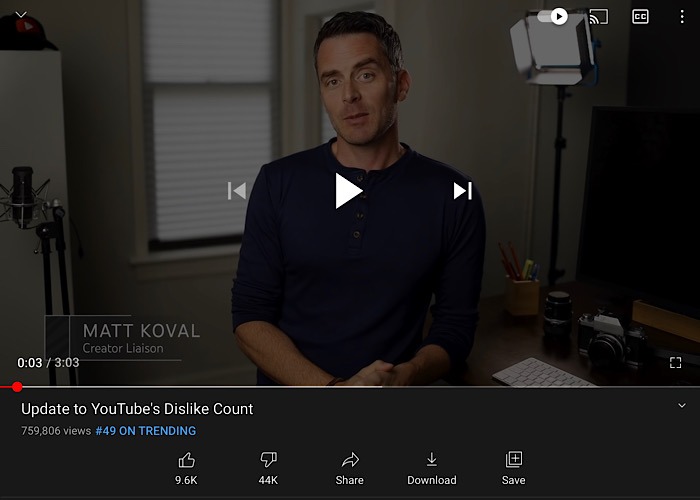
YouTube explained the change in a video on the YouTube Creators channel. At the time of writing, it had received 9.6K positive likes. But it also had 44K dislikes, meaning the change didn’t happen yet – at least not soon enough for YouTube itself.
The question is how this will impact YouTube as a whole. It would seem it’s probably not going to affect it that much, as it would have figured that out in its experiment earlier this year. YouTube knows it’s safe doing this – but probably also knows users won’t be happy and is willing to go with it.
Read on to learn about a recent dispute Google had with Roku, that led to it pulling its YouTube apps and the best YouTube downloaders to watch videos offline.