
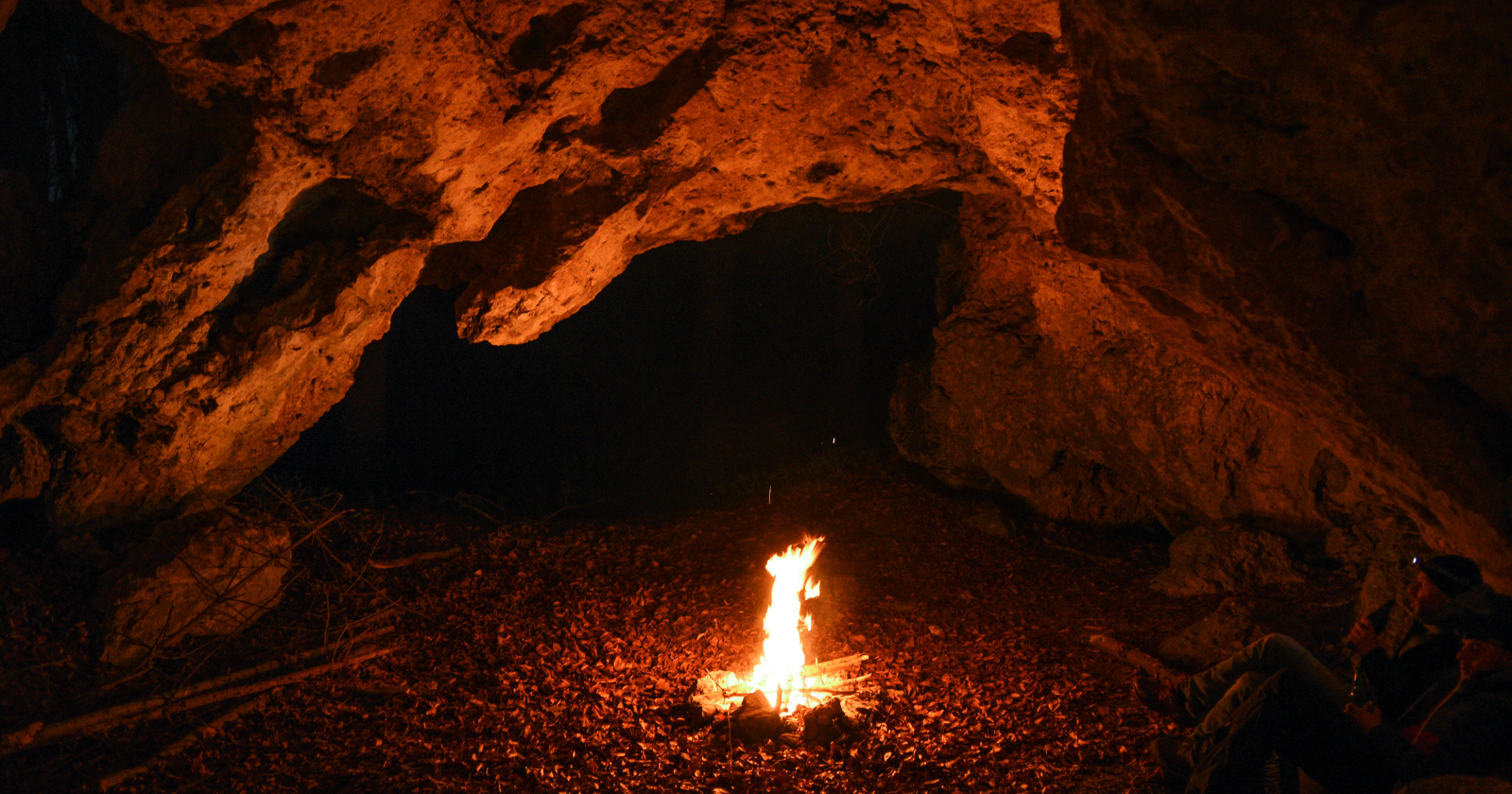
Bruniquel Cave preserves two low rings of broken stalagmites 336 metres from the entrance, in a chamber so far beyond daylight that the Neanderthals who built them had to carry fire deep into the dark. The structures were dated in 2016 to about 176,500 years ago, with a margin of roughly 2,100 years, making them among the oldest well-dated human constructions ever found.
A chamber sealed until 1990
Bruniquel Cave sits in the Tarn-et-Garonne region of southwestern France, above the Aveyron gorges near the commune of Bruniquel. Its entrance had been naturally sealed during the Pleistocene, and the site remained closed until local cavers reopened it in 1990.
Deep inside, they found something that did not look like geology. Stalagmites had been snapped, selected, and arranged into two annular structures, with four smaller piles nearby. The larger ring measures about 6.7 by 4.5 metres. The smaller one measures about 2.2 by 2.1 metres.
The total structure contains roughly 400 broken stalagmite pieces, or speleofacts, with a combined length of more than 112 metres and an estimated mass of about 2.2 tonnes. Some pieces were stacked in low layers. Others were set upright against the rings, as if used to brace them.
The uranium date that changed the builders
For years, the Bruniquel structures were thought to be much younger. A burnt bone had produced only a minimum radiocarbon age, beyond the useful range of carbon dating, and the first archaeological work stopped after the death of François Rouzaud, the archaeologist who had studied the cave in the 1990s.
The decisive test came when Jacques Jaubert and colleagues returned to the site and dated the calcite itself. Their 2016 study in Nature used uranium-series dating on stalagmite regrowth, stalagmite tips, and calcite linked to burnt bone, producing an age of 176.5 thousand years, plus or minus 2.1 thousand years.
That date pushed the site far beyond the arrival of widely accepted Upper Palaeolithic Homo sapiens in Europe. Fossils from Bacho Kiro Cave in Bulgaria, for example, are directly dated to about 45,000 years ago, according to the Max Planck Institute for Evolutionary Anthropology.
The builders at Bruniquel were therefore not modern humans. They were Neanderthals, using fire underground more than 130,000 years before the earliest securely dated Upper Palaeolithic modern human fossils in Europe.
336 metres in the dark
The distance is the hard part of the fact. The structures sit 336 metres from the cave entrance, well past the point where reflected daylight can help a person see a hand in front of their face.
A modern visitor would have a helmet, a headlamp, rope, batteries, and a mapped route. The Neanderthals had open flame. They had to move through sloping passages and limestone chambers with enough light to see the floor, enough oxygen to keep the fire alive, and enough shared direction to reach the same chamber more than once.
Bruniquel also contains clear fire evidence. Researchers documented reddened and blackened stalagmite pieces, burnt bone, and heated zones associated with the structures. A CNRS summary of the study described the site as evidence that Neanderthals had mastered deep cave space, including artificial lighting.
The rings were not the accidental by-product of sheltering at a cave mouth. They were built in a place with no daylight, no easy exit, and no obvious practical reason to spend time unless the group had planned to be there.
Why snap hundreds of stalagmites
No one knows why the Bruniquel rings were built. The safest version of the claim is not that they were a temple, a shrine, or a ritual space. The evidence does not go that far.
What it does show is planning. Someone broke hundreds of stalagmites, moved them, sorted them by size, and arranged them in repeated geometric forms. That requires coordination, memory, strength, and communication.
It also requires a reason to return. The structures and fire traces are organised enough that the site is difficult to explain as a single confused episode. The people who made it knew where they were going and knew what they were doing when they got there.
Some researchers have suggested practical possibilities, including shelter or refuge, but the distance from the entrance makes ordinary habitation unlikely. Others have noted that the chamber may have had sensory properties, including unusual acoustics. The most honest sentence is still the strongest one: a Neanderthal group built something deep underground, and the purpose has not survived.
Neanderthals were already losing the old caricature
Bruniquel fits into a wider collapse of the old picture of Neanderthals as dim, fire-shy, or socially simple. In 2025, a Nature paper on Barnham in Suffolk reported 400,000-year-old evidence for fire-making, including heated sediments, fire-cracked flint hand axes, and fragments of iron pyrite. The Natural History Museum, whose researchers were part of the team, described it as the earliest known evidence of human fire-making.
Other sites point toward stranger and more symbolic behaviour. At Cueva Des-Cubierta in central Spain, researchers reported a Neanderthal accumulation of large herbivore crania, with skulls of animals such as bison and rhinoceros appearing in a cave context that was not simply butchery waste.
In 2026, a PLOS One study described a 59,000-year-old Neanderthal molar from Chagyrskaya Cave in Russia with a large human-made concavity on the chewing surface, interpreted as deliberate manipulation during the individual’s life. Even if the authors are cautious about calling it medicine in the modern sense, the tooth adds another hard detail to the same pattern.
Genetics has changed the picture too. Princeton researchers noted that present-day non-African populations carry Neanderthal ancestry, and newer work continues to refine how that ancestry moved through ancient populations. A Nature Communications study found that Eurasian genomes carry about 2 percent Neanderthal ancestry, with surviving effects especially visible in traits such as skin and hair.
What the calcite remembers
Other fact explainers on Make Tech Easier have followed machines into places humans cannot survive, from the Soviet probe that lasted 127 minutes on Venus to the corrupted memory chip that left Voyager 1 speaking nonsense from deep space. Bruniquel reverses the scale. The technology is only fire, stone, bodies, and time.
After the Neanderthals stopped visiting, mineral water kept dripping. Calcite slowly grew over broken stalagmite surfaces, sealed traces of burning, and made the structures dateable long after the people who built them were gone.
That is why Bruniquel is so difficult to dismiss. The cave did not preserve a story, a toolmaker’s name, or a picture on a wall. It preserved an arrangement, a distance, a fire record, and a clock locked inside stone.
For roughly 176,000 years, the rings stayed in the dark while climates shifted above them, Neanderthals vanished, modern humans spread across Europe, and every later architecture of history rose in the light. The stone kept closing over the evidence, millimetre by millimetre, until headlamps found the chamber again.