
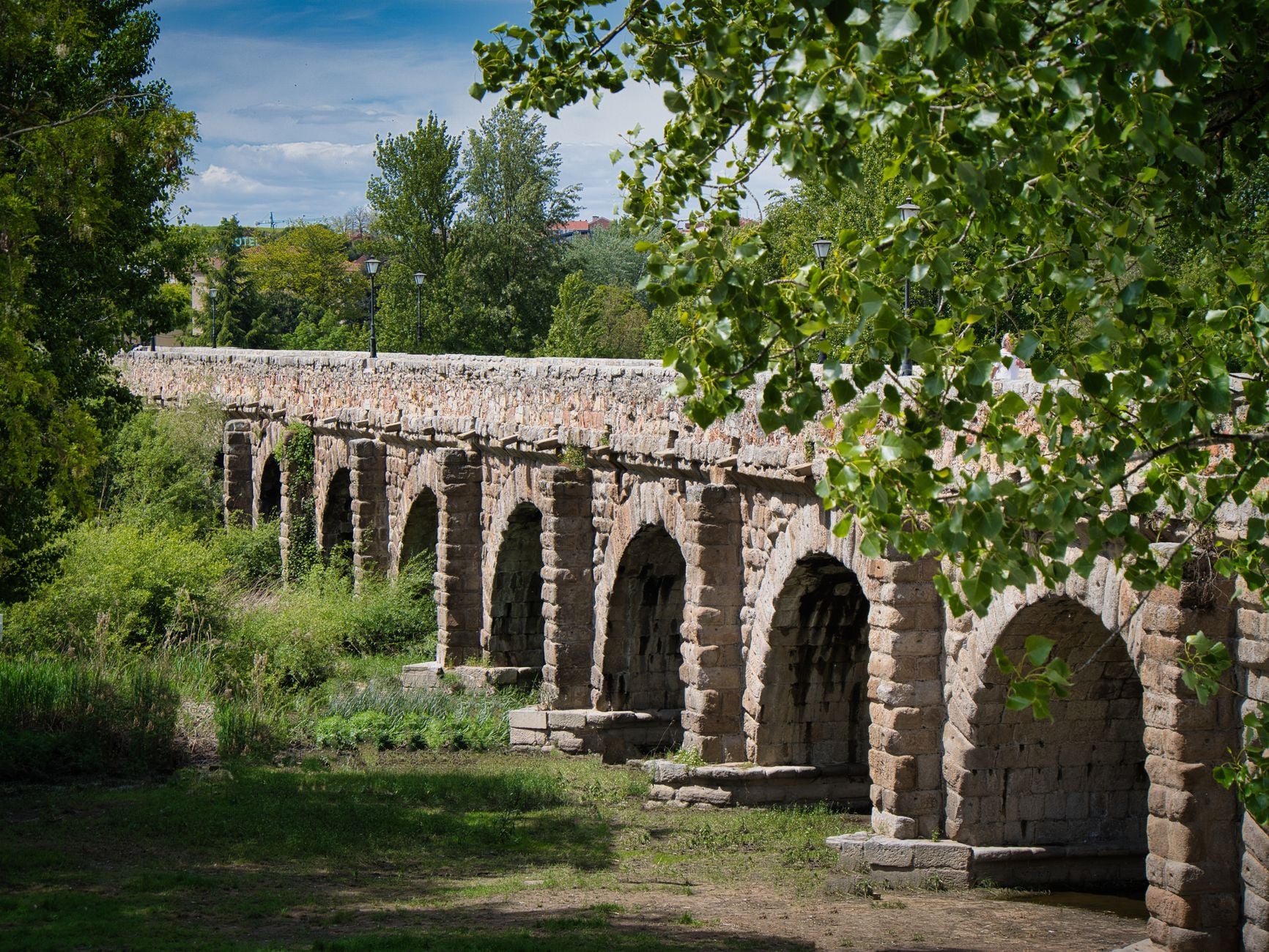

The Aqueduct of Segovia rises out of the Plaza del Azoguejo in central Spain with granite arches stacked in two tiers, climbing nearly 28 metres above the street at its tallest point, and not a single one of those arches is held together by mortar. The Romans who cut the blocks sometime around the late first century AD — most archaeologists place it during the reign of Domitian or Trajan, between roughly 90 and 110 AD — relied entirely on gravity, friction, and the obsessive precision of their stonemasons. The aqueduct carried drinking water from a spring in the Sierra de Guadarrama foothills into the old quarter of Segovia. It kept doing that job, with repairs and interruptions, until municipal authorities finally retired it from active service in the second half of the twentieth century.
That is the part most visitors find hardest to absorb. The stones you photograph from the plaza were quarried under an emperor whose name barely survives in popular memory, and they were still delivering water to Spanish kitchens well into the modern era.
A wall of stone that behaves like a chain
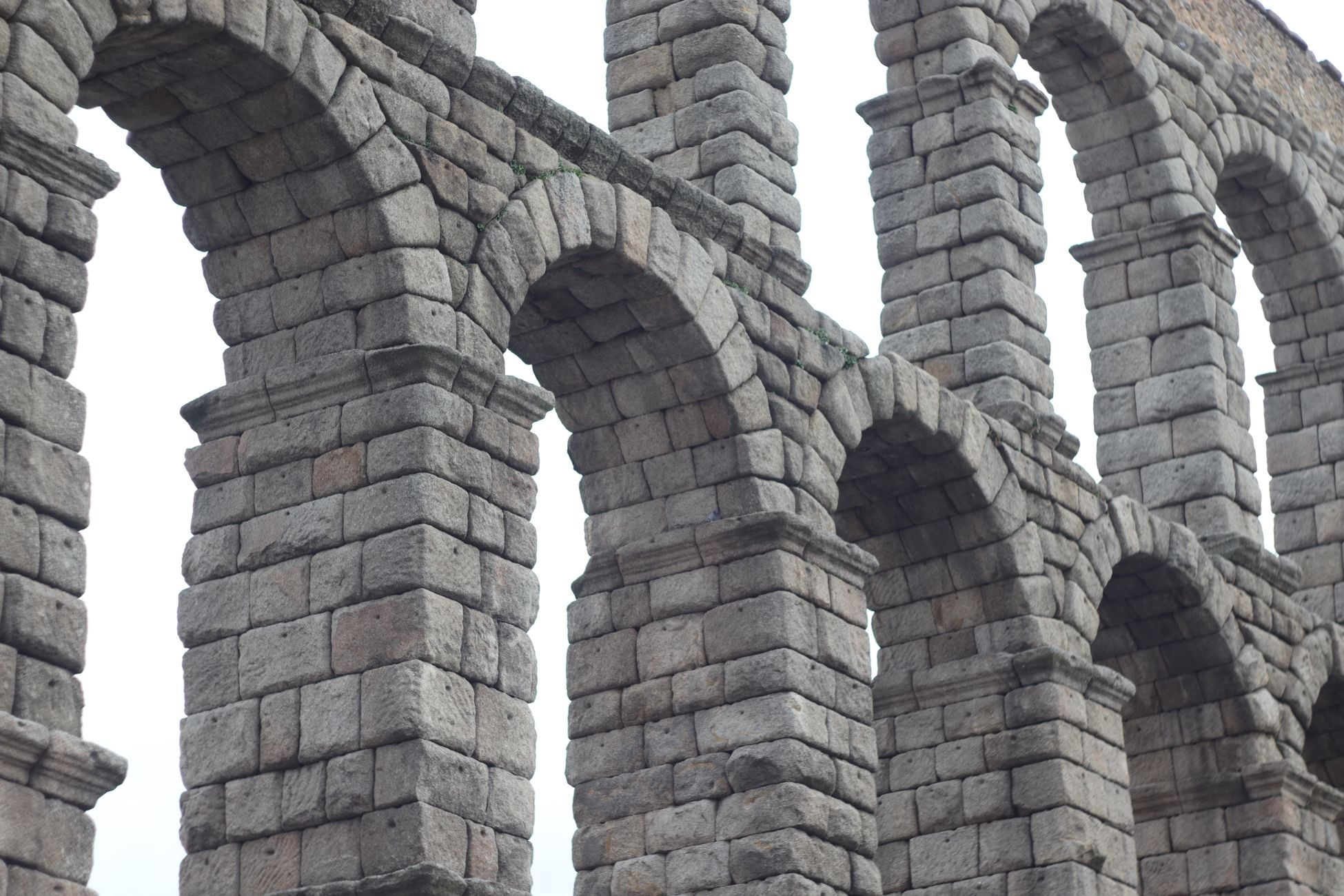
The aqueduct’s visible section — the part tourists know — uses thousands of blocks of unmortared granite, quarried from the nearby Guadarrama range. The blocks are rough on the outside, almost shaggy with chisel marks, but the contact surfaces where one stone meets another were dressed flat to within fractions of a millimetre. Each arch transmits its load downward and outward to its neighbours, so the structure behaves less like a series of independent arches and more like a single chain in compression. Pull one stone out of the middle and the whole bay above it would unzip.
This is the same principle the Romans used in their bridges and amphitheatres, but Segovia is the cleanest demonstration of it still standing in everyday view. The lower arcade carries the upper arcade, and the upper arcade carries the specus — the covered channel along the top where the water actually flowed, lined with a waterproof mortar made from crushed ceramic and lime. The mortar was for the channel lining, to keep the water in. The structural granite below it needed nothing but its own weight to stay put.
The water came from the mountains
The source was a spring in the Sierra de Guadarrama. From there the water travelled through a buried channel that wound through the countryside on a barely perceptible gradient — the Romans were famously fussy about slope, aiming for drops of around 0.3 to 1 percent over long runs so the water moved fast enough not to stagnate but slow enough not to erode the channel. By the time the aqueduct reached the edge of Segovia, the engineers needed to lift the channel high into the air to clear a valley and deliver water at sufficient pressure into the upper town, where the Roman castrum sat on a rocky spur.
The arches you see in the plaza are the solution to that valley. Everywhere else along the run, the water moved through tunnels and shallow trenches. Only in the final approach did Roman engineers build the towering double arcade that became one of the most recognisable pieces of Roman architecture still in its original location.
Why mortar would have made it worse
Modern intuition says glue holds things together. Roman engineering says glue is a liability. Mortar in a structure of this size and exposure would have expanded and contracted with Segovia’s hot summers and freezing winters at a different rate than the granite itself, creating stress lines and crack initiation points. Dry-stacked granite, by contrast, can flex microscopically. The blocks settle into each other over centuries, the contact surfaces wearing into even tighter conformity.
The Romans understood this through trial and accumulated craft rather than through formal stress analysis. They knew, as National Geographic has documented in surveys of their building tradition, that borrowing the arch from the Etruscans and refining it into a load-bearing module let them span gaps with stone instead of timber, and that stone in compression is almost indestructible if you let it do what it wants to do. The Segovia aqueduct is a demonstration of that insight.
What it carried, and to whom
At its peak the channel delivered enough water to supply the public fountains, baths, and private cisterns of a Roman provincial town of perhaps 5,000 to 10,000 people. After the western empire collapsed in the fifth century the aqueduct kept working, more or less, through Visigothic and then Moorish control. According to local tradition, some of the arches were destroyed during a medieval raid and sat broken for over four centuries until their restoration in the late fifteenth century, carried out in a manner that matched the original technique closely enough that the rebuilt section is difficult to spot from the ground.
Spanish households drew water from fountains fed by the aqueduct through the medieval and early modern periods. The arches carried water during the Spanish Armada year of 1588. They carried water while Velázquez was painting in Madrid, while Napoleon’s troops marched through Castile, while the Spanish Civil War tore the country apart in the 1930s. The municipal water supply that finally replaced the aqueduct’s job in the twentieth century was driven not by structural failure but by the realisation that diesel exhaust from the trucks idling in the plaza below was etching the granite faster than two millennia of weather had managed.
The damage came from cars, not centuries
The single biggest threat the aqueduct has faced was twentieth-century traffic. Sulphur compounds in exhaust fumes react with moisture to form weak acids that attack granite’s feldspar minerals, leaving the stone pitted and crumbly. By the 1990s, the deterioration was alarming enough that Segovia closed the plaza to vehicles, rerouted the road, and began a long restoration programme overseen by UNESCO, which had declared the old town and aqueduct a World Heritage Site. Stonemasons replaced the worst-affected blocks with granite from the same Guadarrama quarries the Romans had used, dressing the new pieces to the same tolerances and slotting them in without mortar, exactly as the original builders would have done.
The work continues. There is no final restoration date because there is no expectation that the aqueduct will ever stop needing care. The current understanding is that maintaining a Roman structure in the open air requires roughly the same skills the Romans used, applied at roughly the same patience.
Why ancient water systems are getting a second look
Segovia’s aqueduct is a closed chapter as working infrastructure, but the broader Roman approach to moving water is not. Athens, which is suffering through prolonged drought, has begun reviving a Roman-era aqueduct from the second century AD to supplement its overstretched reservoirs. Smithsonian magazine reported on the project, which uses the original Hadrianic channels to distribute non-potable water to gardens and parks across the city. North Carolina’s WFAE has covered how the Athens revival is forcing engineers to rethink water resilience in cities whose modern systems were designed for wetter climates.
The lesson the Romans built into Segovia — that gravity, slope, and patient stonework can outlast almost any other infrastructure choice — turns out to be portable. A channel that needs no electricity and very little maintenance keeps delivering water as long as someone keeps the leaves out of it.
Standing under the arches
If you walk into the Plaza del Azoguejo today you can stand directly beneath the tallest arches and look up at the gap where two stones meet. The seam is so tight in places that a sheet of paper will not slide between them. The blocks above your head weigh between one and two tonnes each. They have been there, in that exact configuration, since the Flavian emperors. The only thing keeping them suspended is the fact that they cannot fall without each other’s permission.
The spring in the mountains still flows. The channel along the top of the aqueduct is dry now, swept clean for the tourists, but the granite below it is doing exactly what it was cut to do — pressing down on its neighbours, hard, the way it has pressed for close to two thousand years.