

Jerry Ehman was sitting at his kitchen table in suburban Ohio a few days after 15 August 1977, flipping through a stack of dot-matrix printouts from the Big Ear radio telescope, when his red pen stopped over a vertical column of six characters: 6EQUJ5. He circled it, wrote “Wow!” in the margin, and handed astronomy its most famous unsolved mystery.
The telescope had been pointed at a patch of sky in the constellation Sagittarius. It was listening on 1420.4056 megahertz, the resonant frequency of neutral hydrogen — the most abundant element in the universe and the channel SETI researchers had long argued any thoughtful civilisation would pick to be heard on.
For 72 seconds, something on that channel was roughly thirty times brighter than the background hum of deep space. Then it was gone. In nearly five decades of follow-up searches, no one has ever heard it again.
A telescope built out of plywood and ambition
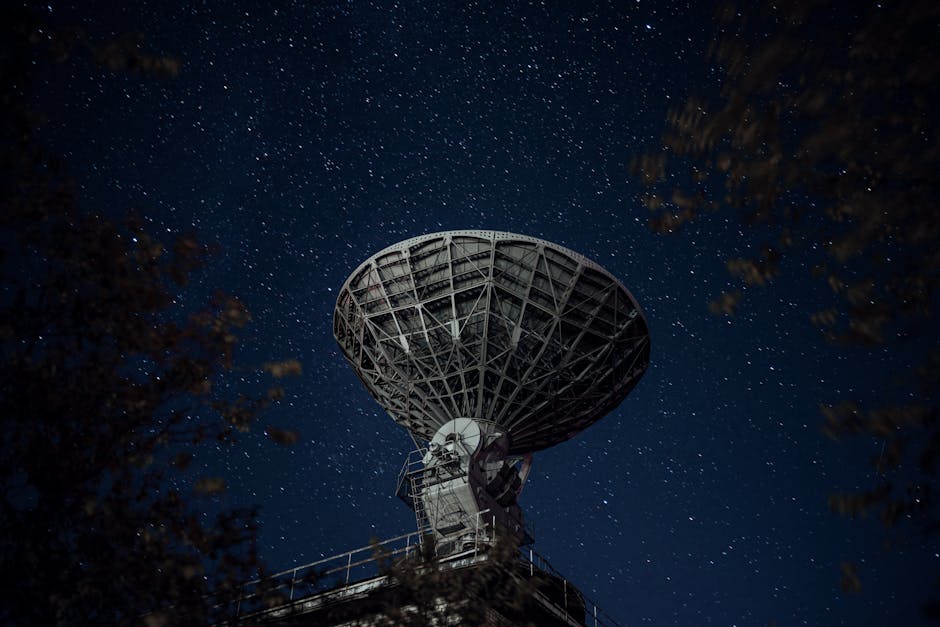
Big Ear sat on the grounds of the Perkins Observatory in Delaware, Ohio. It did not look like a telescope. It looked like a flat football field of wire mesh, with two enormous aluminium reflectors at either end, the smaller one tilted like a drive-in movie screen.
It had no motors to track the sky. The Earth rotated, and the strip of sky overhead drifted across its narrow field of view. Anything Big Ear caught, it caught once. Whatever passed through the beam had about 72 seconds to announce itself before the planet’s spin carried it out of frame.
That number is not a coincidence. The Wow! Signal lasted exactly as long as the beam was pointed at any single spot. It rose in intensity, peaked, and faded in a shape that matched what an astronomer would expect from a steady source in the sky, not a passing aircraft or a glitching circuit.
What 6EQUJ5 actually means
The printout was not transmitting in code. Big Ear’s computer sampled signal strength on each of fifty channels for ten seconds, spent about two more seconds processing the result, and so every twelve seconds printed a single character to represent the intensity of each channel. Blank meant background noise. Numbers 1 through 9 meant a few standard deviations above the baseline. Letters started at 10. U, the highest character on the strip, meant the signal was roughly thirty times louder than the cosmic background.
Six readings in a row. A rise. A peak. A fall. A clean bell curve printed in alphanumeric shorthand on green-and-white paper. Six characters at twelve seconds each is where the famous 72 seconds comes from.
Ehman, a volunteer working without pay on the SETI search, reportedly walked back to the observatory and asked his colleagues if anyone had been transmitting nearby. No one had. The signal had come from outside the solar system, on the one frequency the team had specifically been told to watch.
The resonant frequency of neutral hydrogen at 1420 megahertz had long been recognized as the most logical place for interstellar communication. Any species advanced enough to do radio astronomy would notice hydrogen first, because hydrogen is everywhere. Tuning a beacon to that frequency was the equivalent of standing on the loudest corner of the universe and waving.
Big Ear was tuned to that corner. And on the night of 15 August 1977, something on that corner waved back.
The follow-up that found nothing
Ehman did not see the printout in real time. The Big Ear computer logged data overnight, and a human had to review the paper days later. By the time he circled the letters, the patch of sky had already moved on.
Within weeks, the team began trying to catch it again. They pointed Big Ear back at the same coordinates dozens of times. SETI researchers and other observatories ran follow-ups for decades. The Very Large Array in New Mexico looked. Australia’s Parkes Observatory looked. Amateurs and professionals have returned to that spot in Sagittarius again and again.
Silence every time.
That silence is the problem. Science runs on reproducibility. A single unrepeatable observation, no matter how striking, cannot be confirmed. The Wow! Signal sits in a strange category: too clean to dismiss as instrument error, too brief and too solo to call a discovery.
The suspects
Plenty of theories have come and gone. Reflected military radar. A passing satellite. A secret aircraft. Each has been examined and most have been ruled out, because the signal arrived on the protected hydrogen frequency, which terrestrial transmitters are not supposed to use, and because its rise-and-fall profile matched a source fixed in the sky, not one moving across it.
One hypothesis from astronomer Antonio Paris suggested that a pair of comets, 266P/Christensen and 335P/Gibbs, had been passing through that patch of sky in 1977 and could have produced a hydrogen cloud bright enough to register. Other astronomers pushed back hard. Comets do not typically emit at 1420 megahertz with anything near that intensity, only one of Big Ear’s two feed horns recorded the signal, and follow-up observations of the comets themselves found nothing comparable.
More recently, a team led by Abel Méndez at the Planetary Habitability Laboratory of the University of Puerto Rico combed archival Arecibo data and noticed that cold clouds of hydrogen near certain stars can flare suddenly when hit by a burst of radiation — say, from a magnetar or a passing flare star. Their 2024 analysis, widely covered at the time, argued that a stimulated hydrogen cloud could briefly mimic exactly what Big Ear saw.
Not everyone is convinced. The mechanism is plausible but unproven, and as other researchers have pointed out, no one has yet caught a hydrogen cloud doing this in real time. The closest match to the Wow! Signal so far is still a theoretical sibling, not an observed one.
Why it refuses to fade
Most anomalous detections in astronomy get explained or quietly forgotten. The Wow! Signal has done neither. Part of the staying power is the printout itself: a real piece of paper, in a real archive, with a handwritten exclamation from one of the most recognizable astronomers in SETI history. It is physical. It is dated. It is signed.
Part is the frequency. If the signal had come in at some random spot on the dial, the cosmic-noise explanations would be easier to accept. It came in exactly where humanity had decided to listen.
And part is the duration. 72 seconds is long enough to rule out a single instrumental hiccup. Short enough that whatever caused it was either moving, pulsing, or pointed somewhere else by the time anyone checked.
Where it lives now
The Big Ear telescope is gone. The land was eventually sold and the structure was dismantled in 1998 to make way for a golf course expansion. The wire mesh field where the universe whispered for 72 seconds is now fairway and rough.
The original printout survived. It sits in the archives of the Ohio History Connection, the red ink still legible, the column of letters still rising into U and back down again. Ehman spent the rest of his life carefully refusing to claim it was aliens. He preferred to say only that he had no good explanation.
Somewhere in Sagittarius, the patch of sky that Big Ear was staring at on the night of 15 August 1977 is still there, sliding overhead every twenty-four hours, on the same hydrogen channel, indifferent to the listeners below. If something is still broadcasting, it has not chosen to repeat itself in 17,000 nights and counting.