
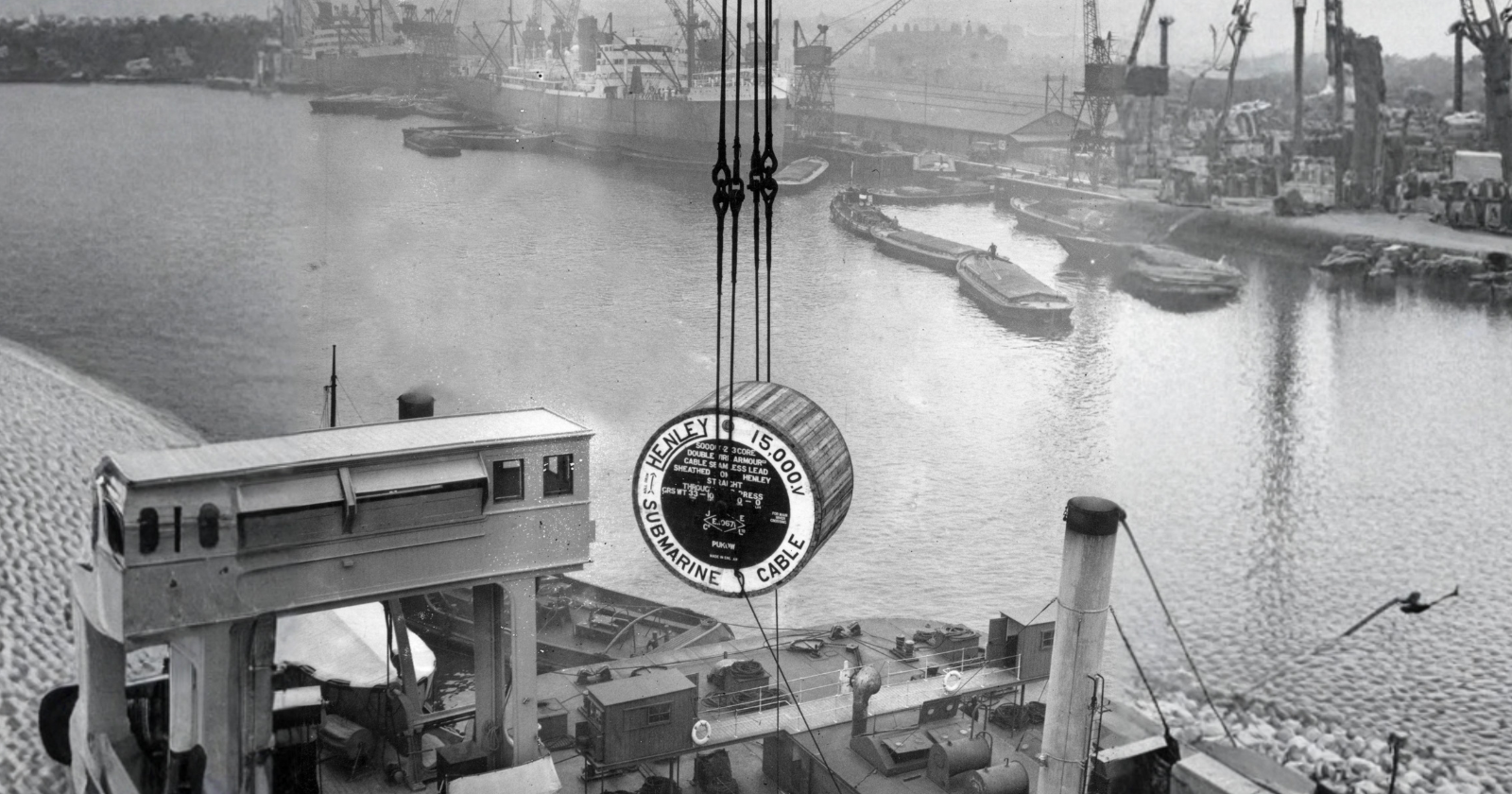
On the morning of July 27, 1866, the SS Great Eastern dropped anchor in Heart’s Content, Newfoundland, with 1,686 nautical miles of insulated copper cable trailing behind her across the floor of the North Atlantic. The cable’s other end sat in Valentia, Ireland. Within hours, an operator was tapping out test signals that crossed to London in minutes. The same news, sent by the fastest mail steamer of the era, would have taken roughly ten days.
The ship was a leviathan. Designed by Isambard Kingdom Brunel, she displaced more than 32,000 tons and was the only vessel afloat large enough to carry the full cable in one piece. Earlier attempts in 1857, 1858, and 1865 had snapped, shorted, or gone silent within weeks. The 1866 cable held. A second one, recovered from the 1865 attempt and spliced live on the seabed, was working by September.
What happened next in the trading rooms of Lombard Street and Wall Street is the part most histories skip past. Prices that had drifted independently for centuries were suddenly forced into the same conversation, in something close to real time, and the people running the markets had no settled idea what to do about it.
The ten-day ocean
Before the cable, a barrel of American cotton, a bushel of Chicago wheat, or a share of Erie Railroad traded at one price in New York and a different price in Liverpool or London, and the difference could persist for weeks. The reason was simple: nobody on either side knew what the other side was paying until a ship arrived.
Mail packets crossed the Atlantic in eight to twelve days depending on weather. A merchant in London buying American securities on Monday was acting on prices that had been current in New York the previous week. Speculators built entire fortunes on the lag. The shipping firm that controlled the fastest steamer effectively controlled the most current market intelligence on the eastern seaboard.
This was not an inefficiency anyone complained about. It was the texture of global trade. A price was a local fact, attached to a city, refreshed whenever a ship came in.
Eight words a minute
The 1866 cable transmitted at roughly six to eight words per minute, painfully slow by any later standard, using a mirror galvanometer designed by William Thomson, later Lord Kelvin. A faint beam of light, deflected by tiny currents in the cable, swung left or right across a paper scale. An operator read the dots and dashes off the wobbling beam.
The first commercial messages cost about ten dollars a word, with a ten-word minimum — roughly ten weeks’ wages for a skilled worker to send a single telegram. The market that could absorb that price was small, wealthy, and almost entirely financial. Banks, brokerages, and the great trading houses paid it without hesitation.
By the end of August 1866, the London Stock Exchange was receiving New York closing prices the same evening. Within weeks, brokers on both sides of the Atlantic were trading on quotes that were minutes or hours old rather than days old. The lag that had structured everything collapsed to almost nothing.
The week the prices converged
Contemporary accounts in the financial press describe the immediate effect as chaotic. Gold, which had traded at meaningfully different prices in New York and London for the entire American Civil War, snapped into alignment within days. Cotton, the most actively cabled commodity of the period, began to be quoted simultaneously in both cities, with arbitrageurs hammering the spreads down to the cost of the telegram itself.
Brokerages that had made their margins on transatlantic information asymmetry watched that margin evaporate. Some adapted by becoming cable agents themselves, charging clients to relay quotes. Others simply stopped existing.
The deeper change was conceptual. For the first time, a price could be understood as a single global number rather than a local one. The phrase the price of cotton stopped meaning the price in a specific port on a given day and started meaning something closer to its modern sense: a number that exists everywhere at once, updated continuously, owned by no one city.
What the cable actually was
Physically, the working cable was an unremarkable object. A core of seven copper wires twisted together, wrapped in layers of gutta-percha (a natural gum tapped from the Palaquium tree of Southeast Asia), bound in hemp soaked in tar, and armoured with ten galvanised iron wires laid in a spiral. It weighed about a ton per nautical mile in air and was designed to sit on the seabed for decades.
The Atlantic Telegraph Company had been trying since 1856. Cyrus West Field, the New York paper merchant who financed and politicked the project into existence, made more than thirty Atlantic crossings during the decade of attempts. The 1858 cable famously carried a congratulatory exchange between Queen Victoria and President Buchanan, then died within three weeks because an engineer applied too much voltage trying to push signals through it.
Thomson’s mirror galvanometer was the breakthrough that made 1866 work. By detecting impossibly faint currents, it let operators use low voltages that did not destroy the cable’s insulation — the failure that had killed the 1858 line. The iron-clad marine galvanometer that travelled aboard the Great Eastern in 1866 survives in the Science Museum’s collection in London, and the University of Glasgow’s Hunterian holds examples of Kelvin’s own mirror galvanometers — the kind of instrument that first read a market quote off a swinging beam of light.
A new kind of information
The cable did not just speed up existing information. It changed what information was. A price quote sent by mail was a historical artefact by the time it arrived. A price quote sent by cable was a claim about the present — the present in two cities at once.
That changed how decisions got made. A trader could now act on prices that were current in another country, not weeks stale. Before 1866, that was structurally impossible across an ocean; after it, current and comparable information became the baseline every later market would assume.
The cost was that misinformation now travelled at the same speed. A garbled quote, or a false rumour planted in one city, could move markets in another before anyone could check it, and a price that had already shifted on bad information was slow to settle back once the correction arrived.
Calling the 1866 line “the Victorian internet” has become a familiar shorthand, popularised by Tom Standage’s 1998 book of the same name. The comparison holds up better than most. Messages were broken into pieces, relayed through stations, reassembled at the far end, and billed by the word.
By 1870, cables reached Bombay. By 1872, Australia. By the 1880s, a London merchant could quote a price in Hong Kong, receive a confirmation, and close the trade inside an afternoon. The idea we now take for granted — that data moves faster than the goods, ships, and people it describes — was laid down spool by spool from the deck of a single ship in a single summer.
The descendants of those cables still do most of the work. More than 95 percent of international internet traffic, including the order flow behind today’s automated trading platforms, still travels through fibre-optic cables on the ocean floor, on routes that in several cases shadow the original 19th-century paths almost exactly. Modern cable ships still drop their grapnels in waters the Great Eastern worked.
The subtler change was in the trader’s own horizon of uncertainty. A London broker buying American railway bonds had always been betting on conditions he could not currently observe, holding that uncertainty as a permanent feature of the trade. The cable did not remove the uncertainty; it compressed it. What had been a question about the next ten days became a question about the next few minutes. The galvanometer’s faint, swinging beam was, in a real sense, an early financial screen — a person sat in a small room in Valentia or Heart’s Content and watched a moving light, transcribing money.
The Great Eastern’s last useful voyage
Brunel’s ship never made commercial sense as a passenger liner. She was too big for the ports of her era and too expensive to run, and her 1860 maiden transatlantic crossing was a commercial disaster. Laying cable was the only work she was ever profitable at. Between 1865 and 1874 she laid more than 30,000 miles of submarine telegraph cable across the Atlantic and the Indian Ocean.
She was broken up for scrap in 1889, at New Ferry on the Wirral side of the Mersey, in work that took the best part of eighteen months. One of her top masts became the flagpole that still stands by the Kop at Anfield — raised when the ground was Everton’s home, years before Liverpool Football Club existed. The 1866 cable she had laid stayed in service until 1965, ninety-nine years after the Great Eastern dropped anchor in Heart’s Content.
For most of the twentieth century, somewhere on the seabed between Ireland and Newfoundland, a copper wire wrapped in tree gum was still doing the job it had been spooled onto a ship to do, while above it, in the trading rooms of two continents, the single global price it had helped invent kept ticking forward, second by second, faster every decade, on infrastructure that had simply been laid on top of it.