
Can You Bypass YouTube TV’s Price Hike Temporarily?

YouTube logo with red and black background.

Saving money by ditching cable and streaming is becoming more and more difficult, especially with the recently announced YouTube TV price hike coming in January 2025. But some consumers have discovered YouTube TV isn’t too keen on the mass exodus of subscribers.

Yet Another Price Hike for YouTube TV

Originally, YouTube TV started out at around $35 in 2017. When I subscribed to get my local stations and a handful of other channels I loved watching on cable regularly, I was paying around $65.

If you’re a subscriber, you probably received the same email I did just a few days ago. Yet another price hike. In 2023, it went up to $72.99. Now, it’s jumping another $10 to $82.99/month. Suddenly, this is starting to look more like my old cable bill.
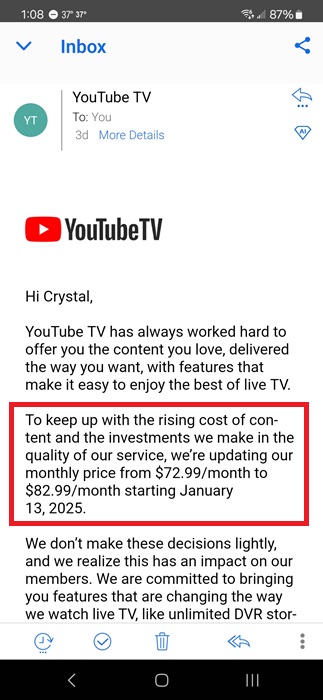
Email from YouTube TV.

Granted, when I started comparing the number of channels YouTube TV has versus competing live TV providers, the price is either on par or cheaper. But it’s still terrible to have to pay this much when we were all promised streaming would be cheaper.

Users Understandably Furious

Anytime a streaming platform raises rates, users get furious, with many deciding it’s time to save money – not just by cutting cable, but cutting back on streaming services. For example, Netflix’s latest price increase didn’t go over well at all.

When users got the email about the YouTube TV price hike, numerous users hit the cancel button immediately. After all, it’s the easiest way to fight back against higher prices.

But why are so many users choosing to stay after they’ve canceled?

YouTube TV Scrambles to Keep Customers

YouTube TV doesn’t want anyone to cancel. According to a user thread, Yet, many users canceling via their desktop, browser, or phone are getting a special offer. Stick around and enjoy six more months at the $72.99/month price. This saves you $60 during the period.

It seems more users are getting the offer than not. However, if you pay for YouTube TV through the Google Play Store, you probably won’t get the offer. At the time of writing, users were still getting the offer, so if you’re on the fence about whether to cancel, I’d suggest at least seeing if you get the offer.
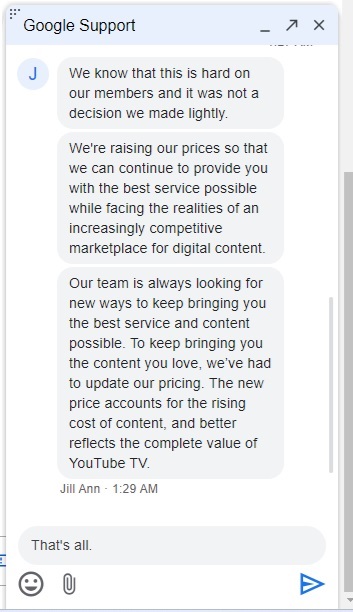
Details of chat with Google about YouTube TV price hike.

I chatted with YouTube TV support about the price hike. I mentioned a retention discount, but that was completely ignored. However, I did get the cookie cutter reason about rising content costs and how I’m still getting the best value.

If you decide to cancel YouTube TV, see how you can save on streaming with these tips. Of course, you can always subscribe to YouTube to skip the ads. Some of my local news stations even broadcast live on YouTube.

Image credit: Unsplash. All screenshots by Crystal Crowder.

Subscribe to our newsletter!

Our latest tutorials delivered straight to your inbox

Crystal Crowder Avatar

Read next

When the SS Great Eastern laid the first working transatlantic telegraph cable in 1866, a message that had taken ten days by steamship suddenly crossed the ocean in minutes, and the financial markets of London and New York were forced, within a single trading week, to invent the modern concept of synchronised global price.
The Big Ear telescope was scanning at 1420.4056 megahertz on the night of 15 August 1977, the exact frequency at which hydrogen atoms vibrate across the universe, because Giuseppe Cocconi and Philip Morrison had argued years earlier that any species trying to be found would broadcast on that channel — and then, for 72 seconds, something did.
When Cingular chief Stan Sigman backed the original iPhone before its 2007 unveiling, he accepted terms American carriers usually refused: no logo on the device, no control over its software, no preloaded apps, and a share of monthly subscriber revenue flowing back to Apple, after signing on without seeing a prototype
In 2016, archaeologists dated two rings of snapped stalagmites in France’s Bruniquel Cave to 176,500 years ago, evidence that Neanderthals had walked 336 metres into darkness with fire and built architecture deep underground long before modern humans reached Europe
Otto von Bismarck was 74 when Germany adopted the world’s first national old-age social insurance program in 1889, setting the pension age at 70 after years of fighting socialists with bans, laws, and a promise few workers would live long enough to use
When cosmonaut Valeri Polyakov stepped out of his Soyuz capsule in March 1995 after 437 consecutive days aboard Mir, doctors recorded him at several centimetres above his pre-flight height, and his spine had become so unaccustomed to gravity that the recovery team carried him to a chair rather than risk the compression of letting him walk.
When Bell Labs engineer Karl Jansky pointed a rotating antenna at the sky in 1932 looking for sources of transatlantic radio static, he kept picking up a faint hiss that peaked every 23 hours and 56 minutes, and he eventually realized he had become the first human to hear the center of the Milky Way.
When Harvard astronomer Cecilia Payne submitted her 1925 doctoral thesis arguing that the Sun was made almost entirely of hydrogen, the field’s senior figure Henry Norris Russell talked her into adding a line calling the result ‘almost certainly not real,’ and then published the same conclusion himself four years later to widespread acclaim.