
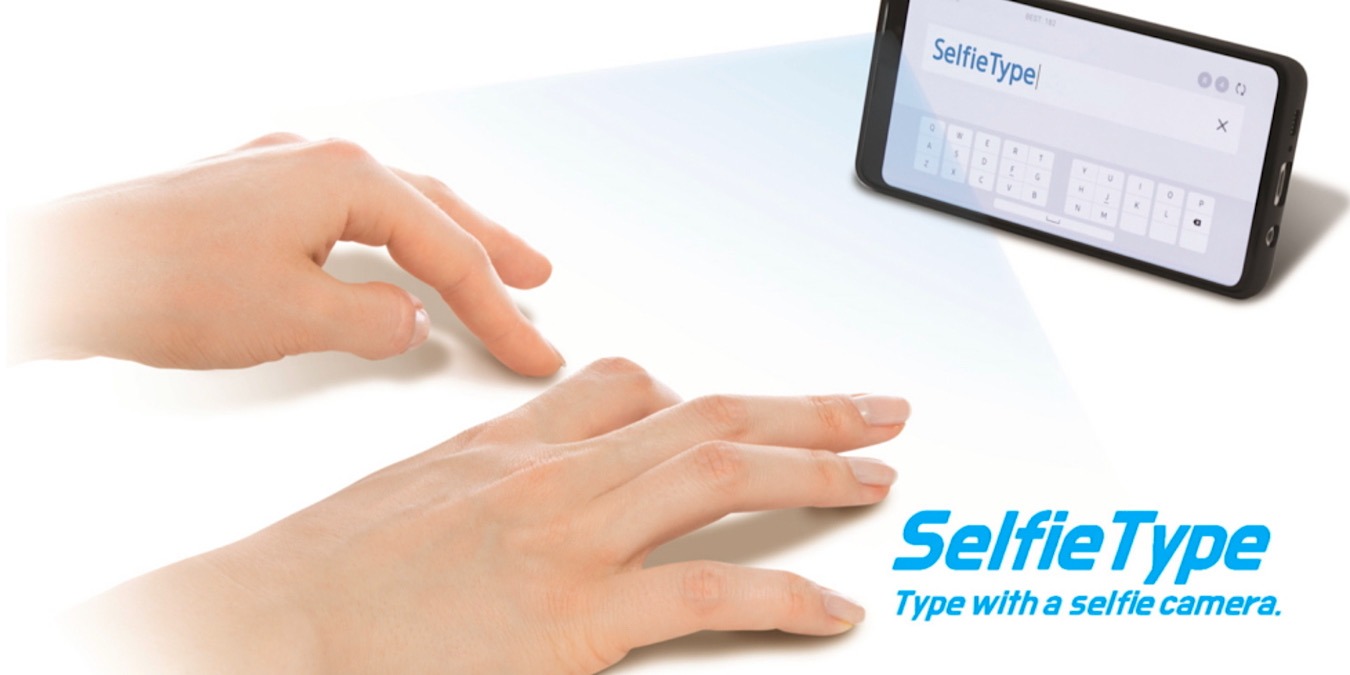

If you’ve ever watched a teenager or other young person who has grown up with cell phones as a normal part of their everyday conversation, you’ve seen what typing on a phone should be. They can text on their phones just as quickly as some of the best typists. But for the rest of us, typing on a phone can still sometimes seem laborious.
While we’ve been hearing about virtual keyboards for some time, we’ve never really seen one put to use. However, those who will be the Consumer Electronics Show (CES) 2020 will finally get that chance. Samsung will be debuting SelfieType and four other projects from its C-Lab Inside program.
Samsung’s SelfieType
For those who came of ae before the age of communicating via texting on cell phones, they learned how to “touch type” on a full-size keyboard attached to a computer, or if they’re even older, like me, on a manual or electric typewriter. These people know the QWERTY keyboard without even looking at it. But to try and transfer that skill to the tiny keyboard on a phone can be difficult.
The Samsung in-house idea development program C-Lab Inside will be debuting its virtual keyboard SelfieType next week at CES. This project and the four others that will be showcased are focused on a convenient and healthy lifestyle.
The company annunced that SelfieType is a virtual keyboard that uses the front-facing selfie camera. “A proprietary SelfieType AI engine analyzes finger movements coming from the front camera and converts them into QWERTY keyboard inputs.”
Samsung added in its announcement that using SelfieType will not require any additional hardware and that it’s “highly adaptable” to multiple mobile devices, including smartphones and tablets.
Other C-Lab Projects
The C-Lab Inside program began in 2012, and it will be the fifth year it has participated in CES. In addition to SelfieType, the program will also be debuting Hyler, a smart highlighter pen that digitizes text printed on paper; Becon, a home-care solution to treat the scalp and hair loss; Sunny Side, artificial sunlight in the shape of a window; and Ultra V, an ultraviolet monitoring sensor and service. Samsung will also be showing projects from outside developers.
For someone like me who is 100 percent mobile, I’ve been waiting for a virtual keyboard. I do my computing on an iPad, and as a writer and editor, I need a physical keyboard and not the onboard keyboard from the iPad. I go through multiple keyboards. I wear them out. To have a virtual one that I could use wherever and whenever that I could also use with my phone seems like a perfect solution.
Could you make use of a product like Samsung’s SelfieType virtual keyboard? Or have you adapted well to typing with your two thumbs? Tell us how this Samsung project could benefit you in the comments below.
Image Credit: Samsung and public domain