
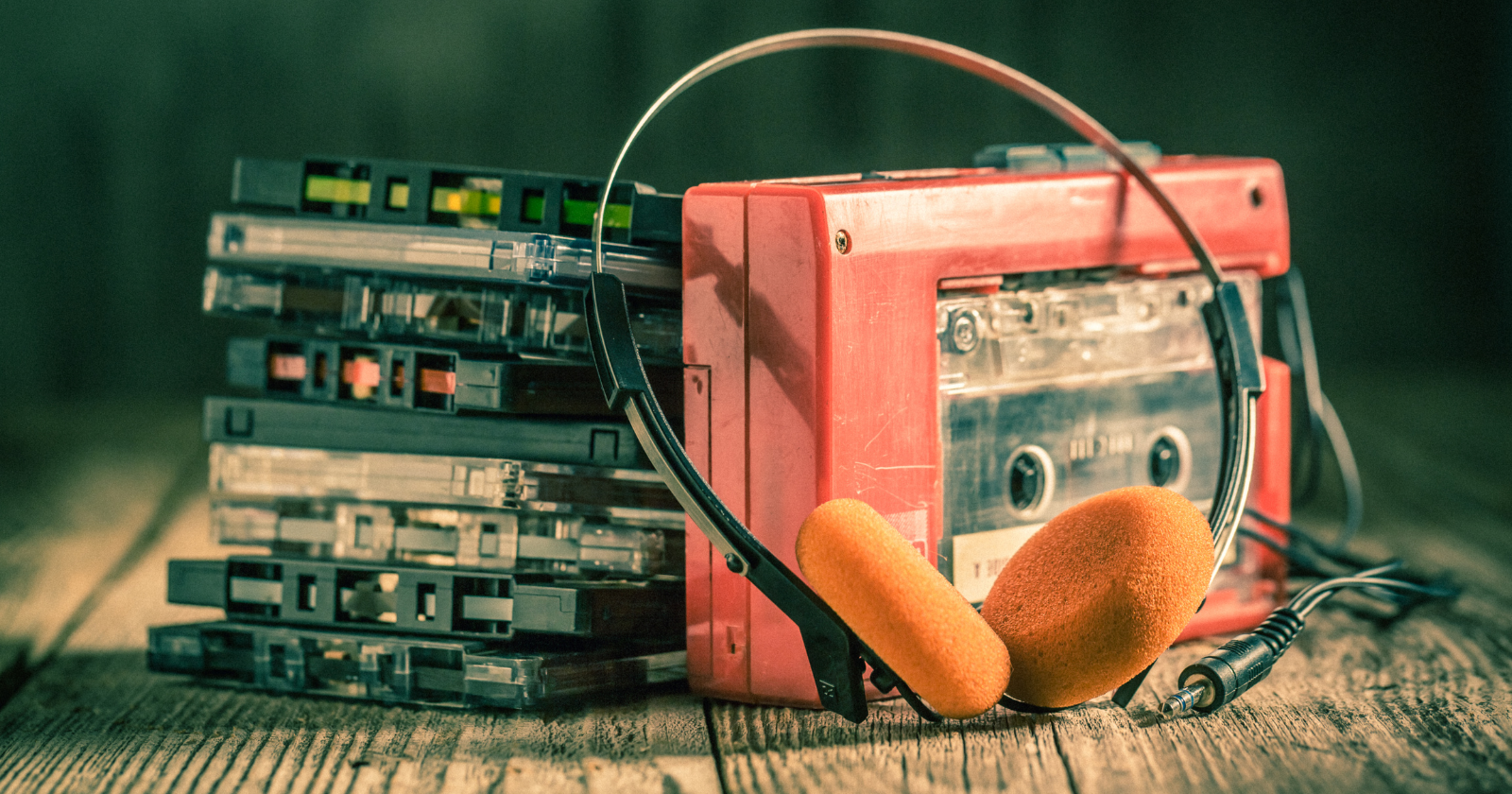

The Sony Walkman TPS-L2 went on sale in Japan on July 1, 1979, and the machine that reached store shelves that summer had two headphone jacks on the side instead of one, plus a small orange button marked “hotline.” Both features came directly from Sony chairman Akio Morita, who was convinced it would be rude and isolating for one person to sit listening to music alone. The second jack let a friend plug in; the hotline lowered the volume and switched on a built-in microphone so two listeners could talk without unplugging. Within a few years buyers had ignored that idea so completely that Sony quietly removed both features — and the image of a stranger sealed inside private music on a train became so ordinary it would define the next forty years of consumer electronics.
The favour that turned into a product
The Walkman began as a personal request. Sony co-founder Masaru Ibuka, who travelled constantly, wanted something small enough to play music on long flights, and he asked the audio team to adapt one of the company’s existing machines so he could listen on the move. The device they reworked was the Pressman, a compact recorder Sony had built for journalists. The engineers stripped out the recording function, added a stereo amplifier, and paired it with a set of feather-light headphones the company had been developing. Ibuka was delighted. Morita saw a product.
The internal resistance was immediate. A tape player that could not record struck much of the company as a device with a missing feature rather than a new category, and the headphones were treated with suspicion — in 1979, personal headphones were associated with hearing aids, switchboard operators, and niche audiophiles, not with something a teenager would wear down the street. Ibuka had asked for a portable player so he could enjoy opera on business trips, and Morita directed the team to turn that one-off into something Sony could sell to the young.
Morita gave the project an unusually tight leash, compressing development to roughly four months so the player would land before the summer. He committed to an initial run of 30,000 units — far above what any previous Sony tape deck had managed — priced at 33,000 yen, about $150 at the time. The forecast inside the building was modest, on the order of 5,000 units a month. When colleagues kept objecting, Morita finally told them he would resign if the 30,000 machines did not sell.
Two jacks, because Morita thought solitude was rude
The second headphone jack was not a hedge against a market-research warning. It was Morita’s own conviction made physical. He believed it would be impolite for a person to be lost in music alone, cut off from whoever was beside them, and he worried the device would isolate people from one another. So he had the engineers build companionship into the hardware: two jacks meant two listeners, and the orange hotline button meant they could still talk to each other over the song.
Market research did exist, and it was not encouraging, but it warned about other things entirely — that customers would reject a tape player with no record function and would be put off by the headphones themselves. Morita overrode that research on instinct. The sociable features were a separate decision, driven by his personal discomfort with the idea of solitary listening rather than by any data about how the public would react.
The execution was specific and a little charming. The two sockets on the original TPS-L2 were labelled “guys” and “dolls.” The hotline button, a bright orange key on the casing, briefly muted the music and opened a microphone so the two people sharing the player could speak without lifting their headphones. The whole design assumed people would want to listen together, and the assumption ran right down into the physical layout of the case.
Early advertising leaned into the same idea, presenting the Walkman as something that brought people together across ages and settings rather than something that sealed them off. The machine was being sold, in other words, as a cure for loneliness as much as a music player.
What people actually did with them
Sony introduced the device with one of the stranger press events in gadget history. Instead of a conventional briefing, the company bused journalists out to Tokyo’s Yoyogi Park, handed each of them a Walkman, and had them listen to a recorded narration explaining the product. Around them, Sony staff rode tandem bicycles and skateboards in silence while the reporters, headphones on, watched a demonstration with no one speaking. Bystanders had no idea what they were looking at.
The launch did not catch immediately. Roughly 3,000 units moved in the first month, well short of the pace Morita needed. Then Sony pushed it onto the street directly, sending young staff into Yoyogi Park on summer Sundays to walk up to strangers and offer them a listen. The first run of 30,000 sold out by the end of the summer, and demand kept climbing into the following year.
But buyers ignored the script. What they did with their Walkmans was walk around alone. Students wore them to school, commuters wore them on the train, joggers wore them at dawn. The private-bubble use case — the thing Morita had built two jacks to soften — became the dominant one within months. The shared-listening feature was real, but rarely used. The hotline button, engineered to make conversation easy, mostly sat untouched.
The quiet subtraction
Sony did not delete the sociable features all at once. The second-generation Walkman, the WM-2, arrived in 1981, became a runaway hit, and still carried two headphone jacks. Dual jacks survived into that model and others around it. It was only over the next couple of years that the layout was simplified: by roughly 1983 the hotline feature was gone and the two jacks had been brought down to one.
The changes were framed in ordinary product terms — slimmer bodies, lower cost, fewer parts — but the cultural meaning underneath them was that Sony had stopped apologising for solitary listening. Buyers had treated the portable stereo as something intensely personal, a private theatre they carried through the city. The company simply stopped engineering for a use case its customers had declined to adopt.
What makes the episode strange in hindsight is the speed of the reversal. A behaviour that had read as odd or even rude in 1979 had, within a few years, become an ordinary marker of youth and modern city life. The discomfort Morita had designed around did not have to be argued away. It evaporated the moment millions of people had a reason to do the supposedly antisocial thing every single day.
The world the Walkman built
The shift was significant enough that academics gave it a name. The musicologist Shuhei Hosokawa coined the term “Walkman effect” in 1984 to describe the way headphone listening lets a person reshape and control the public space around them — a small private film score laid over a shared street. The concept long outlived the cassette, and it now gets applied to every personal-audio device that followed.
Each of those devices inherited a settled question. The iPod in 2001 needed no second jack, because the social meaning of wearing headphones in public had already been decided two decades earlier by Sony’s customers refusing to use the one their chairman had insisted on. AirPods, which arrived in late 2016, could ship as openly solitary objects — little white stems on a subway platform — without anyone reading them as rudeness.
Morita’s instinct was not entirely wrong. There really was a line between private listening and public courtesy in 1979; he simply guessed wrong about where it would eventually settle. The line did not disappear so much as move, which is why wearing earbuds through a conversation can still read as rude today even though wearing them alone on a train never does.
The hole that’s still there
When Sony marked the Walkman’s 40th anniversary in 2019, it released a tribute device, the NW-A100TPS, styled to look like the original TPS-L2, with a cassette-tape animation for a screensaver and a soft case shaped like the 1979 shell. It carried a single working headphone jack and could not play cassettes at all. The homage recreated the silhouette of the original almost exactly. The one thing it did not bring back was the second jack — the sociable feature was the part of the design history had quietly erased.
The original units have become artefacts. A first-run TPS-L2 — the same model carried by Star-Lord in the 2014 film Guardians of the Galaxy, which sent a new generation looking for one — now sits in museum cases at institutions like the Smithsonian and the V&A, and clean working examples change hands among collectors for hundreds of dollars, more for complete boxed ones. On every one of them, the second jack is right there on the side: a small empty circle a couple of centimetres from its twin, doing nothing.
It is the physical residue of a belief that someone took seriously enough to build into the hardware, and that the world outgrew faster than anyone at Sony expected. For an object that helped invent the modern habit of walking around inside your own private soundtrack, that empty jack is the most honest part of the design. It marks the exact spot where a company assumed people would not want to be alone with their music — and the exact moment people started doing it anyway.