
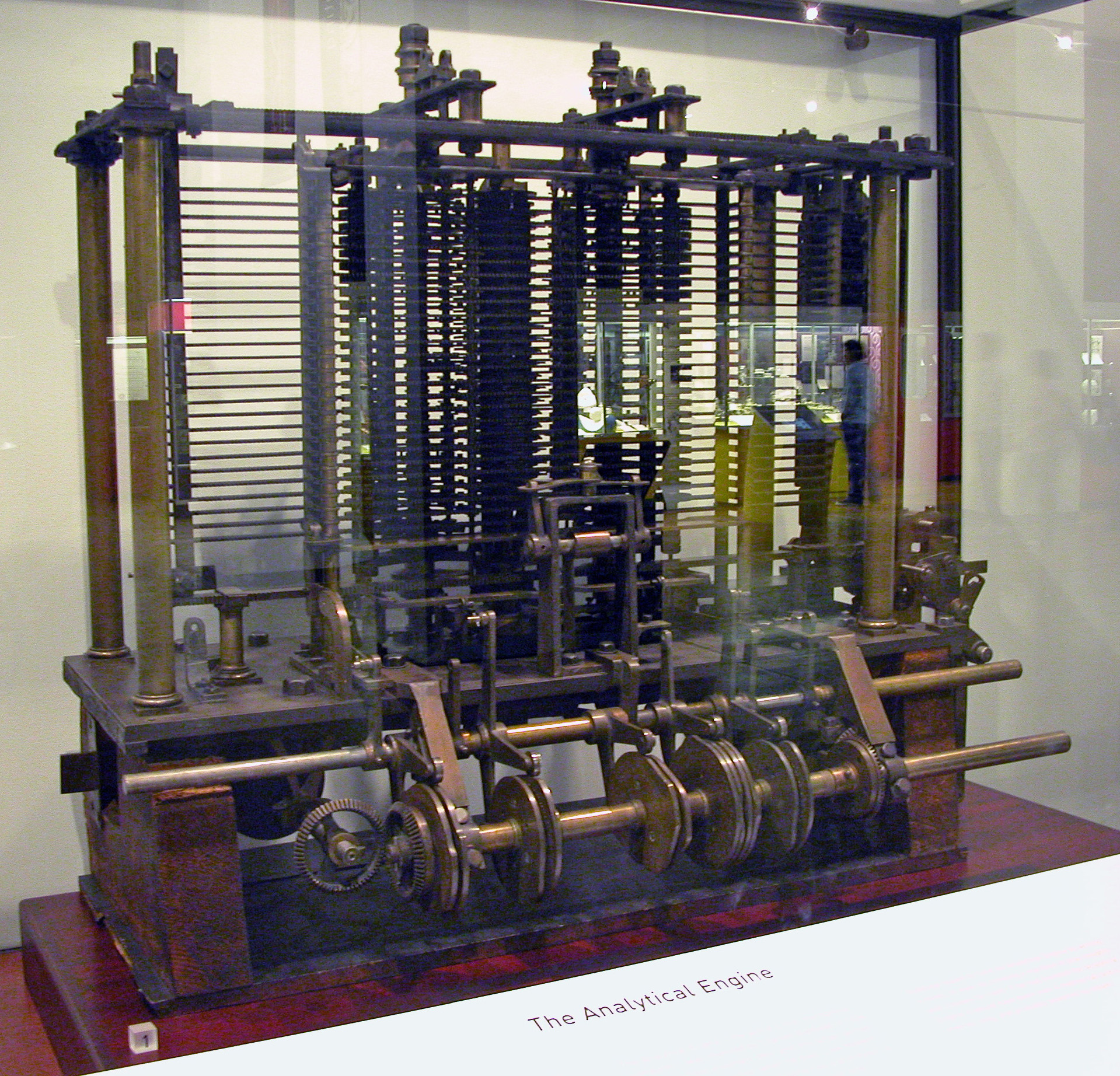

In 1843, Ada Lovelace looked at Charles Babbage’s unbuilt Analytical Engine and described something stranger than a calculator. If the relationships inside music could be expressed in symbols, she wrote, the engine “might compose elaborate and scientific pieces of music of any degree of complexity or extent.”
That sentence is the shock in the record. Lovelace was not looking at a machine humming on a desk. She was looking at drawings, mechanical plans, punched-card logic, and a proposed engine of brass wheels and columns that Babbage never completed.
Her published work appeared as a translation of an 1842 French paper by the Italian engineer Luigi Menabrea, but the translation became the smaller part of the event. Lovelace added seven notes of her own, labelled A through G, and those notes ran about three times longer than the original article, according to Scientific American’s history of the text.
The note that made numbers into symbols
The machine was Babbage’s Analytical Engine, a proposed steam-powered programmable computer that modern historians recognise as one of the clearest ancestors of general-purpose computing. The Bodleian Library’s account describes it as a machine that could modify its own calculation while running, using earlier results to choose between later steps.
Menabrea’s paper treated the engine as a mathematical machine. Lovelace’s notes stretched the idea. If a machine could manipulate symbols according to fixed operations, the symbols did not have to stand only for quantities.
They could stand for relationships.
In Note A, Lovelace made the leap that still makes the document feel modern. The engine, she wrote, “might act upon other things besides number,” provided those things could be expressed through the abstract relations of operations. A number could represent a musical pitch, a letter, a logical relation, or any other formal object that could be reduced to rule and symbol.
That is why the music passage matters. It is not a whimsical flourish. It is a precise claim that computation is not only arithmetic, but symbol processing.
The program on the fold-out page
Note G is the famous one. It contains a table for calculating Bernoulli numbers with the Analytical Engine, arranging variables, operations, and intermediate results in a sequence a machine could follow.
The transcribed notes preserve the two passages that define Lovelace’s reputation: the Jacquard loom comparison and the claim that the engine “has no pretensions whatever to originate any thing.” Between them sits the Bernoulli table, the reason she is often called the first computer programmer.
That title needs care. Recent scholarship has argued that Babbage had earlier unpublished programs and that Lovelace’s table was part of a collaboration, not a solitary act. Thomas J. Misa’s work on Lovelace, Babbage, and the Bernoulli numbers argues for a shared technical context while still crediting Lovelace with creating an elemental sequence of instructions for the Bernoulli calculation.
The safest version is also the most interesting one. The published 1843 table was the first widely visible program-like sequence for a programmable machine, and it appeared under Lovelace’s initials, A.A.L.
A collaboration built from letters and corrections
Lovelace had met Babbage in 1833, when she was seventeen, after seeing a demonstration model of his earlier Difference Engine. By the time she worked on Menabrea’s paper, she had become one of the few people able to follow the Analytical Engine closely enough to explain it in public.
She was not a passive editor. The surviving correspondence shows her arguing over wording, correcting at least one mathematical error, and pressing Babbage for clarity. The collaboration was uneven in the way many technical collaborations are uneven: Babbage understood the machinery more deeply, while Lovelace saw further into what the machinery implied.
Her education made that possible. Her mother, Anne Isabella Milbanke, insisted on serious mathematical training for Ada after separating from Lord Byron, partly to steer her away from what the family saw as Byron’s dangerous romantic temperament. Lovelace later studied with Augustus De Morgan and read Mary Somerville.
She called her approach “poetical science.” The phrase can sound decorative now, but in the notes it describes a real habit of mind. Lovelace could hold the punched card, the algebraic operation, and the image of a loom weaving flowers into silk in the same technical frame.
The engine that never ran
The Analytical Engine was never completed. Babbage died in 1871 with the machine still existing as drawings, notebooks, trial pieces, and mechanical ambition.
The Difference Engine has a different afterlife. The Science Museum built Babbage’s Difference Engine No. 2 from his drawings; the main section was completed in June 1991 for the bicentenary year of his birth, and the printing mechanism was added in 2002, according to the Science Museum Group collection record.
That matters because it changes the emotional weight of Babbage’s failure. The later machine worked. His drawings were not fantasy, even if the engineering, money, and Victorian manufacturing conditions could not carry the Analytical Engine to completion.
Lovelace’s program therefore ran nowhere. It was software for hardware that existed only on paper, a sequence of instructions addressed to a machine that never heard them.
The century before the computer caught up
The long delay was not only neglect. It was material. Babbage was trying to build a general-purpose computer from gears, shafts, and mechanical tolerances, before vacuum tubes, reliable electrical switching, transistors, or cheap mass production existed.
The timeline is brutal. Lovelace’s notes appeared in 1843. Babbage died in 1871. Herman Hollerith used punched cards to process the 1890 US census. Alan Turing published “On Computable Numbers” in 1936. Konrad Zuse built the Z3 in 1941. Harvard’s Mark I ran in 1944. ENIAC became operational in the mid-1940s. The Manchester Baby executed a stored program in 1948.
The conceptual line from Lovelace to Turing is not a simple handoff. Turing formalised computation mathematically in a way Lovelace did not. But Lovelace had already seen that a machine following operations on symbols could become more than a numerical calculator.
Turing returned to her directly in 1950, in “Computing Machinery and Intelligence,” when he named “Lady Lovelace’s Objection.” He quoted her claim that the Analytical Engine could only do what people knew how to order it to perform, then argued that machines might still surprise us.
Her name entered working technical vocabulary again through Ada, the programming language developed for the US Department of Defense. The original military standard, MIL-STD-1815, was approved on December 10, 1980, her birthday, and its number echoed her birth year, 1815.
For readers following the later history of software as something physically made, Make Tech Easier’s account of the Apollo Guidance Computer’s woven core-rope memory picks up the same strange material thread. Its piece on the Harvard Mark II moth in 1947 catches another moment when programming was still close enough to machinery that a bug could have wings.
Reading Lovelace now
The notes survive because they do more than predict a machine. They show a mind trying to name a category before the category existed.
Lovelace was careful about the engine’s limits. She did not imagine a conscious machine. She said it could not originate anything, only execute what people knew how to command. That caution has followed artificial intelligence debates for more than a century and a half.
But her larger insight survived the caution. The same mechanism that could calculate Bernoulli numbers could, in principle, operate on anything whose relationships could be symbolised. The brass engine became a way to think about music, language, logic, and eventually every modern file on a screen.
The Bernoulli table still looks dry at first glance: columns, symbols, numbered operations, a fold-out page of Victorian notation. Then the hinge appears. A machine built for numbers becomes a machine for patterns.
Babbage’s engine never turned its full set of wheels. Lovelace’s program never clicked through its intended gears. Yet the idea kept moving, quietly, for a hundred years, until the machines finally arrived with enough electricity, memory, and speed to make her paper engine feel less like a speculation and more like an early map of the room we now live inside.