
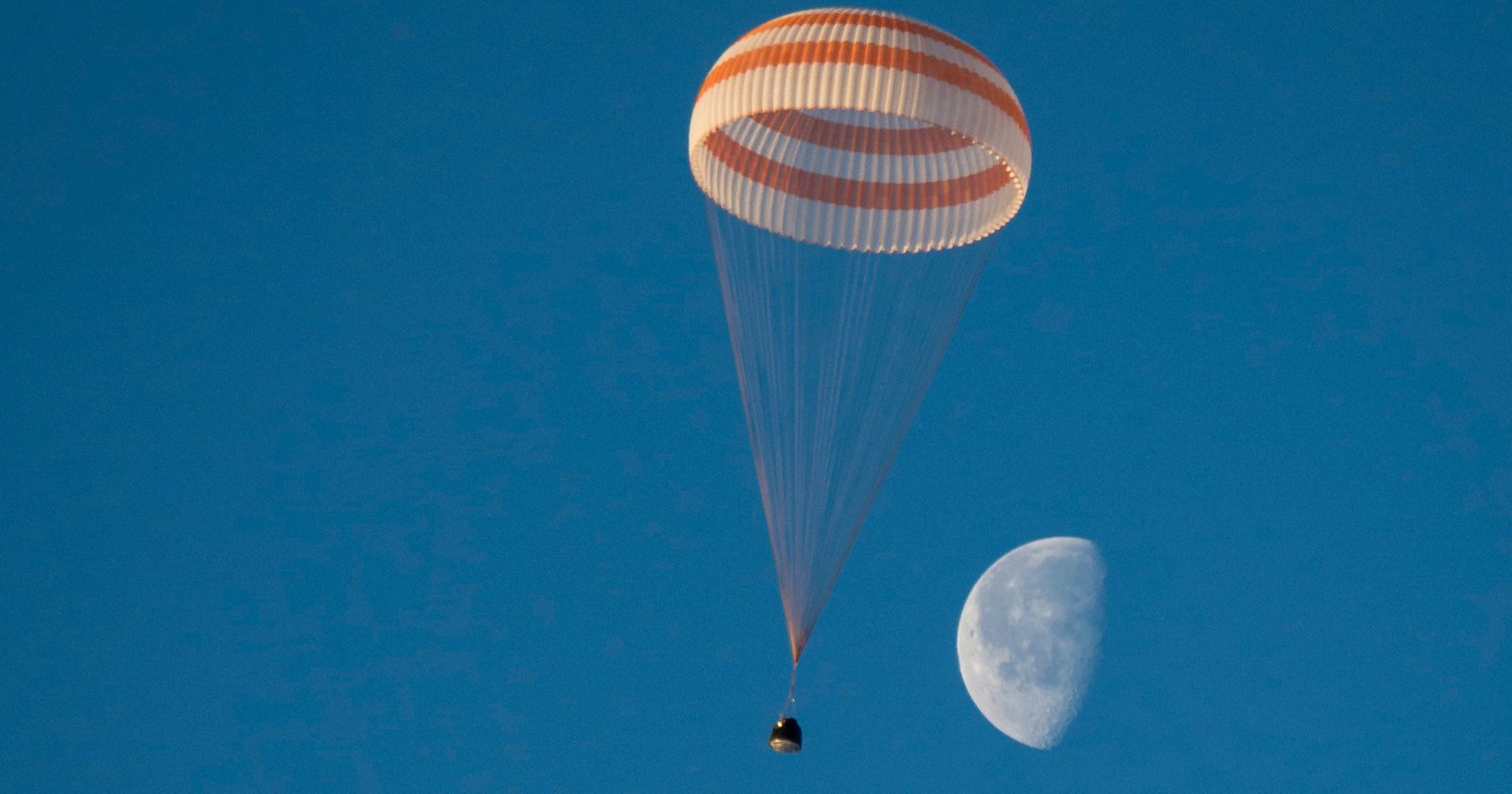

Scott Kelly came back from the International Space Station in March 2016 measurably taller than the brother he had left behind on Earth. After 340 days in orbit, the NASA astronaut had grown in spinal length, a change his identical twin Mark — a former astronaut himself, staying Earth-side as a genetic control — had not experienced. Within days of landing in Kazakhstan, Scott began shrinking back. Within months, the brothers matched again.
That stretch is why the seat liner cradling Scott’s body inside the Soyuz capsule on the way home had to be fitted weeks before he ever left the planet — and why the Russian space agency, working alongside NASA, hand-sculpts each one from a cast of the crew member’s actual back, hips, and shoulders. A seat moulded to an astronaut’s pre-flight spine would no longer fit the elongated body coming down through the atmosphere at terminal velocity under a parachute.
Why spines grow in orbit
Gravity spends every waking hour compressing the human spine. The twenty-three intervertebral discs sitting between the vertebrae act like small gel-filled cushions, and on Earth they spend the day squeezing thinner under the weight of the head, torso, and whatever the body is carrying. Humans wake up taller than they go to bed, because a night of lying flat lets those discs rehydrate and expand. By evening, gravity has flattened them again.
Take gravity away entirely and the cycle never resets. The discs swell. The natural S-curve of the spine straightens out toward something closer to a column. Astronauts on long-duration stays aboard the ISS typically gain several centimetres of height over the course of a six-month mission. The change happens fast. Most of the growth shows up in the first weeks.
It comes with a price. A 2016 study of six NASA crew members who spent four to seven months in microgravity found that the deep paraspinal muscles that stabilise the lower back atrophied significantly, even though disc height itself did not increase as dramatically as earlier research had suggested. The supporting scaffolding around the spine weakens at the same time the column itself elongates, which is part of why returning astronauts are at elevated risk of herniated discs in the months after landing.
The seat that has to fit two different bodies
The Soyuz descent module is famously cramped. Three crew members fit inside a bell-shaped capsule barely big enough for them to bend their knees, strapped into custom-shaped couches called Kazbek seats that are designed to absorb the bone-jarring impact of landing. The capsule comes down under parachute and fires retrorockets just above the steppe, but the touchdown still hits with the force of a low-speed car crash. The seat has to cradle the spine perfectly, distribute load across the pelvis and shoulders, and hold the body rigid enough that vertebrae do not slam against each other on impact.
That is hard enough when the body fits the mould. It becomes a serious engineering problem when the body has grown several centimetres since the mould was made.
The fitting process is old-school. Weeks before launch, each crew member lies down in a fibreglass shell while technicians take detailed measurements and casts of the back of the body in a specific reclined posture. The liner — the personal insert that bolts into the Kazbek frame — is then machined to match. Every seat is one-of-one. The liner that flies up to the station with a crew member is the same liner that flies back down, often six months or a year later, after the spine inside it has changed shape.
What engineers actually do about the stretching
The fix is geometric. The seat liners are built with extra clearance at the head and along the lumbar curve, anticipating the elongation. Foam pads and adjustable inserts let the crew fine-tune the fit before re-entry. The custom cast establishes the baseline shape; the in-flight adjustments accommodate the new dimensions.
Crew members also spend the days before undocking actively trying to shrink. They curl up in fetal positions during sleep. They wear constrictive garments. They run their final fittings inside the docked Soyuz, sometimes discovering that helmets sit at the wrong angle or that knees press into the instrument panel in ways they did not during launch. Adjustments get made on orbit, with cosmonauts and astronauts trimming foam and repositioning padding before they commit to the seat that will absorb their landing.
Missing this detail is not a comfort problem. It is a compression fracture problem. The Soyuz comes down hard. If the spine is not properly supported, the deceleration loads at touchdown can crack vertebrae, especially vertebrae that have been floating in microgravity for half a year with weakened surrounding musculature.
The disc biology behind the stretch
The intervertebral discs doing all this swelling and shrinking are some of the most metabolically unusual tissues in the human body. They have almost no blood supply. Nutrients diffuse in slowly from the vertebrae above and below, which is part of why disc injuries heal poorly and why disc degeneration is a leading driver of chronic low back pain.
In microgravity, those discs get a holiday. With no compressive load, they pull in fluid and swell to their full capacity. The nucleus pulposus — the gel-like core at the centre of each disc — expands. The annulus fibrosus, the tough fibrous ring around it, stretches. Multiply that across all twenty-three discs in the spinal column and the cumulative effect is a body that is genuinely a few centimetres longer.
Researchers now use organ-on-a-chip platforms — tissue chips sent to orbit as stand-ins for human organs — to study how disc cells and other tissues respond to extended microgravity exposure. The chips ride up on resupply missions, get exposed to the same conditions astronauts experience, and come back for analysis. They are how the field is starting to model what is happening at the cellular level inside a spine that has been floating for six months.
Coming back down
The stretch reverses, but it takes time. Most astronauts lose the extra height within a few weeks of landing, as gravity squeezes the swollen discs back to their normal dimensions. Some of the change lingers. Studies of long-duration crew members have found subtle differences in disc shape and back muscle composition that persist for months after return, which is part of the reason returning astronauts face an elevated risk of herniated discs in the year following a mission.
The spine is only one system that gets recalibrated. Crew members coming back from long stays struggle to walk, balance, and even hold their heads up against full gravity. Their vestibular systems need to re-learn which way is down. Bone density drops in weight-bearing bones during extended spaceflight. Cardiovascular conditioning degrades. The immune system shifts in ways researchers are still mapping.
For the Artemis II crew preparing to fly around the Moon, NASA’s medical teams have catalogued an entire taxonomy of physiological risks — radiation exposure, fluid shifts that affect vision, cardiovascular deconditioning, and the same kind of musculoskeletal changes that have plagued long-duration ISS crews. The shorter Artemis II mission profile will spare the crew the worst of the spinal elongation, but the deeper concern for future Moon and Mars missions is what happens when a crew member has to step out onto a planetary surface, in real gravity, after months of floating.
What it feels like
Astronauts describe the in-flight stretch as oddly painful. The fluid shift causes a constant dull ache in the lower back during the first weeks in orbit, as discs swell against ligaments and nerves that were never designed for that geometry. The same fluid migration that elongates the spine also pushes blood and lymph toward the head, producing the characteristic puffy-face appearance familiar from station livestreams, sometimes described informally as resembling Charlie Brown. Astronauts report congestion that never quite clears, taste changes, and a persistent feeling that they have been hung upside down for too long.
Coming back is worse. The reverse-compression of the spine over the first days on Earth is genuinely uncomfortable, and the loss of the in-flight relief from gravity often surfaces old back injuries that had been pleasantly silent in orbit. Crew members are tracked closely in the post-landing months, scanned and measured to monitor the cascade of physiological readjustments their bodies undergo on the way back to Earth-normal.
A piece of fibreglass that knows your spine
The cast and the fibreglass shell sit at the strange intersection of cutting-edge spaceflight and pre-industrial tooling. The Soyuz has been flying crew since 1967. The seat liner process has barely changed. It is a workflow built around a body that is the same shape on the way up and the way down — and quietly engineered around the knowledge that the body coming home is not the body that left.
Somewhere in a storage facility outside Moscow, there are racks of these custom liners. Each one is a negative-space portrait of a single human spine on a single day, captured in plaster and fibreglass weeks before a journey that would change its dimensions. The liner that brought Scott Kelly home from his year in space cradled a back longer than the one it had been moulded to fit. It held. The body inside it slowly returned to the shape the cast remembered.