
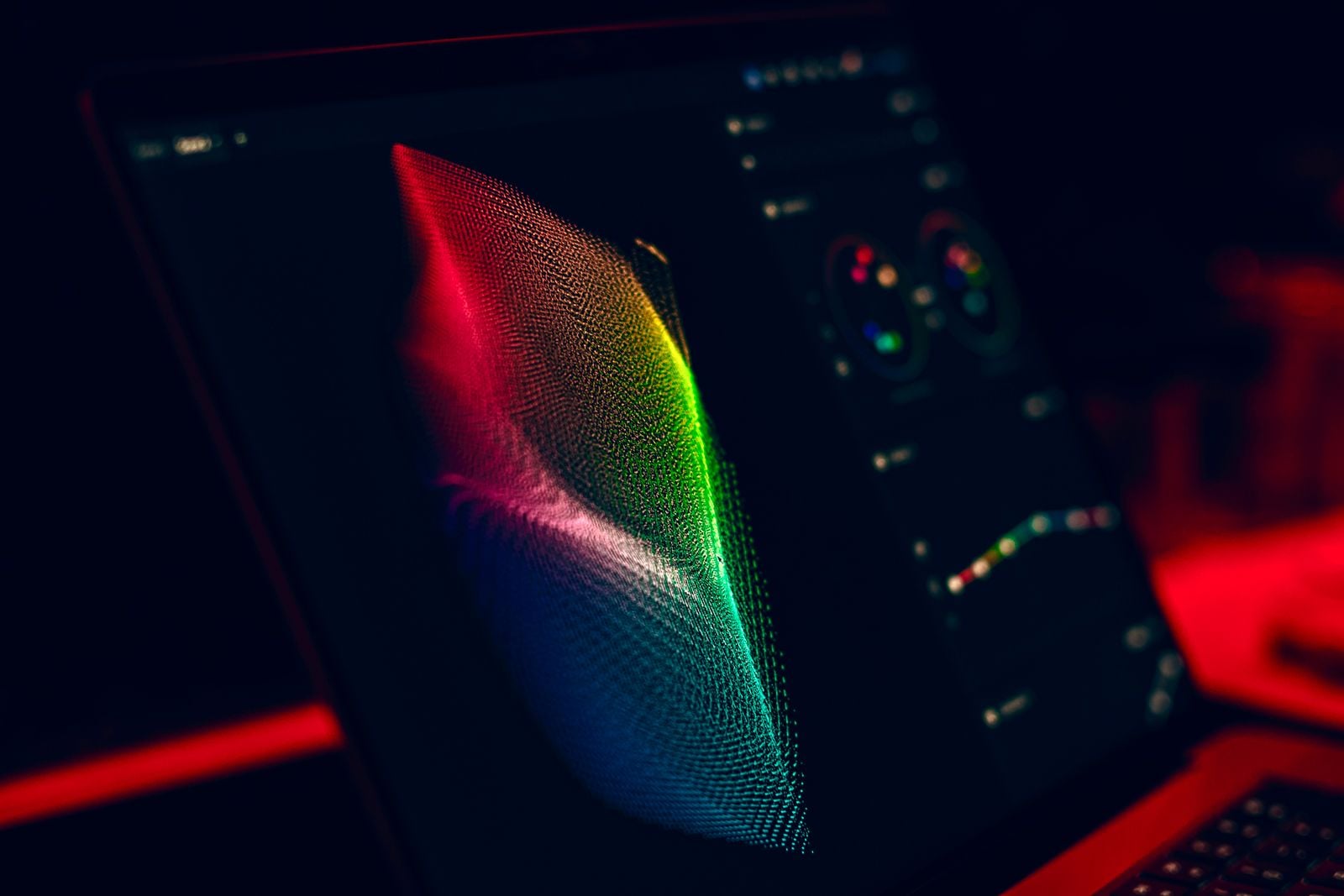

Hold a magnifying glass to a switched-on phone and the illusion falls apart. The smooth photograph on the screen resolves into a tight grid of red, green and blue dots, each one glowing at a different brightness. There is no yellow subpixel, no cyan, no orange.
A sunset on a display contains no orange light at all — only red and green photons hitting the eye close enough together that the brain, unable to tell them apart, invents the orange. The screen isn’t matching the colour of a real sunset. It’s matching the response of three specific cells in the back of the retina, and everything else follows from that.
Human colour vision runs on cone photoreceptors, and there are only three kinds. The short-, medium- and long-wavelength cones, usually labelled S, M and L, peak in sensitivity at roughly 420, 530 and 560 nanometres — very approximately blue, green and yellow-green.
Each cone doesn’t report a colour; it reports a rate, a count of photons weighted by its own sensitivity curve. The brain sees only those three numbers and reconstructs the entire visible world from the ratios between them. Every colour a person has ever seen, from a kingfisher’s back to a bruise, is a triangle of firing rates on those three channels.
Three numbers, not a spectrum
This is why screens can get away with what they do. If human vision sampled the full spectrum — the way a prism spreads it — a display would need to reproduce every wavelength faithfully. Instead, vision throws almost all of that information away at the retina.
Two lights with wildly different physical spectra can produce identical S, M and L responses and look indistinguishable. Colour scientists call these pairs metamers, and they are the loophole every screen exploits. A monochromatic yellow laser at 580 nanometres and a mixture of red and green LEDs can excite the same ratio of L and M cones. To a spectrometer they are different lights. To a human, they are the same yellow.
The formal recognition of this dates to the 1920s. Physicists William David Wright and John Guild ran painstaking experiments in which observers adjusted knobs controlling the intensity of three coloured lamps until the resulting mixture matched a target hue.
Their combined data became the CIE 1931 colour-matching functions, which the International Commission on Illumination adopted as the mathematical foundation of every colour standard since — from television broadcasting to printer inks to the sRGB space your browser is rendering this paragraph in. The functions are, in effect, a numerical portrait of an average human retina.
Why red, green and blue specifically
Given that the eye has three sensors, a screen needs at least three primaries to address them independently. But why these three?
The choice is a compromise between physiology, physics and manufacturing. To reproduce as many colours as possible, the primaries should sit near the edges of the visible spectrum, spreading the addressable triangle — the “gamut” — as wide as the eye can perceive. Red and blue at the two ends and green in the middle roughly maximise that triangle.
Anything closer to the centre would compress the gamut and desaturate every image. Anything further out runs into the limits of what phosphors, LEDs and quantum dots can actually emit efficiently.
Modern wide-gamut standards like Rec. 2020 push the primaries closer to pure spectral colours — a deeper red near 630 nanometres, a greener green near 532 — precisely to enlarge that triangle, but the underlying logic is unchanged. Three sensors, three primaries, one triangle of everything you can see on that screen.
There is nothing sacred about red, green and blue as physical categories. A hypothetical species with four cone types would need four primaries to be fooled properly, and a two-cone species — including most mammals, dogs and cats among them — would only need two.
Some birds and reptiles have four or even five cone types and can perceive ultraviolet. A television built for a pigeon would look, to a human, like it was missing a channel.
The colours that don’t exist
Because the trick relies on stimulating cone ratios rather than reproducing physical light, screens can produce colours that never appear in nature — and fail to reproduce colours that do. Pure spectral violet, near 400 nanometres, excites the S cones strongly and the L cones very slightly. No combination of a display’s red and blue primaries can quite hit that ratio, which is why the deepest violets in a real rainbow always look a little off on a monitor.
Magenta, on the other hand, has no wavelength at all. There is no single frequency of light that produces the sensation of pink or magenta; the brain manufactures it whenever the L and S cones fire together without much M in between, a pattern that the sun’s continuous spectrum essentially never delivers on its own.
Some rare humans carry a fourth functional cone type — a condition called tetrachromacy, arising from an X-chromosome quirk. In principle they should see distinctions the rest of the population cannot, and metamers that fool the standard three-cone eye should fall apart for them. In practice, the extra cone often overlaps heavily with the existing ones, and rigorous demonstrations of expanded colour discrimination have been rare. Their screens, calibrated for three-cone viewers, would be lying to them about most things — the same way a black-and-white television lied to everyone.
Subpixels, dithering and the persistence of the trick
Zoom back out from the retina to the display, and the engineering follows the biology. LCDs use white backlights filtered through red, green and blue subpixels. OLEDs use three separately emitting organic materials. Quantum-dot displays use nanocrystals tuned to precise wavelengths. All of them are trying to hit the same three cone responses with as much control as possible, and they all use the same sRGB or Display P3 mathematics to decide, for any input colour, how bright each of those three lights should glow.
The compression is astonishing. A single 24-bit pixel — eight bits per channel — encodes roughly 16.7 million distinct combinations, which is close to the number of colours the average human eye can actually discriminate. Not because 16.7 million is a special number, but because it lines up with what three cones can meaningfully distinguish. The bit depth of your monitor is a physiological measurement in disguise.
Everything downstream of that — the JPEG algorithm’s aggressive throwing-away of colour detail the eye barely notices, the way the GIF format squeezed images down to a 256-colour palette in the modem era, the entire discipline of video compression — leans on the same fact.
Human vision is far cheaper to satisfy than to describe. Cameras record spectra, screens emit three lights, and somewhere in the middle a great deal of physical information is discarded because the eye was never going to notice it in the first place.
The pixels on the screen, in the end, aren’t a picture of the world. They’re a picture of what three cells in the back of a human eye happen to be capable of counting.