


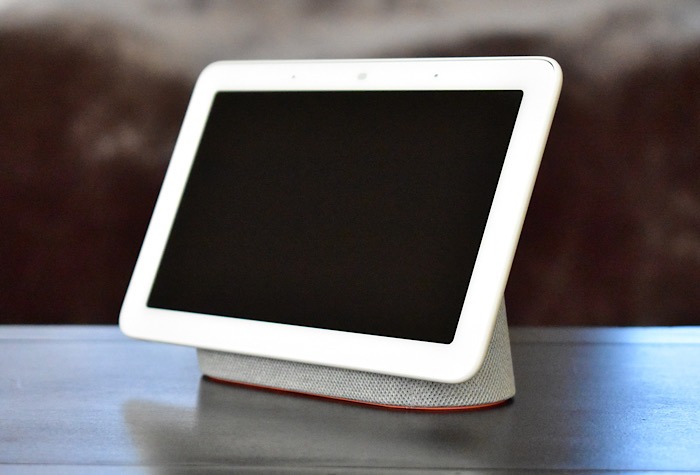
The long-rumored Android replacement, Fuchsia, has finally been released, yet not to Android devices – to the 1st-Gen Google Nest Hub. While you might think such a release would be deserving of much fanfare, it was a very quiet release – and to a device that would be one of the least noticed.
Google Fuchsia Meets the Nest Hub
We’re been hearing about Google Fuchsia for some time, but it was always described as an Android replacement, not a smart home device OS. When Flutter, the power behind the Google Nest Hub, is taken into consideration, it’s not so surprising, as Flutter works with multiple OS by design.
Earlier this month, it was noticed that Google was running Fuchsia on a 1st-Gen Nest Hub. The assumption was that it was nearing more of a public testing, especially so close to Google I/0 2021. Nothing was mentioned at the event, so questions arose once again of what Google had in store for Fuchsia.
It was finally reported this week that Google is making Fuchsia public. The plan is for it to continue to be more widely available as the months roll out.
Starting with the Google Nest Hub, a 1st Gen Nest Hub yet, the switch to Fuchsia wasn’t very noticeable. Google seems to be handling this rollout in a very metered, controlled fashion – there’s no big splashy OS announcement like you’d get with Apple. There’s no big rumor mill with prognostications – just a slow look at a new exciting OS.
But instead of replacing Android, it’s replacing Cast OS, at least on this one device – for now. Yet Fuchsia is capable of so much more, of running on desktops and on mobile. The idea could be to not replace Cast OS or Android.
Hiroshi Lockheimer, Google SVP of Android, Chrome OS, Play, and Photos, said two years ago: “It’s not just phones and PCs. In the world of IoT, there are increasing number of devices that require operating systems and new runtimes and so on. I think there’s a lot of room for multiple operating systems with different strengths and specializations. Fuchsia is one of those things, and so, stay tuned.”
Where Is Fuschia Headed?
That worked. Lockheimer’s words have kept everyone tuned in to find out what was happening with Fuchsia and just when it would be released and possibly replace Android.
All of this just raises more questions of where Fuchsia is headed, but perhaps that’s by design – maybe Google doesn’t know either. By moving into this slow release and by first replacing the OS on an early generation device like the Nest Hub, Google allows itself time to decide whether the OS is meant for more than a smart home device and whether it could possibly be a leading mobile OS platform to replace Android.
It also answers a question – somewhat – of when you may get a chance to use Fuchsia. The answer is not for a long time unless you happen to still have a 1st Gen Nest Hub hanging around.
Read on to learn how Google was pushing Fuchsia to be open soure and when it was assumed it was nearing its firts developer release.
Image Credit: Google Home Hub on table.jpg by Y2kcrazyjoker4 and public domain