How to Enable and Use Gmail Offline

Featured Image Gmail Blacklist Whitelist Ip Addresses

Gmail is the go-to email app for pretty much everyone. The very word is often used interchangeably with “email,” and no one bats an eyelid. It’s a feature-packed email client. With a little tweak, you can even use Gmail offline, browsing existing emails and composing emails so they automatically send when you’re back online.

Here’s how to enable and use Gmail offline.

Also read: How to Create a Gmail Desktop App

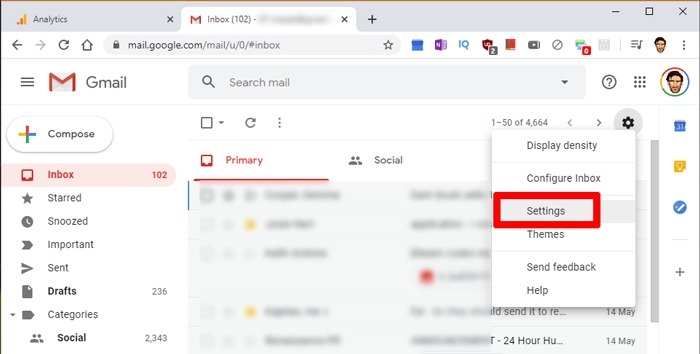
It’s not a complicated process. Log in to Gmail in your browser, then click the cog icon at the top right and click Settings.
Use Enable Gmail Offline Settings

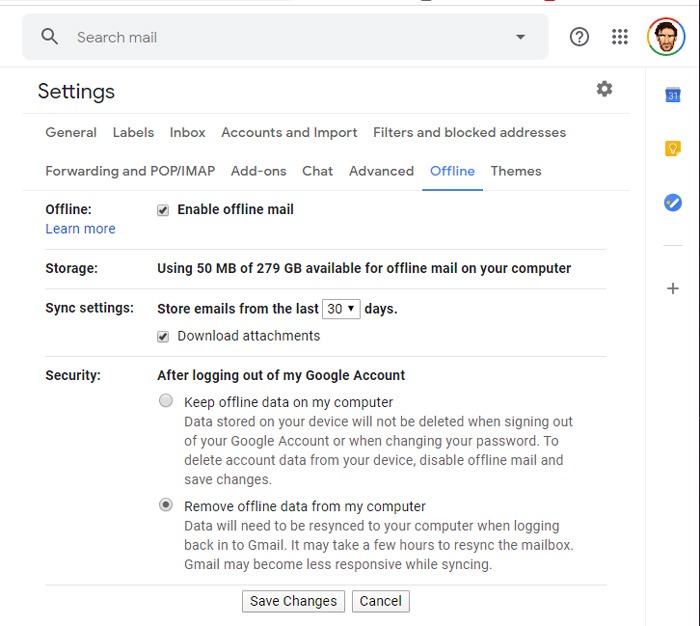
Click the “Offline” tab, then tick the “Enable offline mail” box.
Use Enable Gmail Offline Settings X

A bunch of new options and information will appear telling you how much storage space Gmail is using on your hard drive. You can also pick how far back you want Gmail to store your emails offline and whether or not to download attachments.

Security-wise, the last option is really important. By default, Gmail offline will of course store data locally on your PC. (That’s the whole point, isn’t it?) With these security options, however, you can choose whether you want Gmail to store your data locally if you log out of your Google account on that PC.

Choose one of the security options, then click Save Changes.

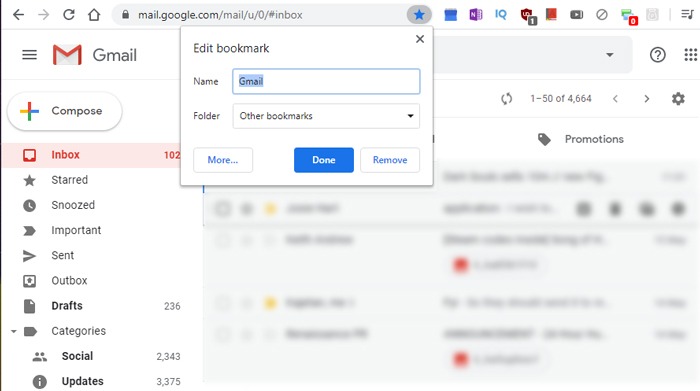
Many people miss this final step. To access Gmail offline, you won’t be able to just type the Gmail URL into the search bar. You need to go back to your Gmail inbox, then create a bookmark (Ctrl + D) pointing to the inbox.
Use Enable Gmail Offline Bookmark

Once you’ve created a bookmark, you’ll be able to access Gmail offline by clicking that bookmark from now on.

Want more Gmail-related tricks? See our list of the best new Gmail features you need to know about. Also see our guide on how to save Gmail attachments on Android.


Subscribe to our newsletter!

Our latest tutorials delivered straight to your inbox

Robert Zak Avatar

Read next

Suzanne Simard sealed paper birch and Douglas fir seedlings inside plastic bags, fed them carbon-14 and carbon-13 dioxide, and nine days later found carbon had crossed between species through fungal threads in the British Columbia soil beneath her boots
A species of jellyfish called Turritopsis dohrnii can revert its adult cells back to a juvenile polyp stage when injured or starving, effectively restarting its life cycle, and biologists have so far failed to identify any natural limit to how many times it can do this.
A Japanese man named Jiroemon Kimura, who lived to 116, was born in 1897 when Queen Victoria still ruled and died in 2013, meaning a single human life personally overlapped with the invention of the airplane, the atomic bomb, the internet, and Instagram
The Hollywood sign originally read HOLLYWOODLAND when it was built in 1923 as a real estate advertisement for a housing development, and it was only meant to stand for 18 months, but nobody ever got around to taking it down and the city eventually adopted it as a landmark
Almost all of the world’s internet traffic does not travel by satellite but through fibre-optic cables lying on the ocean floor, a hidden web of wires crossing the deepest parts of the sea to connect the continents.
People who flip their phone face down on every table aren’t being secretive. They figured out that staying interruptible meant handing their time to whoever rang first
Twitch vs. Facebook Gaming vs. YouTube Gaming: What’s the Best Live Game Streaming Platform?
Chrome Extensions Ownership Transfer is a Direct Threat to You: How to Stay Safe