
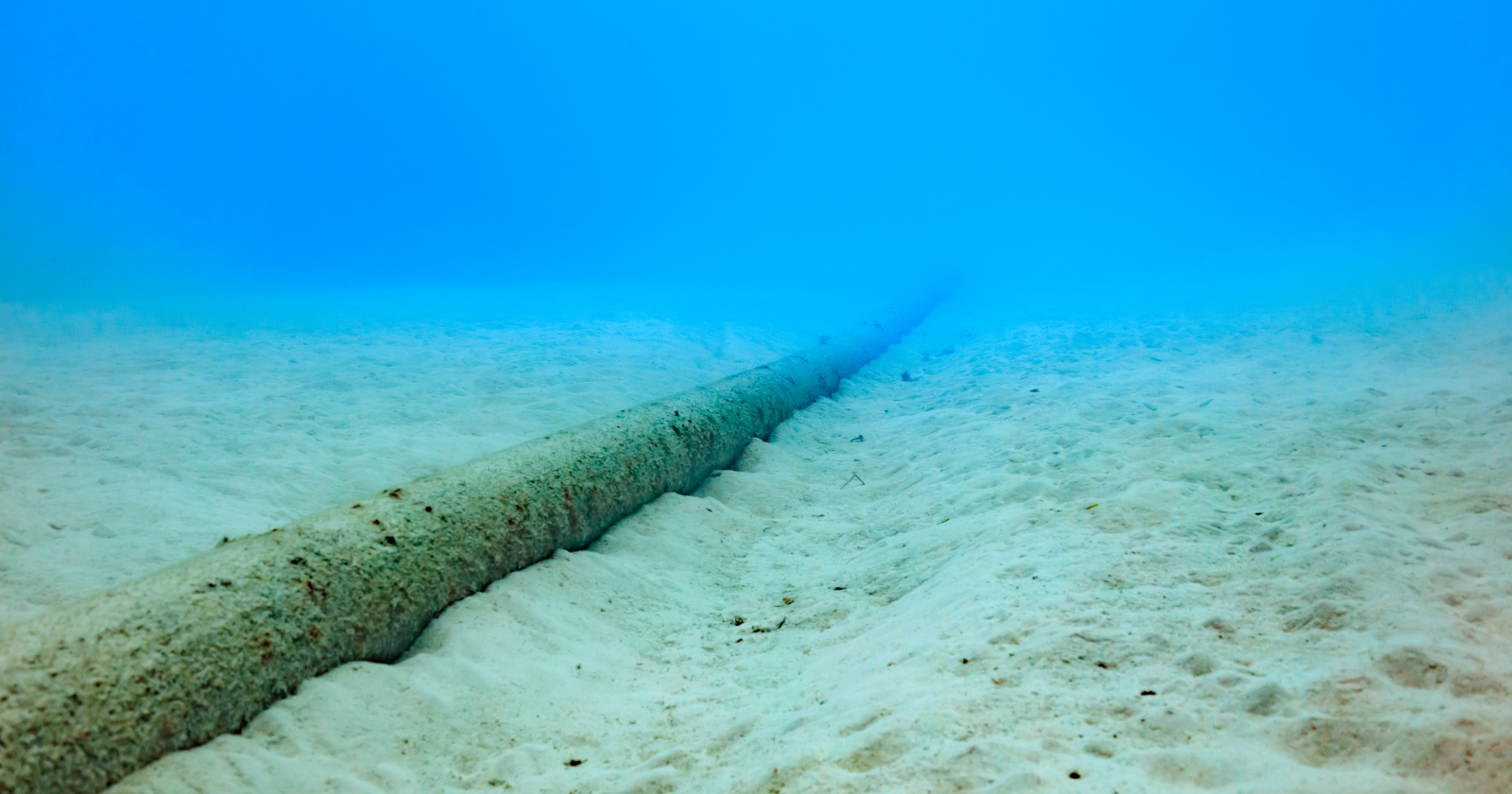

The great majority of data that crosses between continents travels through fibre-optic cables on the seabed, not through satellites. Estimates put the share at somewhere between 95 and 99 per cent of international traffic. Satellites, for all their visibility, carry the remainder.
The word to watch is “all.” The figure is about traffic that crosses oceans, not every byte the internet moves.
International traffic, not all traffic
Most of what you do online never goes near the ocean floor. The video you stream, the page you load, the file you open are very often stored on a server in your own country or cached nearby by a content delivery network, a system that keeps copies of popular content close to the people requesting it. That data travels over land, or a short distance, and never touches a submarine cable.
The 95 to 99 per cent figure applies specifically to international, intercontinental traffic: an email to Japan, a video call to Australia, a page held on a server in another hemisphere. For that traffic, the cables do almost all the work. So the factoid is right about the part it is actually describing, and the looser phrasing, “all the world’s internet traffic,” overstates it. A great deal of the world’s internet traffic stays local and never crosses a sea at all.
It is also worth knowing where the often-quoted “99 per cent” comes from. The telecoms research firm TeleGeography, which others cite for the number, has traced it back in part to a single US Federal Communications Commission statistic showing satellites carried a fraction of a per cent of US international capacity, drawn from data that is now more than a decade old. The broad conclusion is sound. The precise figure is softer than its repetition suggests, which is why the honest version is a range.
What the cables actually are
The physical reality is stranger than the diagram. The lines carrying the bulk of intercontinental data are, in the deep ocean, about as thick as a garden hose.
According to the research firm TeleGeography, which tracks the global network, there were around 570 submarine cable systems in service in 2025 with another 81 planned, more in-service systems than in any year in the past two decades, spanning well over a million kilometres in total. Each carries hair-thin glass fibres down which data travels as pulses of light. Near the coast, where fishing gear, anchors and currents pose a threat, the cables are armoured and buried under the seabed. Out in the deep ocean, across the abyssal plains, they are thinner and simply lie on the bottom, unburied, because little down there is likely to disturb them.
So the “hidden web crossing the deepest parts of the sea” is accurate. It is just thinner, and more exposed on the deep seabed, than the phrase suggests. Damage is routine rather than rare: faults run to roughly 200 a year worldwide, most caused by fishing and anchoring, and a fleet of repair ships exists to find and mend them.
Why under the sea rather than in orbit
This is the part that belongs on a publication about space, because the obvious question is why the backbone of the global internet sits on the ocean floor rather than in the sky.
The answer is capacity and physics. A single modern cable system can carry hundreds of terabits of data per second, and the newest designs run higher still. The total capacity of the world’s satellites, across every operator, is a small fraction of what the undersea network carries. Industry projections for 2026 put global subsea cable capacity in the thousands of terabits per second and total satellite capacity at a few tens. The gap is not a rounding difference. It is more than two orders of magnitude.
Distance is the other factor. A signal to a satellite in geostationary orbit travels roughly 36,000 kilometres up and the same back down, which adds delay no amount of engineering can remove. Light through a cable takes a far shorter path. For the high-volume, low-delay traffic that financial systems, cloud services and video calls depend on, the cable wins on both counts.
Does the satellite boom change this
The rise of low Earth orbit constellations is the reason this factoid is worth revisiting rather than just repeating.
Systems such as SpaceX’s Starlink, with more than 7,000 satellites in orbit, and competitors including Amazon’s Kuiper and Eutelsat OneWeb, sit far closer to Earth than the old geostationary satellites, which cuts the delay sharply and makes satellite internet genuinely usable for everyday tasks. That is a real shift, and it has already changed connectivity for remote regions, ships, aircraft and disaster zones where laying a cable is impossible.
What it has not done is close the capacity gap. Even the most ambitious projections for Starlink’s total capacity over the next few years remain well below what the cable network already carries, and a single new cable can match a large share of an entire constellation. The view across the industry is that satellites are becoming a complement and a backup, not a replacement: they add reach where cables cannot go and resilience when cables are cut, but the heavy lifting of intercontinental data stays underwater. The framing increasingly used is hybrid, sea and space together, rather than one displacing the other.
What to keep from the factoid
The substance holds. The connections between continents run through fibre on the seabed, not through the sky, and they have for decades. The cables are thinner, more numerous and more frequently damaged than most people picture, and they outrun satellites on both capacity and delay by margins that are not about to vanish.
The one correction worth carrying is the scope. It is international traffic that depends on the cables, not every click and stream. Much of the internet never leaves home. The part that crosses an ocean almost always does so underwater, and is likely to keep doing so even as the sky fills with satellites.