

The Hollywood sign that crowns Mount Lee in Los Angeles started life in 1923 as a flashing real estate billboard for a suburban subdivision called Hollywoodland, a hillside tract being promoted by Los Angeles Times publisher Harry Chandler and his development partners. According to the Hollywood Sign Trust, the sign was built as a $21,000 billboard for Chandler’s upscale real estate development and was intended to last just 18 months.
The original letters were huge, rough, and temporary by design. They stood about 45 feet tall, were faced with sheet metal, supported by poles and scaffolding, and were wired with thousands of bulbs that flashed the words HOLLY, WOOD, and LAND in sequence after dark. The point was not civic identity. It was land sales.
A century later, the LAND is gone, the bulbs are gone, the original wood is gone, and the sign has become one of the most recognizable pieces of typography on Earth. The reason it survived is almost entirely accidental.
A billboard for a hillside subdivision
The Hollywoodland tract was announced in 1923 by a development syndicate associated with Chandler, banker S. H. Woodruff, and Tracy E. Shoults. They were selling homesites on the steep slopes below Mount Lee in what is now Beachwood Canyon. To advertise the development to drivers and streetcar riders down in the Los Angeles basin, they commissioned a temporary sign on the ridge above the lots.
The contract went to the Crescent Sign Company, run by Thomas Fisk Goff. His crews hauled materials up the mountain, anchored the letters into the hillside with poles and scaffolding, and wired them for a light show. The project cost about $21,000 in 1923 dollars, the equivalent of several hundred thousand dollars today.
The exact birthday of the sign is more complicated than the tourist version. The Hollywood Sign Trust says there is no record of an official July 1923 dedication, though the sign was completed by the end of that year. In a 2023 myth-debunking release, the Trust said the sign was first lit on December 8, 1923, according to a Los Angeles Evening Express report.
An 18-month plan that nobody finished
The agreement with the developers was that the sign would come down once the lots were sold, which they assumed would take about a year and a half. The Great Depression intervened. Sales of expensive hillside homesites collapsed in the early 1930s, the developers stopped maintaining the structure, and the sign stayed where it was because the people responsible for removing it had bigger problems.
By the mid 1930s the letters were already deteriorating. The wood was warping. Bulbs blew out and stayed dark. In 1932, aspiring actress Peg Entwistle climbed the ladder behind the H and jumped, an incident that fixed the sign in tabloid memory and made it harder to dismantle quietly. The land underneath the letters eventually became city property, and the sign came with it, a piece of advertising debris Los Angeles now effectively owned.
The H falls off, and the LAND comes down
By the late 1940s the sign was a wreck. Letters had collapsed or tilted. Vandals had stripped wiring. The Los Angeles Recreation and Parks Commission wanted it gone. A 2023 Hollywood Sign Trust myth-debunking release also cautions against repeating one famous story too confidently: although many accounts say caretaker Albert Kothe knocked over the H with his Ford Model A while drunk, the Trust says the more likely explanation is simple deterioration and strong winds.
The Hollywood Chamber of Commerce intervened in 1949. By then the word Hollywood meant the film industry, not a failed real estate tract, and the Chamber argued that the sign should be preserved as a symbol of the neighborhood. The compromise was straightforward. The Chamber agreed to repair the first nine letters. The last four, LAND, would be removed. The original blinking bulbs were not replaced. What had been a 45-foot illuminated billboard advertising a subdivision became a daylight-only word reading HOLLYWOOD.
That patched-up version lasted into the 1970s, by which point it was again falling apart. Termites had eaten the wooden supports. Sheet metal had rusted through. The third O had slid down the hillside. As Smithsonian Magazine later summarized, the sign was in terrible shape within a few years of a limited 1973 restoration.
Hugh Hefner, Alice Cooper, and a $250,000 rescue
In 1978, the Chamber launched a public campaign to rebuild the sign from scratch. The price was roughly a quarter of a million dollars, with each letter sponsored by a donor. The roster of sponsors is part of why the sign survives in popular memory. According to the Hollywood Sign Trust’s account of the 1978 rebuild, Alice Cooper pledged $27,700 for the third O in memory of Groucho Marx, Warner Bros. Records pledged for the second O, and Hugh Hefner hosted a fundraiser at the Playboy Mansion.
Other donors joined quickly. Andy Williams contributed for the W. Gene Autry and KTLA contributed for the second L. Terrence Donnelly funded the H. Dennis Lidtke funded the D. Giovanni Mazza took care of the first O, and Les Kelley, founder of Kelley Blue Book, contributed for the first L. Together, the donors covered all nine letters and allowed the old sign to be demolished and replaced.
The new sign, completed in November 1978, is the one visible today. It is built of steel, enamel, and concrete rather than telephone poles and sheet metal. It carries no bulbs. It was engineered to last decades, not 18 months.
Why the sign stuck
The Hollywood sign is a useful case study in how temporary infrastructure becomes permanent. Objects already in place tend to stay in place, because removing them requires someone to take responsibility, allocate budget, and absorb whatever backlash follows. As long as the cost of leaving a thing alone is lower than the cost of removing it, the thing stays.
The Hollywood sign was a billboard that nobody owned clearly enough to demolish at the right moment, in a city that had little reason to prioritize removing it during the Depression, and by the time anyone could afford to take it down, it had become famous.
The same pattern shows up in temporary buildings that outlast their architects, provisional tax codes that run for decades, and pop-up bridges that carry traffic for half a century. The Hollywood sign is the postcard version of that pattern. A 1923 sales gimmick became a landmark because removing it was always somebody else’s problem.
What the original sign actually looked like
The 1923 version was much rougher than the clean white letters tourists photograph today. Each letter was framed in scaffolding and faced with sheet metal painted white. The bulbs were socketed into the front face in rows, and wires ran behind the letters to power the night display. Some early accounts also describe a large illuminated dot below the sign, another detail that has mostly disappeared from the popular memory of the structure.
The sign’s caretaker lived near the letters and was responsible for replacing burned-out bulbs. Albert Kothe became attached to one of the sign’s most persistent legends, the story that he knocked down the H in a drunken crash. That story is still widely repeated, but the official Trust now treats it as a myth rather than settled fact.
From real estate to cultural shorthand
The transition from advertisement to symbol happened gradually. Through the 1930s and 1940s the sign was just part of the hillside, a faded piece of subdivision marketing visible from Sunset Boulevard. As the film industry concentrated in the studios below, the word Hollywood drifted away from the neighborhood and toward the business of movies. By the time LAND was removed in 1949, the sign was already being understood less as a housing ad and more as a shorthand for the industry.
By the 1970s the sign appeared in opening shots of films set in Los Angeles, in establishing montages on television, and on souvenir postcards sold around Hollywood Boulevard. It became the kind of image that needs no caption. The same shape, the same nine letters on a brown hillside, instantly readable as a place and an industry at once. Streaming services and studios still use the silhouette in their branding, the way that even free legal streaming sites reach for Hollywood iconography when they want to signal cinema.
The sign today, and what it costs to keep
The Hollywood Sign Trust, a nonprofit formed in 1978 and now responsible for maintenance and preservation, handles repairs, repainting, security systems, and public messaging around the landmark. The 2012 restoration used 105 gallons of primer and 255 gallons of paint, according to Sherwin-Williams, and took nine weeks to complete.
The sign has also had periodic refreshes since then. In 2022, ahead of the centennial year, the Hollywood Sign Trust and Sherwin-Williams announced another major repaint using up to 400 gallons of paint and primer, with work scheduled to run from September to mid-November.
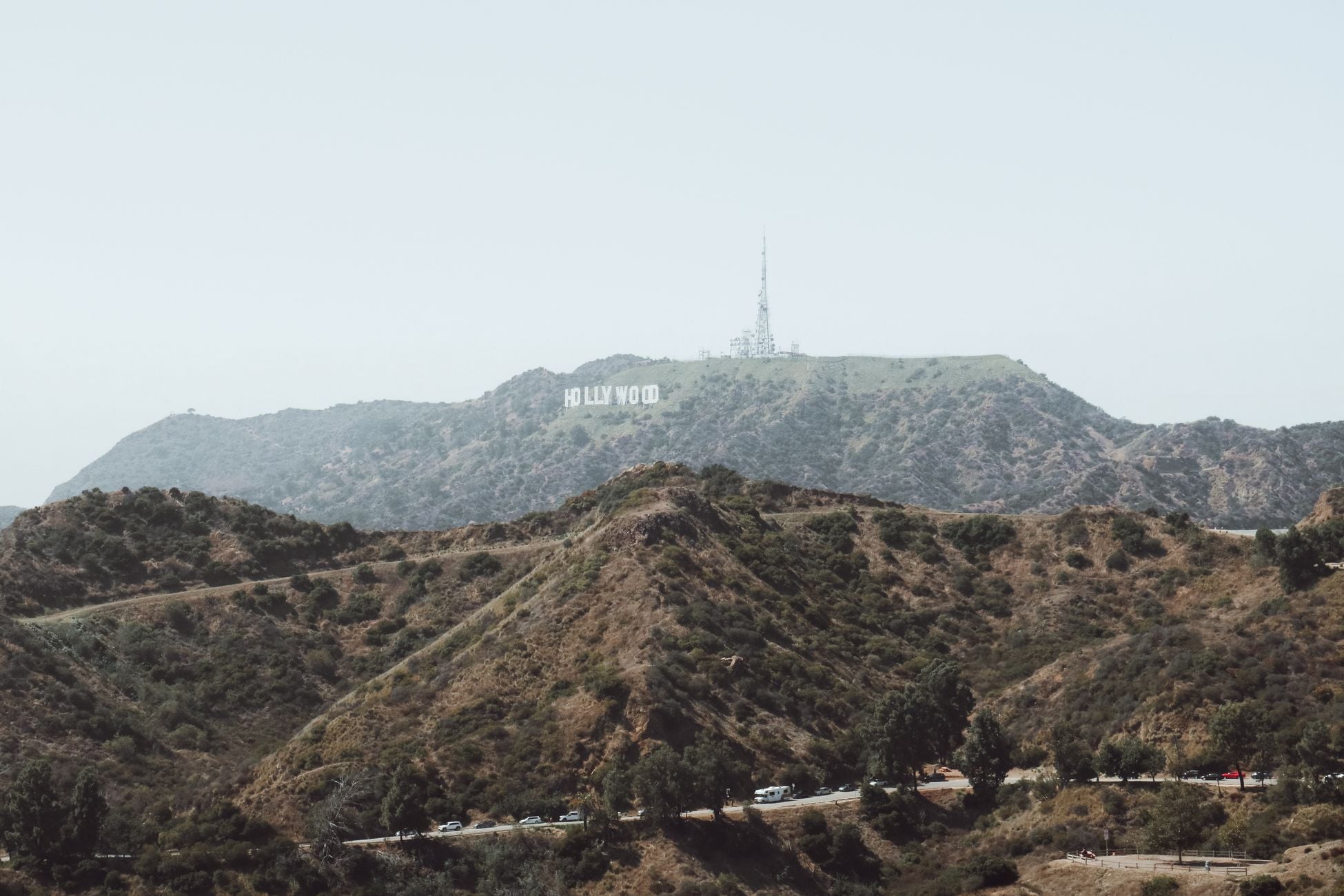
The sign cannot be visited up close. The hillside is fenced, alarmed, and patrolled. Tourists view it from official lookouts in Griffith Park, from nearby streets and trails, and from the Griffith Observatory area a few ridges to the east.
The current letters, the 1978 steel ones, are now older than the original wooden sign ever got to be. The 1923 advertisement stood for about 26 years before LAND came off. The replacement has now stood for nearly half a century. The temporary billboard erected to sell hillside lots in 1923 has, at this point, advertised nothing in particular for longer than most marketing campaigns, most buildings, and plenty of political eras. It just stayed where it was, because nobody made it leave.