
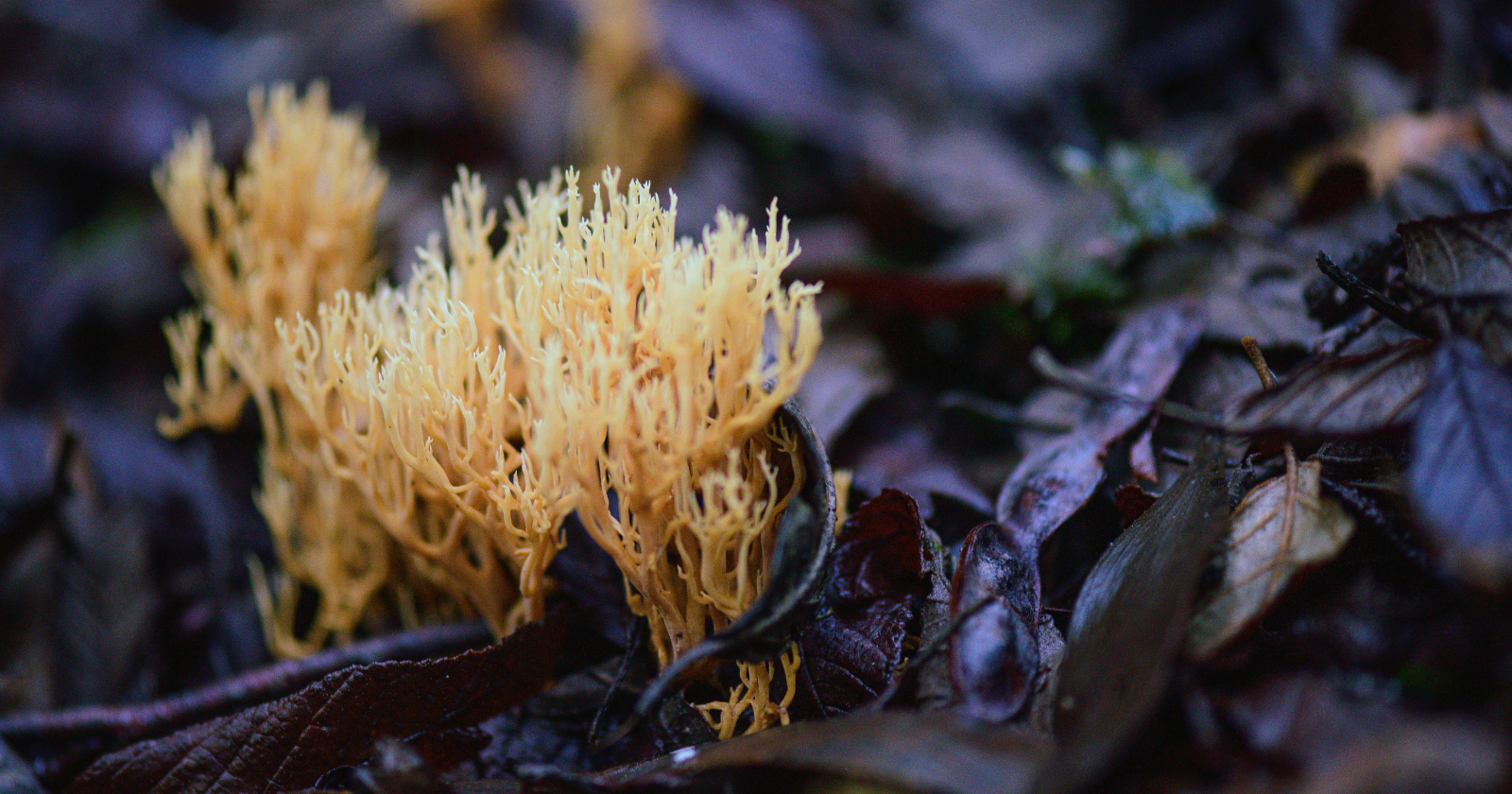
The first land plants did not have roots. They had stubby green tissue pressed against bare Ordovician rock about 450 million years ago, and the only reason they survived long enough to become ferns, then conifers, then oaks, was that a thread of fungus reached up out of the mineral grit and traded them phosphorus for sugar.
That trade is still happening under every forest on Earth right now.
The fungus is called a mycorrhiza, from the Greek for “fungus-root,” and it wraps around or pushes into the root cells of most land plants. The plant photosynthesises sugar in its leaves and sends some of it down to the fungus. The fungus, in return, extends a web of microscopic filaments called hyphae through the soil — far thinner and far longer than any root — and pulls in phosphorus, nitrogen, and water the plant could never reach on its own.
Pull a redwood out of the ground and you would be looking at half the organism. The other half is fungal, and it is busy.
A partnership older than wood
Wood, as a tissue, is around 380 million years old. Mycorrhizal symbiosis predates it by roughly 70 million years. Before plants invented bark, before they invented seeds, before they invented the upright stem, they had already invented the deal with the fungus.
The fossil record shows fungal structures inside the tissue of Aglaophyton and other early plants preserved in the Rhynie chert in Scotland, where arbuscules more than 400 million years old are morphologically identical to those forming in living roots today. The hyphae are coiled inside plant cells in exactly the same arrangement seen now in the roots of clover, wheat, and apple trees.
The genetic toolkit a modern plant uses to recognise and admit a mycorrhizal fungus is the same toolkit found in liverworts, which are among the most ancient plant lineages still alive. The handshake hasn’t changed in 450 million years.
Without it, the leap from algae to land plant probably never happens. Bare Ordovician rock had no soil in the modern sense — no humus, no decayed leaf litter, no earthworms. Phosphorus was locked in mineral form. A plant on its own had no way to get at it. A fungus did.
Two flavours of fungus
There are two main kinds of mycorrhiza, and most forests run on one or the other. Arbuscular mycorrhizal fungi push their hyphae directly into root cells and form tiny tree-shaped structures called arbuscules where the nutrient trade happens. They partner with grasses, most crops, and tropical trees.
Ectomycorrhizal fungi take a different approach. They wrap a dense sheath around the outside of fine roots and weave between cells without piercing them. Pines, oaks, beeches, birches, and most of the boreal belt run on ectomycorrhizas. The mushroom flush after autumn rain — chanterelles, porcini, fly agarics — is the fruiting body of that sheath, pushed up through the leaf litter to release spores.
A 2019 study in Nature that mapped more than a million forest plots confirmed these two as the dominant strategies shaping nutrient cycling and carbon storage across forest biomes, with ectomycorrhizal trees dominating cold, high-latitude and boreal forests and arbuscular types dominating warm tropical ones.
The wood wide web
In the 1990s, the Canadian forest ecologist Suzanne Simard ran an experiment in a British Columbia forest that became famous. She sealed paper birch and Douglas fir seedlings in bags and fed them carbon dioxide tagged with carbon-14 and carbon-13, then tracked where the labelled carbon went. Within the chase period, carbon from one tree turned up in the tissue of its neighbour — and the transfer ran through the fungal links connecting their roots.
The result, published in Nature in 1997, was the first field evidence that trees of different species could move carbon between themselves through a shared fungal network. Nature’s editors gave the cover story the label “wood wide web,” and the term stuck.
Later work, summarised by Scientific American, found that stressed and dying trees can route significant amounts of carbon into the network, and that the carbon ends up in the tissue of neighbours — sometimes of completely different species.
Whether the dying tree is “giving” anything, in any intentional sense, is a separate question. The carbon moves. That part is measured.
The mother tree question
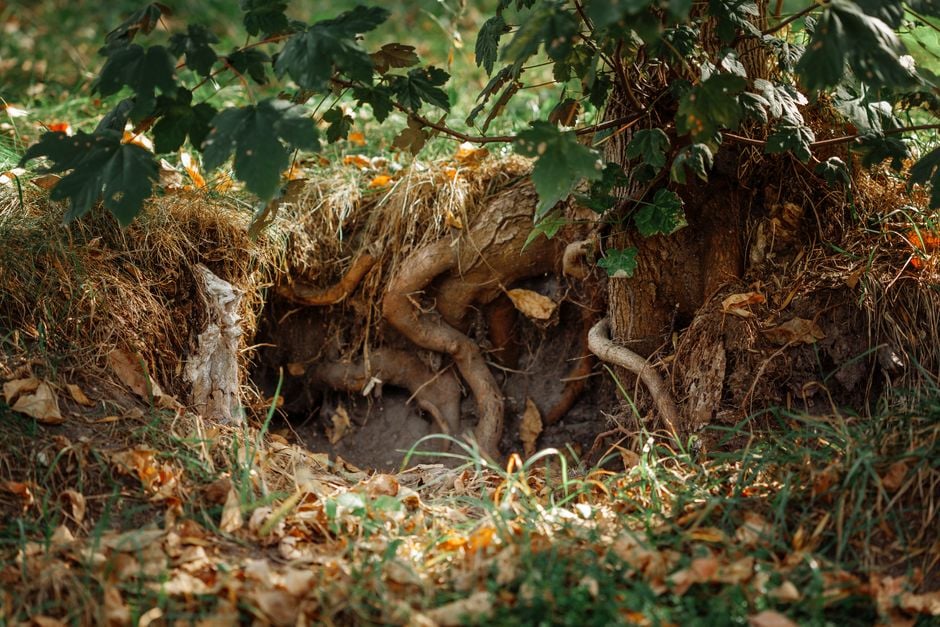
The popular version of the story goes further. Simard’s later work, and her 2021 book Finding the Mother Tree, argues that the oldest and largest trees in a forest act as hubs — sending sugar through the fungal network to their own seedlings, recognising kin, and orchestrating the health of the whole stand.
That framing has reached an enormous audience. It has also drawn a careful pushback from other ecologists, who think the evidence has been stretched.
A 2024 feature in Nature laid out the dispute in detail. After reviewing the field, Karst, Jones, and Hoeksema concluded that while shared fungal networks between trees clearly exist, the evidence that mother trees deliberately direct resources to their offspring is thinner than the public story suggests. Some of the most-cited studies, they argued, have not been replicated. Others measured carbon flow without confirming the fungal connection was the route it took.
A separate re-examination of the evidence published in 2023, led by Nils Henriksson at the Swedish University of Agricultural Sciences, reached a similar verdict. Networks exist. Carbon moves. The intentional, parent-to-child framing is doing more work than the data can carry.
The fungus, the critics point out, has its own interests. It is not a neutral pipe between trees. It is an organism trading for sugar, and where it sends what it pulls from the soil depends on which root is paying the best price at that moment.
That trading behaviour is one of the strangest things about mycorrhizal networks. Studies tracking nutrient isotopes have shown that fungi preferentially move nutrients toward plants that send back more sugar, and away from plants that try to freeload. The relationship looks less like a family and more like a market.
When a tree is stressed — shaded, defoliated, or dying — the documented pattern is that carbon and chemical signals move through the fungal network toward healthier neighbours, sometimes of different species. The fungus picks up the slack. The plant pays what it can.
So the forest floor is doing several things at once. It is a nutrient exchange. It is a slow communication channel, because some chemical signals do appear to travel through the hyphae. It is also a competitive marketplace in which a fungus connected to twenty trees is choosing, in some functional sense, which ones to favour.
How much of the forest is actually fungus
In a healthy temperate forest, the total length of fungal hyphae in the soil is immense — by some estimates, kilometres of fungal filament threaded through a single handful of dirt.
Most of the carbon a tree pulls out of the atmosphere through photosynthesis ends up, eventually, in the soil. A substantial fraction passes through fungal tissue on the way. The fungi themselves, when they die, leave behind sticky proteins that help bind soil into the crumbly structure that holds water and supports the next generation of roots.
Pull the fungus out and the soil collapses into dust. This has been observed in heavily ploughed agricultural fields, where decades of tillage and fungicide use have stripped the mycorrhizal community down to a fraction of what a nearby uncultivated patch holds.
What’s at stake underground
Most conservation work happens above the soil line. Trees get counted. Birds get counted. The fungi do not. A 2026 report in High Country News noted that mycorrhizal communities across the foothills of California’s Sierra Nevada, Oregon’s Willamette Valley, and the Columbia River Gorge have almost no formal protection, despite playing a measurable role in how much carbon those forests can hold — with roughly 90 percent of mapped fungal hotspots lying outside protected areas.
Conservation advocates have been mapping fungal hotspots — places where mycorrhizal diversity is unusually high — and arguing that conservation policy should treat them the way it treats coral reefs. So far, no jurisdiction has done so.
The trees, in the meantime, keep paying their fungal partners in sugar. The fungi keep pulling phosphorus out of the rock. The exchange has been running, with interruptions for ice ages and asteroid impacts, since before there were leaves.
If you stand in a redwood grove and put your hand on the bark of a tree that started growing during the Roman Empire, you are touching one end of a partnership that started when the continents were in different places and nothing on land had yet figured out how to grow taller than a thumb. The other end is somewhere under your boots, threaded through a few grams of dirt, still trading.