
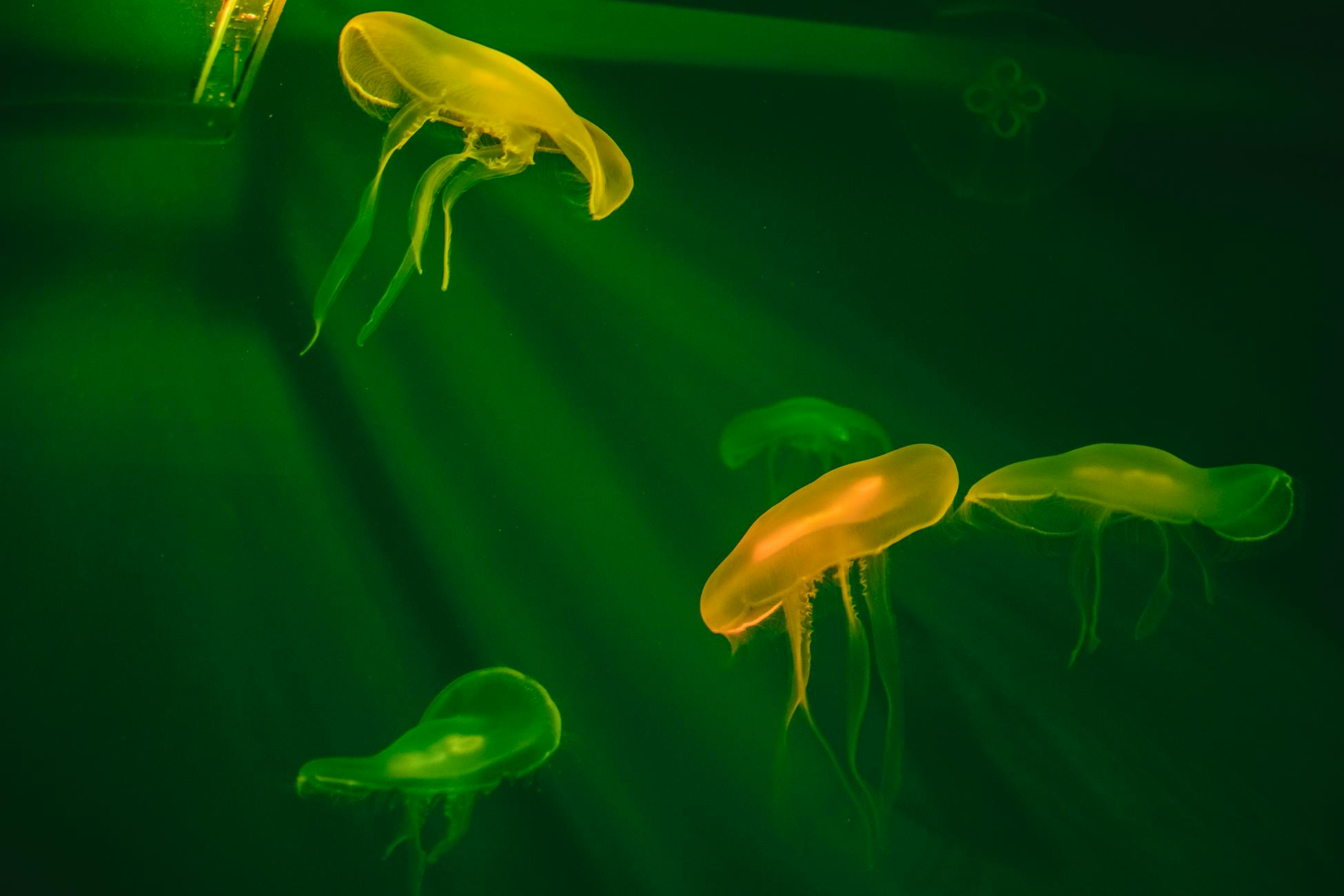

In a lab tank at the Shirahama Aquarium on the Pacific coast of Japan, a jellyfish smaller than a pinky nail is doing something no other animal is known to do reliably. When the biologist Shin Kubota stresses it — by starving it, puncturing its bell, or shifting the water temperature — Turritopsis dohrnii shrinks, drops to the bottom of the tank, and over the next few days reorganises its adult cells into a juvenile polyp colony, the equivalent of a frog turning back into a tadpole, or a butterfly into a caterpillar. Kubota has watched individual specimens go through this reset more than ten times in a row, and biologists have yet to identify any natural limit to how many times a single animal can do it.
The species is roughly the size of a contact lens — about 4.5 millimetres across when fully grown, with a translucent bell and a bright red stomach visible through the jelly. It drifts in coastal waters from the Mediterranean to Japan to the Caribbean, eating plankton and fish eggs. None of that is remarkable. The trick is what happens when something goes wrong.
The reverse life cycle, in slow motion
Most jellyfish follow a strict, one-way developmental script. A fertilised egg becomes a swimming larva called a planula. The planula settles on a hard surface and grows into a polyp, a tiny stalk anchored to rock or shell. The polyp eventually buds off free-swimming medusae — the umbrella-shaped adults most people picture when they hear the word jellyfish. The medusa spawns, ages, and dies. Forward only.
Turritopsis dohrnii can run the script in reverse. When the adult medusa is injured, starved, or otherwise pushed past its tolerance, its bell contracts and its tentacles retract. Within hours the animal sinks. Over the next 24 to 72 hours, its specialised adult cells — muscle, nerve, digestive — undergo what biologists call transdifferentiation, shedding their identities and reassembling as the cells of a polyp. From that polyp, new medusae will eventually bud off, genetically identical to the original adult that triggered the reset.
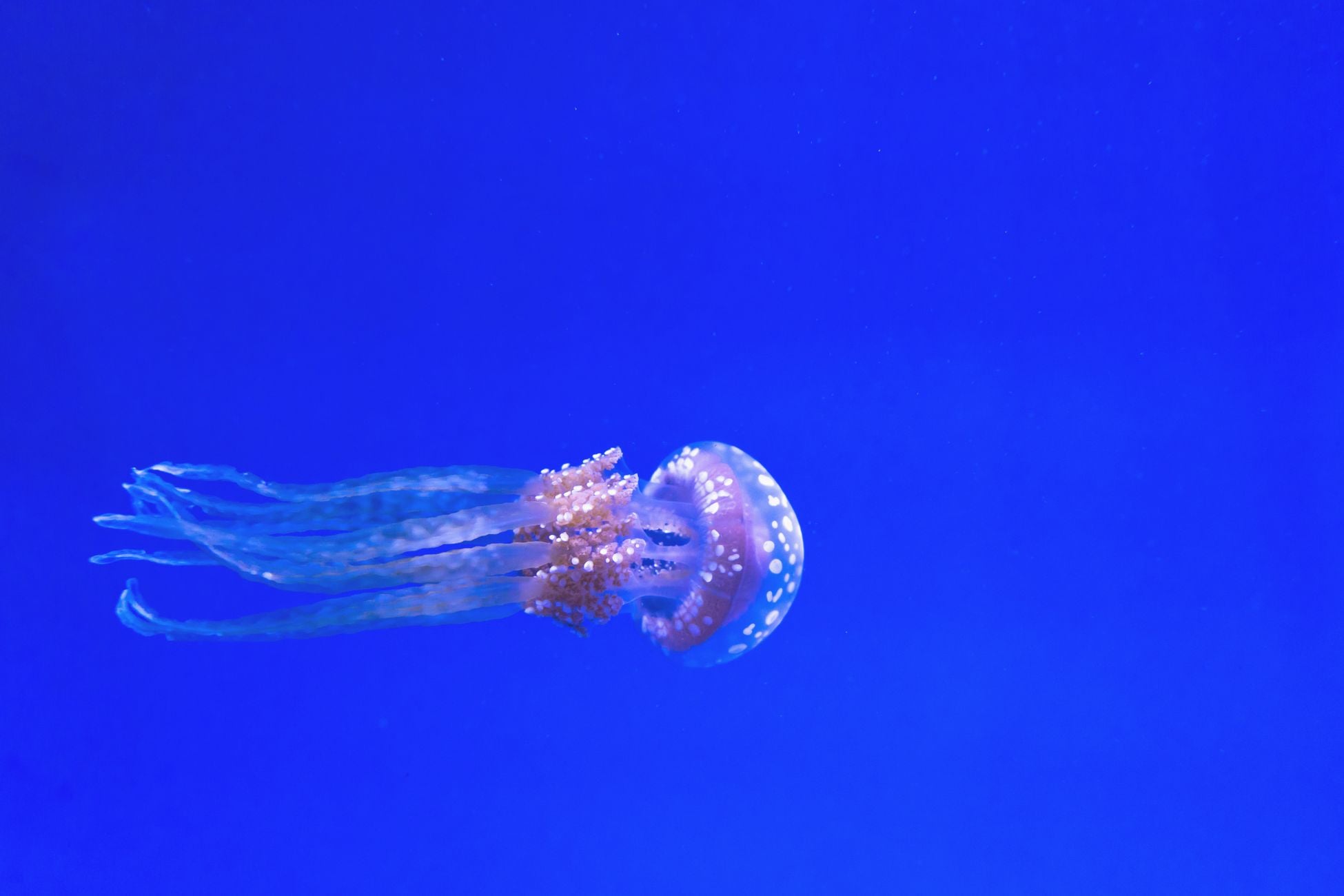
The closest familiar analogy is a chicken turning back into an egg, except the chicken does it on purpose and walks away from the experience as a brand-new chick. In the wild, the same individual could in principle cycle through this loop indefinitely, as long as something doesn’t eat it first.
How a biologist noticed
The discovery was an accident. In the late 1980s, a German marine biology student named Christian Sommer was studying hydrozoans at a station in Rapallo, on the Italian Riviera, and kept a batch of Turritopsis medusae in jars. They refused to die. Instead of decaying, the stressed adults kept reorganising themselves into polyps that then produced new medusae. Sommer and his colleagues published the observation in 1996, and the species went from biological curiosity to one of the most-studied animals in cellular senescence research.
Shin Kubota at Kyoto University has cultivated the species in lab tanks for decades. He has reported individual jellyfish that completed the reversal more than ten times within a two-year span, and he has spent so much of his life on the animal that he writes pop songs about it in his spare time. He is one of the few people in the world who can reliably keep them alive in captivity, where they are notoriously fragile.
What “immortal” actually means here
The word immortal does a lot of misleading work in the headlines. A Turritopsis dohrnii medusa can still be eaten by a fish, crushed by a wave, or killed by disease. What it appears to lack is the internal countdown — the senescence — that limits the lifespan of nearly every other animal. As biologists who study the species point out, calling it immortal is shorthand for biologically non-ageing under controlled conditions, not invulnerable.
The distinction matters because most animals carry hard cellular limits. Human cells stop dividing after roughly 50 replications, a ceiling called the Hayflick limit. Telomeres shorten. DNA damage accumulates. Senescent cells pile up in tissues and gum up the works. Turritopsis dohrnii, somehow, sidesteps the whole process by erasing the adult body and rebuilding from a juvenile stage.
The genetic homework
In 2022, a team led by Maria Pascual-Torner and Carlos López-Otín at the University of Oviedo in Spain published the first comparative genome of Turritopsis dohrnii against its close cousin Turritopsis rubra, which cannot reverse its life cycle. They found that the immortal species carries roughly twice as many copies of genes involved in DNA repair and telomere maintenance, plus distinctive variants in genes that regulate the cellular machinery for replication and stem-cell pluripotency.
The genomic comparison suggested that the reversal is not powered by one master switch but by dozens of small advantages stacked together — better repair, better silencing of damaged regions, a more flexible cellular identity. The jellyfish is not cheating physics. It is, on a molecular level, doing the boring janitorial work other animals stop doing as they age.
Why this isn’t a path to human immortality
The leap from a 4.5-millimetre cnidarian to a 70-kilogram mammal is enormous, and not just in scale. Turritopsis dohrnii has no central nervous system, no skeleton, no organs in any meaningful sense, and no continuous memory or identity across its life cycle. When an adult medusa reverts to a polyp, whatever counted as that animal — its position in the water column, its accumulated experience of light and current — is wiped. A new medusa buds off later carrying the same DNA but no continuity with the one that triggered the reset.
For a human, that is not life extension. It is closer to dying and being replaced by a clone who shares your fingerprints. The biology is fascinating and the molecular mechanisms — transdifferentiation in particular — are real targets for regenerative medicine. But the marketing image of a jellyfish-derived anti-ageing pill is several rungs of plausibility removed from anything in the literature.
The cells that change their minds
Transdifferentiation, the trick at the centre of the whole story, is what makes the species genuinely strange. Most differentiated cells in adult animals are locked in. A muscle cell stays a muscle cell. A liver cell stays a liver cell. The mammalian exceptions are rare and usually pathological — cancer is partly a story of cells losing their identity in the wrong way.
In Turritopsis dohrnii, transdifferentiation is controlled and reproducible. The medusa’s striated muscle cells become smooth muscle cells, then nerve cells, then polyp tissue, in a coordinated sequence. Researchers studying the process have called it one of the cleanest natural examples of cellular reprogramming known, and it happens without the artificial gene cocktails that human stem-cell research depends on.
A globe-spanning hitchhiker
The species’ geographic range has expanded dramatically over the past few decades, largely by accident. Tiny polyps colonise the inside of ships’ ballast tanks, ride across oceans, and seed new populations when the tanks are flushed. Originally described in the Mediterranean, Turritopsis dohrnii has now been documented along the coasts of Japan, the eastern United States, the Caribbean, the Atlantic side of Spain, and parts of the Pacific. Genetically, the populations remain remarkably similar, which suggests the spread is recent and ongoing.
None of this would be possible without the reversal trick. A polyp stuck to the inside of a ballast tank, starved of plankton and shifted between water temperatures, would simply die — in any other species. In this one, hardship is the cue to reset and try again on the other side of the ocean.
What still isn’t known
The hardest question is also the simplest: how many times can a single individual actually do this? Kubota has documented more than ten cycles in lab conditions. Other teams have reported similar numbers. No upper limit has ever been observed, but tracking the same individual across many reversals is logistically miserable — the animal is a few millimetres across, drifts in and out of polyp stages, and looks identical to every other member of its species. There is no way to tag it.
What biologists can say with confidence is that no internal mechanism has yet been identified that would prevent unlimited cycles. The DNA repair stays sharp. The telomere maintenance keeps up. The cellular reprogramming machinery does not appear to wear out. Whether that holds for a thousand cycles or ten thousand is, for now, an open empirical question rather than a theoretical one.
Somewhere off the coast of Italy or Japan, in a patch of water no bigger than a teacup, there is almost certainly a Turritopsis dohrnii medusa that has already gone through the reset more times than any researcher will ever count. It is the size of a pinhead. It glows faintly red around its stomach. And it has, by every available measure, no particular reason to stop.