
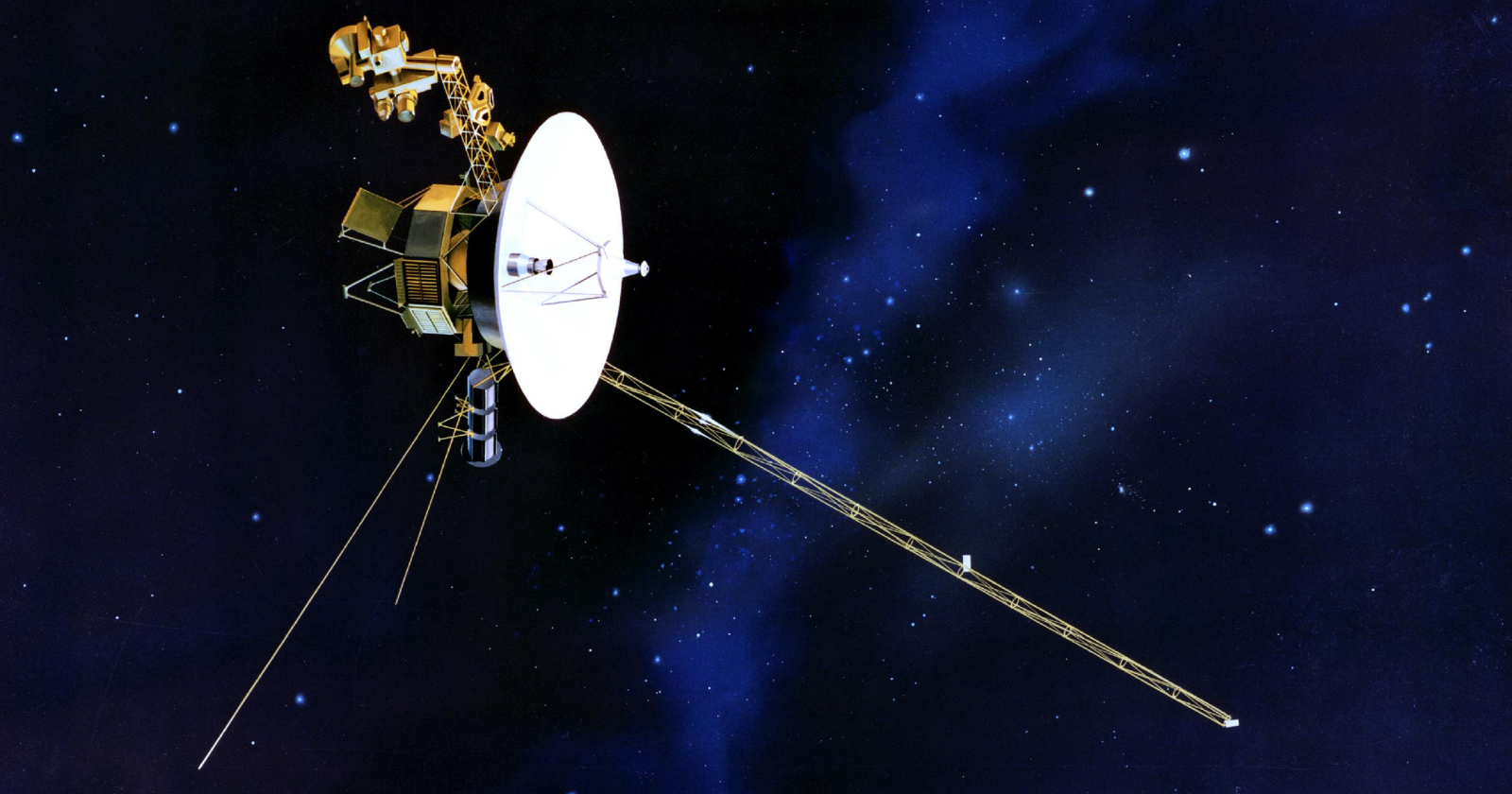

Voyager 1 launched on 5 September 1977. Nearly forty-nine years later it is still operating, about 25 billion kilometres from Earth, roughly 16 billion miles, in the region beyond the Sun’s heliosphere that NASA describes as interstellar space. It remains the most distant human-made object ever built, and it is still returning data.
The detail that tends to get repeated is the size of its memory. The three computers aboard each Voyager hold a combined 69.63 kilobytes, a figure NASA’s engineers have cited directly. A single photograph taken on a current smartphone is several megabytes. The spacecraft’s entire memory would not hold a fraction of one such image.
It is worth resisting the obvious framing here. The interesting thing is not that a machine survived despite primitive computing. In several respects the simplicity is part of why it lasted. But that same small memory has also been a genuine operational problem, and the spacecraft is now in a managed decline rather than an open-ended one.
What is actually onboard
Voyager 1 carries three computer systems: the Computer Command System, the Flight Data Subsystem, and the Attitude and Articulation Control System. They were built before 1977, from the discrete logic chips of the era. There is no microprocessor in the modern sense and no operating system.
That austerity was not a limitation the designers reluctantly accepted. A computer with no operating system has no operating system to crash. Memory held in simple, radiation-tolerant circuitry copes with deep-space conditions better than denser modern hardware would. The Voyagers were designed for a five-year mission to Jupiter and Saturn. The fact that the hardware has kept working for almost half a century owes something to how little there was to go wrong.
When the small memory became a problem
The cost of that design showed itself clearly in late 2023.
On 14 November 2023, Voyager 1 stopped sending readable science and engineering data. The spacecraft was still receiving commands, but what it transmitted back was unusable. NASA’s Jet Propulsion Laboratory traced the fault to the Flight Data Subsystem, the computer that packages data before transmission. A single chip storing part of the FDS memory, including some of its software code, had failed.
On Earth, an engineer would replace the chip. That was not an option 25 billion kilometres away, so the team had to move the affected code elsewhere in the FDS memory. The difficulty was that no single free location was large enough to hold it. Engineers split the code into sections and placed them where space could be found, after first identifying functions the spacecraft no longer needed. The size of the memory, as the Voyager project scientist Linda Spilker told IEEE Spectrum, was the biggest challenge in the whole repair. Voyager 1 resumed returning usable data on 20 April 2024, after roughly five months.
Why it is slowing down now
The more pressing constraint is not memory but power.
Voyager 1 is powered by radioisotope thermoelectric generators, which produce electricity from the heat of decaying plutonium-238. The output falls steadily. NASA puts the loss at about 4 watts each year, and after nearly five decades the margins have become very thin.
The team’s response has been to switch instruments off in a planned sequence. Of the ten science instruments Voyager 1 carried, eight have now been turned off. In April 2026, JPL sent the command to shut down the Low-Energy Charged Particles experiment, a decision the mission manager Kareem Badaruddin described in a NASA release as the best option available. That shutdown followed a routine roll manoeuvre on 27 February 2026, during which the spacecraft’s power dropped unexpectedly and came close to triggering its automatic fault-protection system.
Two science instruments remain in operation on Voyager 1: one that measures magnetic fields and one that records plasma waves. They continue to send back readings from a region no other working spacecraft has reached.
What is next
NASA has said that, with this power-conservation approach, the two Voyagers could continue operating at least one science instrument into the 2030s. That is a projection, not a guarantee, and the agency has been explicit that unforeseen problems on hardware this old could end either mission sooner.
Engineers are also preparing a more substantial intervention, referred to within the team as the “Big Bang”, which would reconfigure a set of powered components at once and bring lower-power alternatives online. The aim is the same as every step before it: to keep the spacecraft returning data from interstellar space for as long as the falling power budget allows.
The next milestones to watch are straightforward. Whether the remaining instruments survive the next scheduled power reductions, whether the “Big Bang” reconfiguration is carried out and works, and how long the magnetometer and plasma wave subsystem keep transmitting, will between them decide how much further this 1977 machine reports back before it goes quiet.