
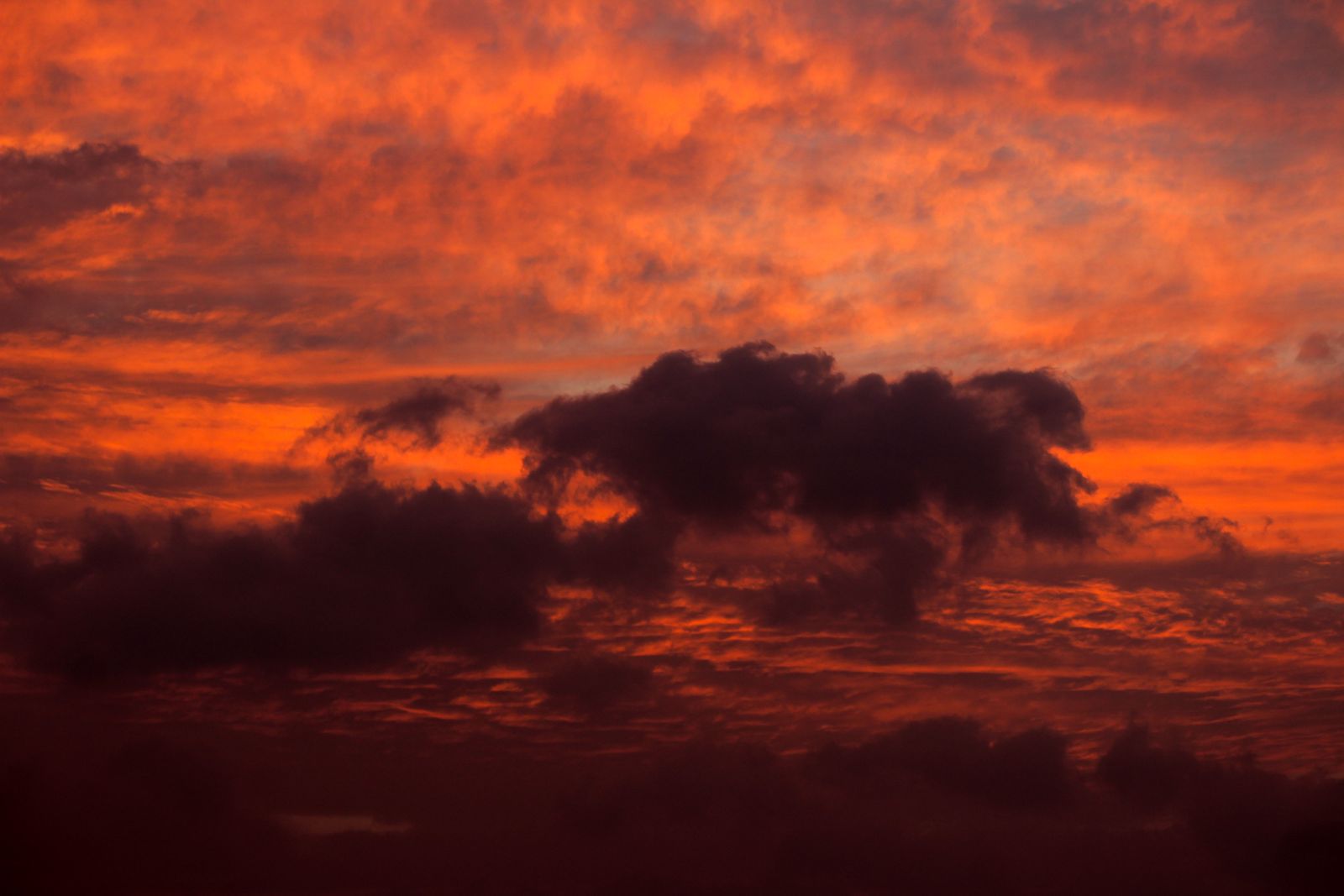
Astronauts on the International Space Station describe the Sun the same way, over and over: a hard, colourless white, painful to look at, with none of the friendly yellow it wears in a child’s drawing. That is the honest colour of the star. The yellow, the gold, the deep orange of a low sunset — all of it is added by the thin shell of gas the light passes through in the last hundred kilometres of a 150-million-kilometre trip.
The Sun is a G-type main-sequence star with a surface temperature of about 5,772 kelvin. A blackbody at that temperature radiates across the entire visible spectrum, with a broad peak near green-yellow wavelengths around 500 nanometres. When those wavelengths are added together, the human eye perceives the mixture as white. NASA’s Sun fact sheet lists that effective temperature directly, and the Sun’s G2 V classification corresponds, in astronomy, to a white star rather than a yellow one. Stars that do take on a genuinely warm tint to the eye — the orange K-type dwarfs — are noticeably cooler, closer to 4,000 kelvin.
What the atmosphere does to sunlight
The colour shift happens because air is not perfectly transparent. Nitrogen and oxygen molecules are much smaller than the wavelength of visible light, and when a light wave passes one of them, the molecule briefly re-radiates it in a new direction. This is Rayleigh scattering, worked out by Lord Rayleigh in the 1870s, and its defining feature is a strong wavelength dependence: the probability of scattering rises as roughly 1/λ⁴. Violet and blue light, with short wavelengths near 400–450 nanometres, are scattered several times more strongly than red light near 700 nanometres. NASA’s educational material on why the sky is blue lays out the same physics in plain terms.
Two things follow from that lopsided scattering. The blue light bounces around the sky in every direction before finally reaching the ground, which is why the sky itself glows blue rather than being black with a single bright disc in it. And the beam of light that arrives directly from the Sun has had some of its blue subtracted out along the way. What remains is slightly biased toward the longer, warmer wavelengths — yellow, and, when the Sun is low, orange and red.
Why sunsets are redder than noon
The effect gets stronger as the Sun drops toward the horizon because the path length through the atmosphere grows dramatically. Directly overhead, sunlight passes through roughly one atmosphere’s worth of air. Ten degrees above the horizon, it passes through about five and a half. At the horizon itself, closer to thirty-eight. Every extra kilometre of air scatters more of the remaining blue and green out of the beam, until what reaches the eye is almost entirely the long-wavelength tail: deep orange, then red.
Aerosols — dust, sea salt, smoke, volcanic sulphate — sharpen the effect further. Larger particles scatter more evenly across colours (Mie scattering), but they also absorb, and they extend the reddening into a broader, more saturated glow. After major eruptions, sunsets around the world turn vivid for months; the 1883 Krakatoa event produced sunsets so intense that fire brigades in the eastern United States were called out to non-existent fires, a story documented in Oregon State University’s Volcano World account of the 1883 eruption.
Why photographs of the Sun look yellow anyway
If the Sun is white, why do so many images — including some from spacecraft — show it as yellow or orange? Partly convention, partly instrumentation. Solar telescopes such as NASA’s Solar Dynamics Observatory observe in narrow ultraviolet and extreme-ultraviolet bands that the eye cannot see at all; the golds, teals and reds in those images are false colours assigned to specific wavelengths of ionised iron or helium. Even visible-light images are often white-balanced, or tinted for legibility, or simply presented the way audiences expect the Sun to look. A properly exposed photograph of the Sun taken through a neutral solar filter, with correct white balance, shows a flat white disc.
The Moon offers a useful sanity check. Moonlight is reflected sunlight, and the Moon’s surface is a dark grey. Yet the full Moon high in the sky looks nearly white to the eye, because at that altitude the atmospheric path is short and little of the blue has been scattered away. Near the horizon, the same Moon turns orange for the same reason a low Sun does.
What the eye contributes
Part of the yellow impression is also in the observer. Human colour vision is strongly adaptive: the brain constantly renormalises what it calls “white” against the ambient light. On a clear day, the sky adds a huge amount of scattered blue to the scene, and the visual system compensates by shifting its white point toward the blue end. Relative to that adjusted baseline, the direct beam of the Sun appears warmer — more yellow — than it really is. Under an overcast sky, where the diffuse light is closer to neutral, the Sun (when it briefly appears) looks noticeably whiter. The same neural machinery makes tungsten bulbs look white indoors and orange through a window from outside.
Sunlight is a good example of how much of the sensory world is actually engineered by the medium between object and observer. The colour of the sky, the colour of the Sun, and the colour of a sunset are three faces of the same physics: short wavelengths scatter more than long ones, and the length of the air column decides how far that process has gone. It is the same class of everyday optical accounting that explains why noise-cancelling headphones can erase a sound by playing its inverse, or why Saharan dust ends up fertilising the Amazon: the interesting behaviour is happening in the space between things, not at the endpoints.
A star seen honestly
Seen from Mercury or from the vacuum outside the ISS, the Sun is a small, blindingly white disc against black. Seen from the seafloor of a shallow reef at noon, filtered through both atmosphere and water, it is a shifting green-blue. Seen from a beach in the last minute before it sinks, it is red. None of those is the star’s true colour; each is a record of what the intervening medium did to a broad spectrum of white light on its way through.
The yellow Sun of children’s drawings is not wrong so much as local. It is the Sun as filtered by a particular planet’s air, viewed by a particular kind of eye, and remembered by a brain that has decided, reasonably enough, that daytime should look warm.