
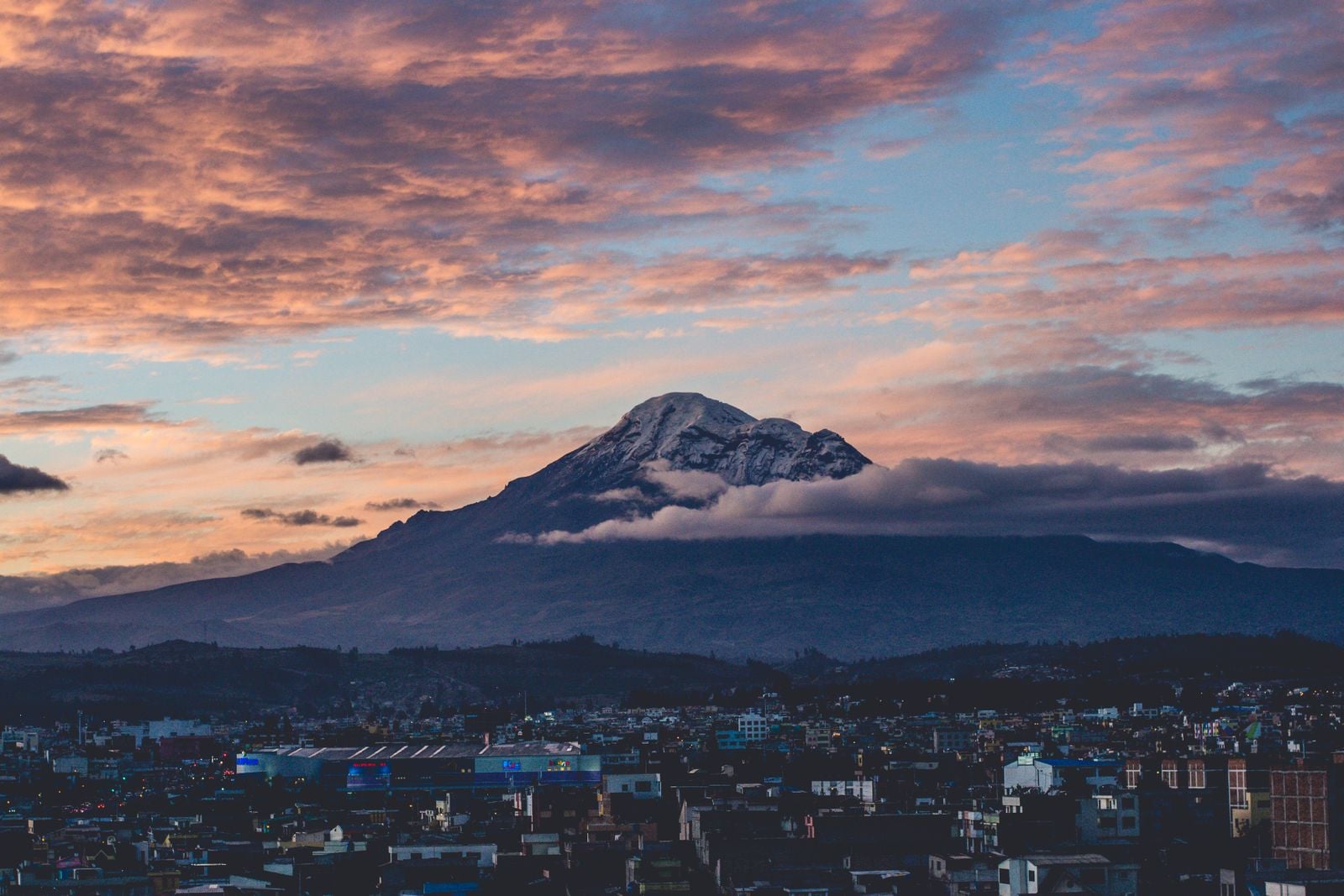

Stand on the summit of Mount Everest and, by the measurement most people mean when they say “the highest point on Earth,” nothing on the planet is above you. Stand on the summit of Chimborazo, a dormant volcano in the Ecuadorian Andes, and you are only 6,263 metres above sea level — nearly three kilometres shorter than Everest. Yet by another measurement, one that is arguably more honest about what a planet actually is, Chimborazo’s peak is about 2,072 metres further from the centre of the Earth than Everest’s. The mountain that reaches deepest into space is not in the Himalayas at all. It is a few degrees south of the equator, sitting on top of a bulge.
The bulge is real, measurable, and the direct consequence of the Earth spinning on its axis once a day. And once you know it is there, a surprising amount of geography — and a fair chunk of satellite engineering — starts to make more sense.
The Earth is not a sphere
Isaac Newton worked this out before anyone had been in a position to check. In the Principia, published in 1687, he argued that a rotating fluid body would not settle into a perfect sphere. Centrifugal effects at the equator, where the surface is moving fastest, would push material outward; the poles, spinning slowly around a fixed axis, would flatten. The Earth, still hot and deformable enough over geological time to behave a little like a fluid, ought to be an oblate spheroid — wider at the equator than pole to pole.
He was right. Modern geodesy, using satellite laser ranging and gravity missions like GRACE, has measured the difference precisely. Earth’s equatorial radius is roughly 6,378.1 kilometres. Its polar radius is roughly 6,356.8 kilometres. The equator sticks out about 21 kilometres further from the centre than the poles do. That is the bulge, and it is the reason Chimborazo wins.
Doing the arithmetic
Everest sits at 27.99 degrees north latitude, well outside the bulge. Its summit is 8,848.86 metres above sea level, based on the joint 2020 remeasurement by Nepal and China. Add that to the local radius of the Earth at that latitude and Everest’s peak lands about 6,382 kilometres from the planet’s centre.
Chimborazo sits at 1.47 degrees south latitude — almost exactly on the equator. Its summit is only 6,263 metres above sea level. But it is standing on ground that is already roughly 21 kilometres further from Earth’s centre than the ground under Everest. Do the sum and Chimborazo’s peak comes out at about 6,384 kilometres from the centre. The margin, roughly 2,072 metres, is not a rounding error. It is bigger than many mountains.
A 2016 Franco-Ecuadorian expedition led by the Institut de Recherche pour le Développement, working with Ecuador’s Instituto Geográfico Militar and the National Polytechnic School’s Geophysics Institute, confirmed the numbers to within a few metres using high-precision GPS on the summit. Chimborazo is the point on the solid Earth’s surface that is furthest from its centre. The runner-up, incidentally, is not Everest either but Huascarán in Peru — also Andean, also near the equator.
Why “sea level” is a strange ruler
The reason this feels counter-intuitive is that “height above sea level” quietly assumes sea level is a sphere. It is not. Sea level follows the geoid — the shape the oceans would take if they were free to flow across the whole planet under gravity alone, ignoring winds and tides. The geoid bulges at the equator too, because gravity there is slightly weaker (the extra distance from the centre reduces it) and because centrifugal effects push water outward the same way they push rock.
So when Everest is measured at 8,848.86 metres, it is being measured against a sea-level surface that is itself already tilted upward at the equator. The mountain is enormous compared with its local baseline. Chimborazo is more modest compared with its local baseline, but that baseline is already sitting higher, in an absolute sense, than the seas of Nepal ever could.
Both statements are true at once. Everest is the highest mountain above sea level. Chimborazo’s summit is the point of land that pokes furthest into space. They are answers to different questions.
The bulge shows up in orbit, too
The equatorial bulge is not just trivia for mountaineers. It is one of the most important terms in the equations that govern satellites. Because Earth is fatter around the middle, its gravity field is not perfectly symmetrical, and the dominant deviation — known to geodesists as the J2 term — pulls on any orbiting object slightly harder when it is over the equator than when it is over a pole.
Over many orbits, that asymmetry causes the plane of a satellite’s orbit to slowly rotate, an effect called nodal precession. Mission designers use it deliberately. Sun-synchronous orbits, used by most Earth-observation satellites, are chosen at exactly the altitude and inclination where the bulge’s tug drags the orbital plane around at one revolution per year, keeping the satellite passing over any given latitude at the same local solar time every day. The bulge is not a nuisance in that case; it is the mechanism.
The same term is what has to be modelled precisely for GPS receivers to know where they are to within a few metres. If engineers pretended Earth were a sphere, positions would drift by kilometres within days.
Standing closer to the Sun
There is one more consequence worth savouring. A climber on Chimborazo’s summit is not only further from the Earth’s centre than a climber on Everest — they are also, on average, marginally closer to the Sun, the Moon, and every star overhead. The difference is trivial in astronomical terms, a couple of kilometres out of 150 million to the Sun. But it is not zero.
Chimborazo is a mountain that quietly rewrites definitions. It is not the tallest by the ruler most maps use. It is the tallest by the ruler the universe uses, if the ruler in question is distance from a planet’s centre. And its existence is a reminder that Earth is not the tidy blue marble of the posters. It spins, and because it spins, it bulges, and because it bulges, an unassuming volcano in Ecuador is the closest anyone can walk to space without leaving the ground.
For more of the counter-intuitive physics of everyday things, see how Earth’s atmosphere is what turns a white Sun yellow, or how noise-cancelling headphones cancel sound by generating its exact mirror image.