
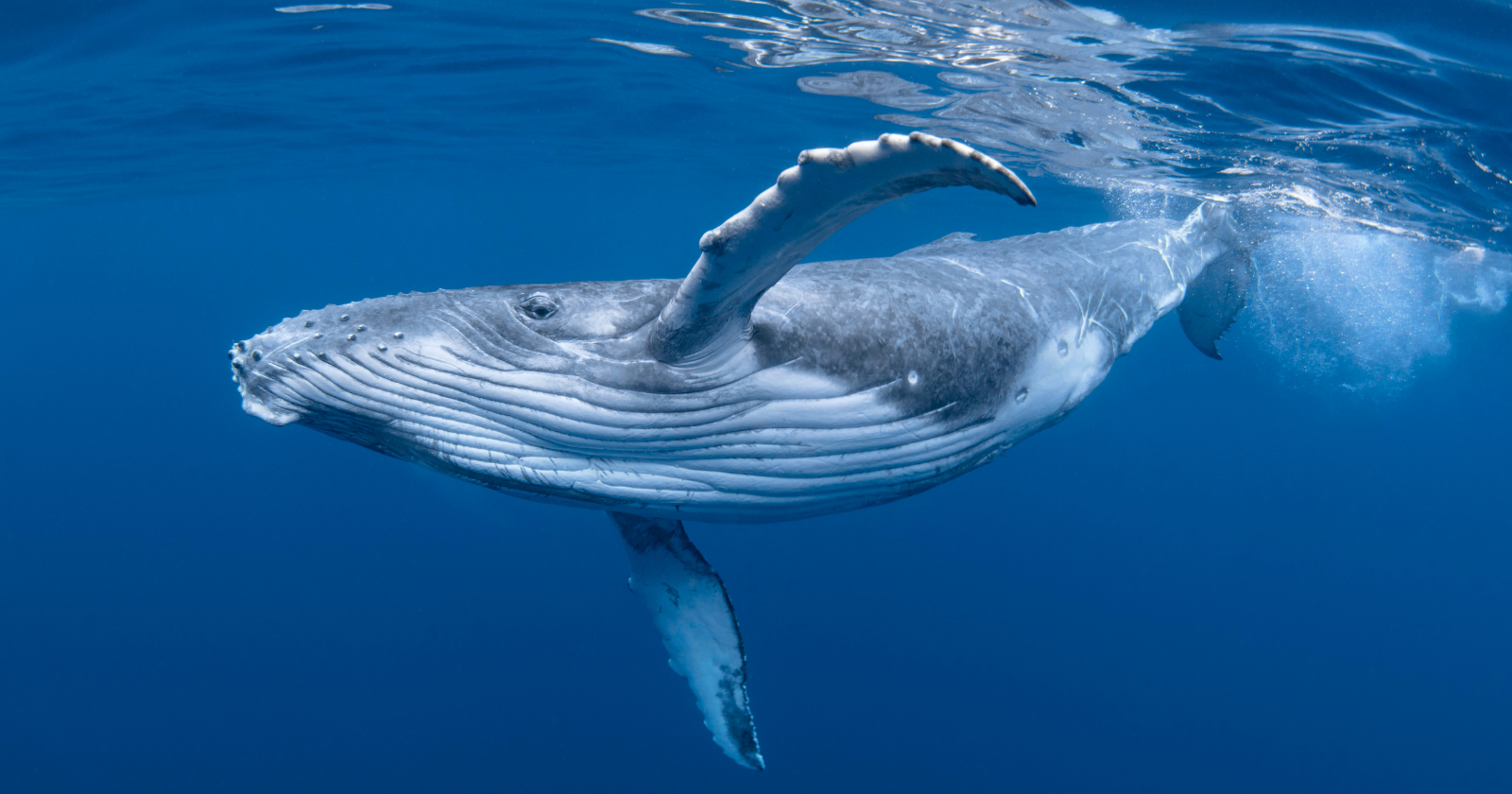

In 1989, a network of underwater microphones picked up a sound in the North Pacific that nobody could explain.
The microphones weren’t built to listen for whales. They were a Cold War system, installed by the U.S. Navy to track Soviet submarines. But the sound they caught wasn’t a submarine. It wasn’t mechanical at all. It was, the technicians slowly realised, a living thing — a whale, calling out across the dark water.
What made it strange was the pitch. The call came in at 52 hertz, and no known whale calls at 52 hertz.
The marine biologist who first studied the recordings, William Watkins of the Woods Hole Oceanographic Institution, tracked the sound for years. It moved through the Pacific in patterns that resembled the migrations of blue and fin whales — but those whales call far lower, blue whales somewhere between 10 and 39 hertz, fin whales around 20. This animal was singing more than twice as high as the giants it appeared to be travelling among.
It was given a name: 52 Blue. And it became known, around the world, as the loneliest whale on Earth.
The whale nobody has ever seen
In more than three decades of tracking, no one has ever laid eyes on 52 Blue.
Everything known about the animal comes from sound alone — its call, picked up year after year by hydrophone networks, traced across thousands of miles of ocean. Nobody knows what it looks like. Nobody knows, for certain, what species it is.
The leading theory is that 52 Blue is a hybrid — the offspring of two different whale species, most likely a blue whale and a fin whale. Hybrids like this are known to occur, and a hybrid could plausibly inherit a vocal apparatus that produces a call unlike either parent species. Another possibility is some kind of malformation affecting the whale’s voice. Nobody can confirm either idea, because nobody has found the animal.
What scientists could do was listen. And listening, year after year, they noticed something. Across all that time, only one source has ever produced the 52-hertz call. The recordings never overlapped. There was never a second voice at that pitch answering the first.
One whale. One unanswered call. For decades.
What the loneliness story gets wrong
Here is where the popular version of the story needs correcting — because the way it’s usually told isn’t quite what the science says.
The myth holds that 52 Blue sings at a frequency no other whale can hear — that it is broadcasting, in effect, on a channel nobody else is tuned to, physically inaudible to its own kind.
That part isn’t true. And marine biologists are quite firm about it.
Christopher Clark, who directed the Bioacoustics Research Program at Cornell, has put it plainly: all whales — blue, fin, humpback — can hear 52 hertz perfectly well, because 52 hertz sits comfortably within their range of hearing. They aren’t deaf to it. The other whales in the North Pacific can almost certainly hear 52 Blue calling.
The real mystery is subtler, and it isn’t about hearing. It’s about recognition. 52 Blue’s call doesn’t match the structure of any known species’ song. So while other whales can hear it, scientists genuinely don’t know how they interpret it. Do they register it as another whale, a potential mate, one of their own? Or does it land as something unfamiliar — a noise that doesn’t fit, that carries no meaning, that there’s no reason to answer?
Nobody knows. That’s the actual open question. Not “can they hear him” — they can — but “does the sound mean anything to them when they do?”
Why the truth is sadder than the myth
The myth is sad in a simple, almost comforting way. A whale on the wrong frequency, calling into a silence that isn’t really anyone’s fault — just a quirk of acoustics, a tuning error.
The truth is harder. 52 Blue is not shouting into a void. The void can hear him. For thirty-odd years, this animal has been calling out across the Pacific, and other whales — real whales, within earshot — have heard those calls and, as far as the recordings show, simply have not answered.
That’s a lonelier picture than the myth. Not a broken radio. A voice that reaches other living creatures and doesn’t get a reply.
It’s worth saying that even this isn’t entirely settled. In 2010, sensors off the California coast picked up calls with a similar pattern detected in more than one place at once — raising the faint possibility that 52 Blue is not entirely alone, that there may be others, or at least one other. The evidence is thin and inconclusive. But it’s there, and scientists are honest about it.
There’s also a quiet detail in the data that does soften the story. Over the decades, 52 Blue’s call has gradually dropped in pitch — from 52 hertz down into the high 40s. Researchers believe this is simply the sound of an animal maturing. Whatever else is true, 52 Blue has lived a long life. It has grown up. It is, by every available sign, still out there.
Why this one whale matters so much to people
There is a reason this story has moved people for decades — why a documentary was made about it, why the filmmaker said people would grab his arm or go pale when he described it.
52 Blue is a near-perfect mirror for a particular human fear. The fear of calling out and not being answered. Of being surrounded by others of your kind, within earshot, and somehow still not reaching them. Of speaking in a way that’s heard but not understood.
The whale itself almost certainly experiences none of this the way we imagine. We are, as ever, pouring our own feelings into an animal that has its own reasons and its own inner life we can’t access.
But the facts underneath remain genuinely striking. Somewhere in the North Pacific, right now, there is one whale that has been calling for more than thirty years in a voice unlike any other — heard, it seems, by others of its kind, and so far unanswered by any of them.
It is still calling. That part, at least, is not sad. It means it is still alive, still out there, still singing.
Whether anything is finally listening back, the ocean has not yet told us.