

Get a Blurams Security Camera with Alexa for Just $25

We may earn a commission from links on this page.
Deal pricing and availability subject to change after time of publication.
Blurams Security Camera Featured

If you’ve been wanting to set up a security camera inside your home to keep an eye on your children, your parents, or an elderly family member but were afraid of the high cost, this is the answer for you. You can get a Blurams Security Camera with Alexa for just $25.49. At that price, you can outfit your home with two or three and still be under $100.

This camera will provide 360-degree coverage with an IR-CUT function for crisp images, no matter how dim the room is. For times when you don’t want to be sharing what’s happening around the camera, turn the privacy mode on. The 24/7 continuous video recording (CVR) will keep a non-stop recording stored in the cloud, so you don’t have to worry about losing important footage. Search for a specific event by time or event type. Alternatively, it supports a micro SD card up to 128GB and works only on 2.4 GHz Wi-Fi.
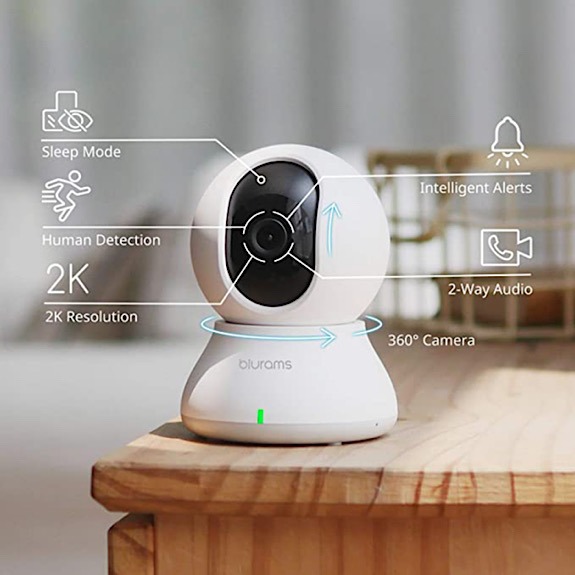
Blurams Security Camera Specs

The Blurams Security Camera with Alexa features smart AI detection with instant alerts to your phone if human motion or an odd sound is detected inside your home. Record a 10- to 15-second alert video to the cloud, which will be saved for 24 hours. Two-way audio will allow you to speak sweetly to your child or pet at any time and listen in to how they are doing.

The enhanced Blurams app or official web portal can help you keep your eye on up to four cameras simultaneously. You can share your camera feed with an unlimited number of people. Use voice commands through Alexa or Google Assistant to instruct the camera to live stream to a device with a screen. It also works with IFTTT.

Take 49% off the price of this security camera and pay just $25.49. No subscription or monthly fees are required.

Blurams Security Camera with Alexa

Make Tech Easier may earn commission on products purchased through our links, which supports the work we do for our readers.

Subscribe to our newsletter!

Our latest tutorials delivered straight to your inbox

Laura Tucker Avatar

Read next

Mycorrhizal fungi colonised plant roots roughly 450 million years ago and biologists now suspect plants could never have moved out of the oceans onto bare rock without them, meaning every forest on Earth — including the redwoods, the Amazon, and the boreal belt — is still running on a partnership older than trees themselves
Suzanne Simard sealed paper birch and Douglas fir seedlings inside plastic bags, fed them carbon-14 and carbon-13 dioxide, and nine days later found carbon had crossed between species through fungal threads in the British Columbia soil beneath her boots
A species of jellyfish called Turritopsis dohrnii can revert its adult cells back to a juvenile polyp stage when injured or starving, effectively restarting its life cycle, and biologists have so far failed to identify any natural limit to how many times it can do this.
French scientist Michel Siffre spent two months alone in a cave with no clock, no calendar, and no sunlight — and when his team finally told him the experiment was over, he thought he still had nearly a month left underground
When Cingular chief Stan Sigman backed the original iPhone before its 2007 unveiling, he accepted terms American carriers usually refused: no logo on the device, no control over its software, no preloaded apps, and a share of monthly subscriber revenue flowing back to Apple, after signing on without seeing a prototype
In 2016, archaeologists dated two rings of snapped stalagmites in France’s Bruniquel Cave to 176,500 years ago, evidence that Neanderthals had walked 336 metres into darkness with fire and built architecture deep underground long before modern humans reached Europe
Otto von Bismarck was 74 when Germany adopted the world’s first national old-age social insurance program in 1889, setting the pension age at 70 after years of fighting socialists with bans, laws, and a promise few workers would live long enough to use
When cosmonaut Valeri Polyakov stepped out of his Soyuz capsule in March 1995 after 437 consecutive days aboard Mir, doctors recorded him at several centimetres above his pre-flight height, and his spine had become so unaccustomed to gravity that the recovery team carried him to a chair rather than risk the compression of letting him walk.