
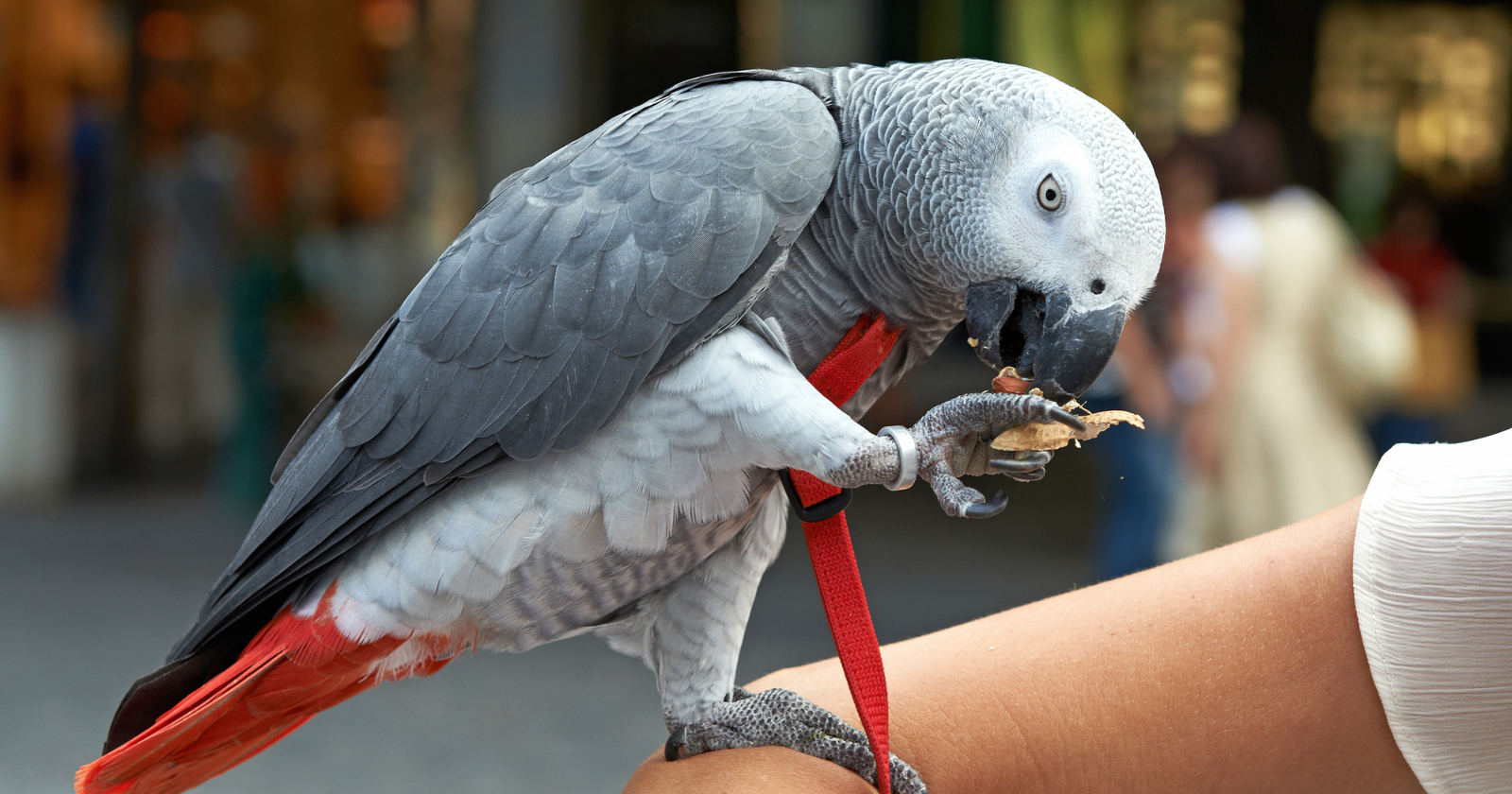

In 1977, a young scientist named Irene Pepperberg walked into a Chicago pet shop and asked the assistant to choose a parrot for her at random.
She didn’t want to be accused, later, of having hand-picked an unusually gifted bird. She was about to attempt something most of her field considered close to absurd: to find out whether a creature with a brain the size of a walnut could not just mimic human speech, but actually understand it.
The parrot she walked out with was an African Grey. She named him Alex — an acronym for Avian Language Experiment. Over the next thirty years, that bird would overturn one of science’s most confident assumptions about the gap between humans and animals. And in one quiet moment in front of a mirror, he would do something no other animal has ever been documented doing.
What Alex could actually do
Before Pepperberg’s work, the phrase “bird brain” was an insult for a reason. Birds were assumed to be incapable of real thought — their tiny brains were thought to allow imitation at best, but nothing resembling comprehension.
Alex demolished that assumption, piece by piece, over three decades of patient work.
By the end of his life, he had a working vocabulary of more than a hundred English labels. He could identify around fifty different objects. He knew seven colors and several shapes. He could count quantities up to six, and later higher. He understood the concept of bigger and smaller, and of same and different — genuine abstract concepts, not just memorized words.
The crucial point, the one Pepperberg spent years proving to skeptical colleagues, was that Alex wasn’t merely parroting. Shown two objects and asked what was different about them, he could answer “color” or “shape.” Shown objects that were identical, he could say “none” — demonstrating that he grasped the abstract idea of difference itself, including its absence. He was reasoning, not reciting.
But the single most remarkable thing Alex did wasn’t about answering questions. It was about asking them.
The thing the apes never did
For decades, researchers had taught language-like systems to great apes — chimpanzees, gorillas, bonobos. These projects produced genuinely impressive results. The apes learned signs, answered questions, made requests.
But there was one thing, Pepperberg noted, that the apes never did. They never asked a question. They responded, sometimes brilliantly, to the questions humans put to them — but as far as the documented research shows, none of them ever turned the process around and queried their human handlers to learn something they wanted to know.
Alex did. Routinely.
He worked out, somewhere along the way, that the words he had could be used as tools to get more words. He learned the label “carrot,” by Pepperberg’s account, by asking the humans what they were eating. He learned “orange” by asking what color the carrot was. He would demand toys from new student volunteers, seemingly to test whether they knew the right names for things. He grasped something that had never been documented in any other animal: that a question is a key, and that he could use it to unlock the world.
That ability — to understand that you can ask — is the foundation of the story’s most famous moment.
The mirror
One day, Alex was presented with a mirror.
He looked at his own reflection for a moment. And then he asked his handler a question: “What color?”
He was asking about himself. About the bird in the glass. He did not know what color he was, and — understanding that he could ask — he asked. Pepperberg told him the answer: grey. She had to tell him six times before the label stuck. But from that point on, Alex knew the word for his own color, a word he had acquired by looking at himself and wanting to know.
This is the moment that has come to be described, in countless retellings, as the first “existential question” ever asked by an animal.
It’s worth being a little careful with that phrase. “Existential” carries a lot of weight — it suggests Alex was contemplating his own existence, his identity, his place in the world. The research doesn’t establish anything that grand. A more careful description is that Alex became the first and only animal ever documented asking a question about itself. Whether that question reflected a sense of self in the philosophical sense, or whether Alex was simply applying a familiar question to an unfamiliar reflection, is something the science can’t resolve.
But even stripped of the romance, what remains is astonishing. An animal looked at itself, registered that it lacked a piece of information about its own body, understood that it possessed a tool for acquiring information, and used that tool. No other animal has been recorded doing this. That alone is remarkable enough that it doesn’t need inflating.
“You be good. I love you.”
Alex died unexpectedly on September 6, 2007. He was 31 — young for an African Grey, a species that often lives to sixty. He was in good health; his death was a shock to everyone who knew him, Pepperberg most of all.
His last words to her, spoken the night before, were the ones he said to her every evening when she left the lab: “You be good. I love you. See you tomorrow.”
It would be a mistake to read too much into that — they were a phrase he had learned, a routine, not necessarily a declaration. Pepperberg, a careful scientist, has always been cautious about over-interpreting Alex’s inner life. But she has also been honest that the loss was profound, and that the work it represented was far from finished.
What Alex left behind is larger than any single anecdote. He changed what scientists believe a bird is capable of. He made “bird brain” into a compliment. And he demonstrated, across thirty years of work, that the line we like to draw between human minds and animal ones is blurrier, and more interesting, than we had assumed.
He was a parrot who learned that he could ask. And one day, in front of a mirror, the thing he chose to ask about was himself.
That has never happened before or since. It may be a long time before it happens again.