There was a time when I wouldn’t even think of moving all the RSS feeds that I read to the cloud and I swore by desktop-based applications like FeedDemon. This was before I discovered Google Reader. Nowadays, I use Google Reader to keep up with all my RSS feeds and while I’m not entirely in love with it, I know my online life won’t be complete without it.
I love the always available convenience of Google Reader and the fact that I can take all my feeds with me wherever I go but I’ll have to admit that I’m not really a big fan of the user interface and I’m sure if the Google engineers sit together for a night or so, they can probably even come up with a better interface.
Till that happens, however, I’ve decided to use this wonderful add-on for Chrome, my browser of choice, that super-charges Google Reader into something incredible.
FeedSquares is an extension for the Google Chrome browser that displays all your subscribed feeds in a visual manner that looks cool and retro at the same time.
Installing FeedSquares, like all Chrome extensions, is a snap and once you have it installed, you can’t miss the small pink colored square button. Click the button to launch feedsquare for the first time.
FeedSquare requires you to login to Google Reader before you start using it.
As soon as you login to Google Reader, you’re taken to the FeedSquare homescreen that looks something like this.
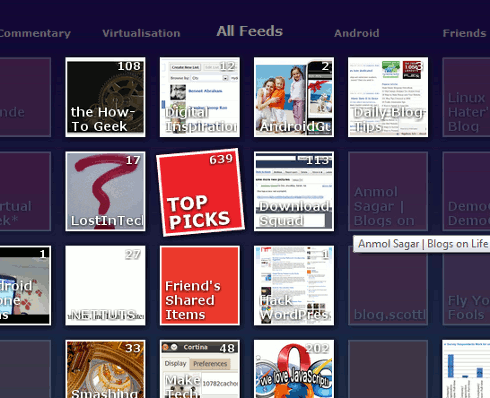
Isn’t that cool?
The reason I also said it looks retro is because the home screen reminds me of a magazine or comic books shelf at the local library. And that is what I like the most about this extension. At a single glance, I can see which one of my subscribed blogs have had updates and the number on the upper right hand corner also tells me the number of unread items that I have in that particular blog. It almost gives me the same joy going through my feeds that I used to get going through the comic books section of a library as a kid.
Clicking on one of the unread feeds, opens up a small area at the bottom of the window and all the unread items from that feed are displayed over here. You can then just click any one of the posts and feedsquares opens it in a window of it’s own over the main interface.
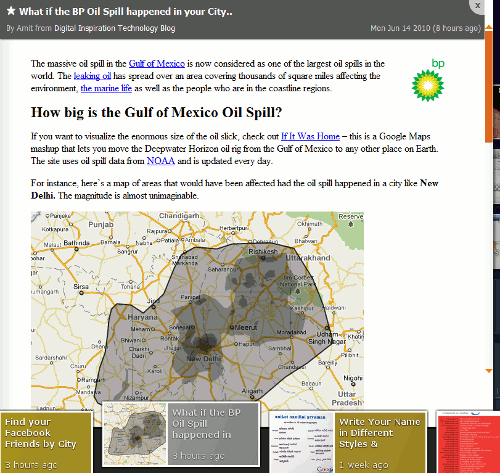
Doesn’t that beat the pants out of Google Reader ?
FeedSquares doesn’t offer much by way of customization right now and I’d love to see them work more on that aspect of their interface. Other than that, FeedSquares has almost replaced Google Reader for all my Weekend feed reading.
So, which one is it for you? Google Reader or FeedSquare? If you ask me, I’d still use Google Reader if I’m looking to get something done quickly and Google Reader’s largely text based interface lets me just concentrate on the actual content. But, when I’m looking to get some work done visually or when I’m just looking to get an idea about the state of all my feeds, FeedSquares is what I’ll prefer.
Which one do you prefer?