
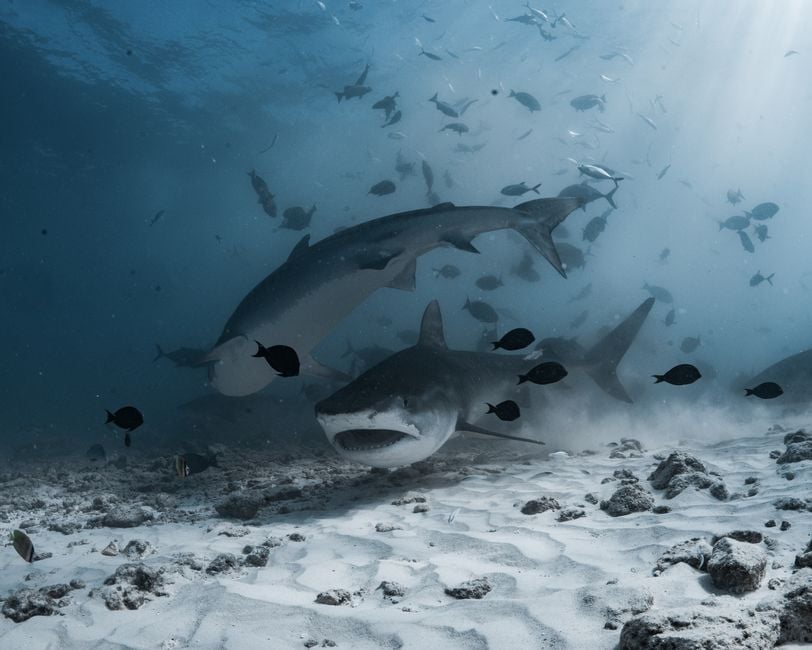
When marine biologist Julius Nielsen pulled the lens from the eye of a five-metre Greenland shark in his Copenhagen lab, he was holding tissue that had started forming before the United States existed. The proteins in his hands had been laid down sometime in the 1600s — possibly earlier still. They had survived three centuries or more of swimming through near-freezing Arctic water, and they were about to make Somniosus microcephalus the longest-lived vertebrate ever documented.
The problem Nielsen had cracked was one that had defeated shark biologists for a century: how do you date an animal that leaves no growth rings?
The dating problem
Sharks are famously hard to age. Bony fish leave growth rings in their ear stones; trees leave them in trunks. Sharks have neither. Their skeletons are cartilage, and Greenland sharks in particular have no calcified vertebrae to count. For decades, the species’ lifespan was guessed at from indirect evidence — Danish whalers in the 19th century noticed the same scarred individuals turning up in their nets year after year, but no one could put a number on it.
Nielsen’s team went for the eye. The lens of a vertebrate eye contains proteins laid down before birth that never get replaced. If you can date those proteins, you can date the animal.
The trick was radiocarbon. Atmospheric nuclear bomb tests in the 1950s and early 1960s flooded the planet with carbon-14, leaving a sharp spike — the so-called bomb pulse — in the tissue of anything alive at the time. Younger sharks in the study carried the bomb-pulse signature in their lenses. Older sharks did not, which meant they had been born before the mid-1950s. The largest specimen predated the signature by a wide margin.
The number Nielsen arrived at
In August 2016, Nielsen and his collaborators published their result in Science: a Greenland shark hauled up as bycatch in the North Atlantic, carbon-dated to a range of 272 to 512 years, with a most-likely midpoint of 392 years. The original paper, “Eye lens radiocarbon reveals centuries of longevity in the Greenland shark,” appeared in Science on August 12, and the institutional press release from co-author Richard Brill’s lab at the Virginia Institute of Marine Science walks through the methodology. The central estimate places the oldest individual’s birth in the early 1600s — contemporary with Galileo’s later telescopic work.
To get there, Nielsen had to calibrate a growth curve against the bomb-pulse anchor points from the younger sharks in his sample. The species grows roughly one centimetre per year. Working backwards from a five-metre body and a growth curve that flattens with age, the math pointed to the early modern period. NPR’s contemporaneous coverage walks through the calibration in plain language, and a 2017 Live Science clarification spells out what the uncertainty bars actually mean.
A life lived at 29 degrees Fahrenheit
The conditions that made Nielsen’s dating method work are the same conditions that made the shark old in the first place. Greenland sharks live in water that hovers between roughly minus one and four degrees Celsius. They cruise the deep North Atlantic and Arctic, sometimes surfacing near Greenlandic and Icelandic shores in winter. Their cruising speed is slower than a casual human walking pace.
Everything about the animal runs slow. Metabolism, growth, reproduction, even the firing of nerves. Cold-water physiology has been the working explanation for their longevity since the 19th century — but the working explanation is not the same as a mechanism, and that gap is what the lens samples have opened up.
What the eye is still revealing
The lens-dating method was the beginning, not the end. Once Nielsen had shown the animals were that old, the obvious next question was what kept them functioning. A decade of follow-up research has converged on a single answer: an unusually aggressive set of DNA-repair pathways.
In January 2026, Dorota Skowronska-Krawczyk, an associate professor of physiology and biophysics at the University of California, Irvine, published a study in Nature Communications on the Greenland shark’s visual system. Her team examined retinas from animals up to roughly 130 years old, compared them against bovine and human eyes, and ran the shark’s genome against five other shark species. The retinas showed no detectable degeneration. The visual system is intact, adapted for dim light, and apparently kept that way by enhanced DNA-repair machinery, even in animals whose corneas are routinely colonised by parasitic copepods. UC Irvine’s writeup of the paper and Science Friday’s January 2026 interview with Skowronska-Krawczyk lay the findings out for a general audience.
The lens samples are not just clocks, in other words. They opened a programme of research into which biological systems in the shark wear out first, and which ones can be coaxed to last longer. The current state of that work overlaps with recent genomic results: a 2024 chromosome-scale assembly of the Greenland shark genome, posted on bioRxiv by an international team led by Arne Sahm at Ruhr University Bochum, found expanded gene families for DNA repair and immune function, along with structural alterations in TP53, the tumour-suppressor gene that does similar work in elephants.
What the same technique has revealed about the species
Applied across Nielsen’s sample, the lens-dating method produced more than a single headline number. It produced the first reliable growth curve for the species — and with it, the unsettling discovery that female Greenland sharks do not reach sexual maturity until around 150 years old, at a body length of roughly four metres. Nielsen’s collaborators put the figure more precisely at 156 years, plus or minus 22.
That figure is itself a product of the dating work. Without a way to age the animals, no one had known when they bred. Now that the curve exists, it has reframed every conservation question attached to the species. A shark caught in a longline today might be a teenager by her species’ clock, decades from her first litter. Historic Greenlandic and Icelandic fisheries that harvested the species for liver oil through the early 20th century were, it turns out, removing animals that had not yet reproduced — and would not have, for another human lifetime.
The meat itself is toxic when fresh, due to high concentrations of trimethylamine oxide and urea, and is only edible after months of curing and air-drying, the basis of the Icelandic dish hákarl. That toxicity is probably the only reason the species was not fished to collapse before anyone knew how slowly it grew.
Why the method matters beyond one shark
Greenland sharks have become a quiet centre of gravity in comparative gerontology — the study of why some species age slowly and others age fast. The bowhead whale lives past 200. The ocean quahog clam, an Icelandic specimen nicknamed Ming, was dated to 507 years. Greenland sharks sit at the top of the vertebrate list, and they sit there because Nielsen found a way to prove it.
The eye-lens technique is now being adapted for other long-lived species where conventional ageing methods fail. And the proteins themselves are being read for what they can tell researchers about cataract formation, cancer resistance — the Sahm group’s genome work suggests the shark’s enhanced DNA-repair networks and altered TP53 pathway may explain how 400 years of cell division can pass without producing detectable malignancies — and the basic biochemistry of biological time.
None of this would exist without a single insight: that the answer to an unanswerable question was sitting, untouched and unchanged, inside the eye of the animal all along.