That trending YouTube video you’re watching live might not be real. As a recent scam proved, live deepfake videos may rank higher than the real version. Naturally, these are designed to trick. Here’s what you need to know to avoid falling into the scammers trap.
Live Deepfake Videos Air Simultaneously
Recently, Nvidia hosted a live stream event for its GTC event. However, while CEO Jensen Huang was busy giving the keynote on legitimate channels, another version of Huang was engaging viewers and sending them on their merry way to a crypto scam.
Both live streams happened simultaneously on YouTube. The worst part is the deepfake ranked higher than the legitimate live stream. The name of the channel, NVIDIA LIVE, probably made it seem more believable. It may also be why it ranked so high. Users were likely searching for “nvidia live,” which led YouTube to recommend the deepfake video over the real one.
Dylan Martin was the first to sound the alarm on X.
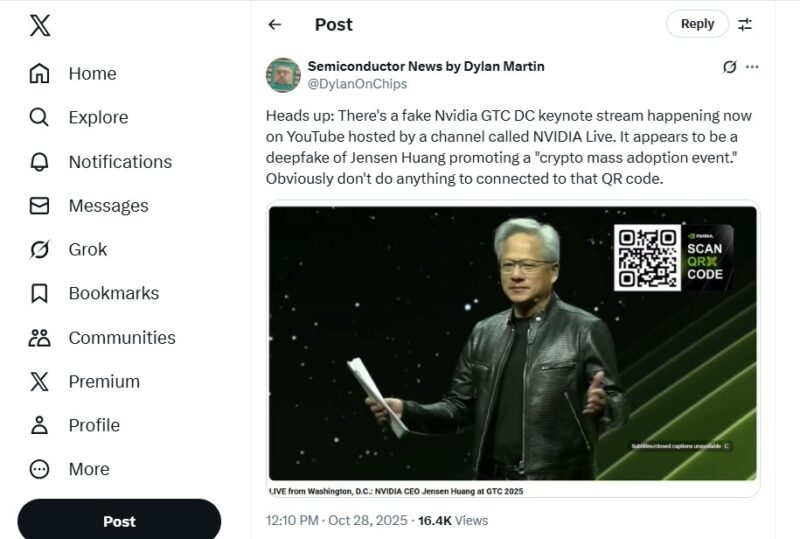
Yes, the video has since been taken down, but the user who hosted it hasn’t been banned, yet. This is yet another major type of scam YouTube’s dealing with.
The key lesson here is to not just click the first result. Make sure the video is streaming from the right channel.
Scammers deliberately use common keywords to ensure their live deepfake videos jump ahead in results. Even if it only works for a short period, that’s all they need to scam hundreds or thousands at once.
Think Carefully About What’s Being Offered
Who doesn’t want free crypto? That’s what scammers know. They know people want things for free.
But, the live deepfake Nvidia stream made a major mistake, at least to those who remembered big corporations aren’t going to give away tons of money out of the goodness of their hearts.
The fake CEO promised that any cryptocurrency sent to the scammers’ wallet would magically be converted to Bitcoin and given back. The conversion would mean getting back more than you sent.
At no point is it realistic to believe that Nvidia would just hand over billions of Bitcoin to help viewers in any way. The company’s busy investing billions in AI, not humans.
Before you believe what’s being promised, think it over carefully. Does it make sense? Are you being sent to a reputable site? For instance, if the cryptocurrency windfall was real, wouldn’t Nvidia have hosted it on their site, not a sketchy third-party site?
Also, if you’re being asked to hand over money to get something for “free,” it’s not free. It’s a transaction. And, it’s a scam.
AI Deepfakes Getting More Sophisticated
Originally, you mainly saw deepfake photos and short video clips. Now, entire live events can be deepfakes. They often use a trusted figure, such as Nvidia’s CEO. AI matches the person’s look, movements, and voice. By using someone well known, it’s easier to gather data on them to train the AI.
Experts are starting to struggle to distinguish between what’s real and what’s not. In one interview, Hany Farid, an AI expert, couldn’t tell which voice was his between two fakes and the real one.

Yes, there are signs that a photo, voice, or video is a deepfake. But, AI is getting better and makes it more difficult to spot these signs, such as irregular movements, blurring, weird fingers or ears, or always keeping the main subject at a distance.
Simple Ways to Avoid Live Deepfake Videos
If you’re just casually watching a livestream, you probably won’t notice any real differences. That doesn’t mean you have to just accept never knowing whether that livestream is real or not.

Instead, use these simple rules to help you pick out the real videos:
- If it’s on a reputable video platform such as YouTube or Twitch, check the channel and/or user. If it’s not coming from the official user or channel that it claims to be from, it’s not real. Report the stream or video and let the real channel know what’s going on.
- Take a moment to zoom in. As incredible as AI is, live deepfake videos often still have some blurring when you zoom in. The main subject is kept at a distance to make this difficult to see. Zoom in and see if there is any blurring around the subject’s face and limbs. This is a clear sign it’s a fake.
- Check the comments. You don’t have to be an expert deepfake detective all on your own. Look through the comments and see if anyone else is questioning the legitimacy of the stream. Users who have already spotted the problem often warn others. Keep in mind that spammers will try to delete these comments quickly.
- Search YouTube, or any other livestreaming service, for the topic of the livestream. If you see a similar option streaming at the same time, check out both. One is likely a scam.
- It’s usually a deepfake if it veers way off-topic. For instance, Nvidia’s CEO talking about a cryptocurrency giveaway makes zero sense. That would be like Microsoft giving away iPhones, but all you have to is give them access to your Microsoft account.
You can also use tools to analyze content to see if it’s real or AI. They’re not always 100 percent accurate, though. Just stay aware of AI scams and don’t take videos, photos, or audio for granted.