

If you keep up on tech news, you’ve doubtlessly seen all the hype surrounding Wolfram|Alpha, the new not-exactly-search-engine that’s making big waves in the web search industry. Your traditional search engines like Google, Yahoo, MSN etc all work on the same basic principle: finding web pages based on keywords. Wolfram|Alpha isn’t about bringing web pages to the user, it’s about bringing information to the user.
Let’s say you open up Google and enter a query like “Princess Bride Cast”. You’d get results linking to several pages with info on who was in that cinematic masterpiece. It would probably look something like this:

Pretty good, right? You’ve got a list of pages that probably all have the info you’re looking for.
Wolfram, on the other hand, doesn’t give you the pages with the info, it gives you the info! That same query in Wolfram gives results like this:
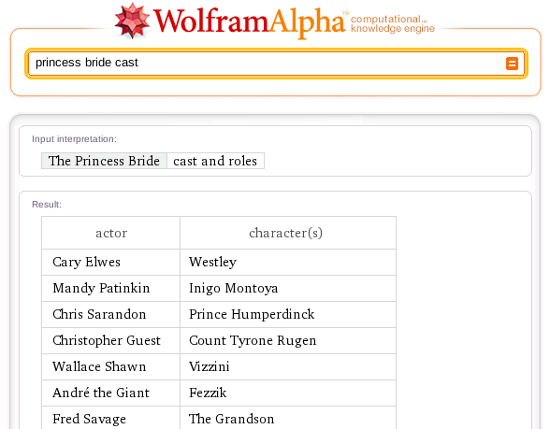
This approach to search opens all kinds of possibilities. Want to know the population of Guam? How many mililiters in a gallon? The current time in Dublin? The radius of the sun in yards? Of course it can’t handle queries that simply don’t make sense (it couldn’t figure out quite what I meant by “Bugrit! Millenium hand and shrimp!”).
You can even lookup weather, stock values, and mathematical formulas, like this one:
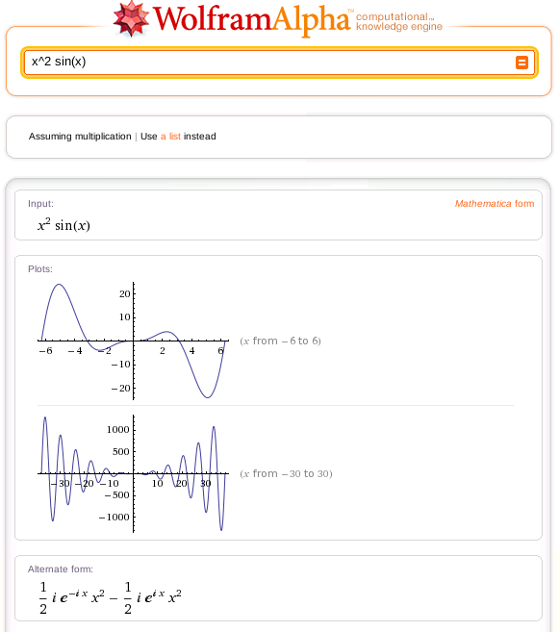
Delivering information in this way is a flashback to those old sci-fi movies where a character walks up to a terminal and asks it something like “Computer, how long until we reach Alpha Centauri?”. The creators of Wolfram|Alpha have cited this as a direct inspiration behind the design of their system. Any why not? With the vast quantities of information available to us, why not make the computer sort and process that information to give us just what we need?
Firefox Addons
Now that you’ve got a good idea how and why to use Wolfram, let’s integrate it into Firefox for easy searches. First is a plain old search box entry that lets you use Wolfram from the search box in the top-right corner of your browser. The Wolfram|Alpha extension can be installed easily, and it’s immediately ready to use.
WARNING: Opinions ahead!
Many of the articles surrounding Wolfram|Alpha have portrayed it as a Google-killer. I think this is extremely inaccurate. For starters, the two have entirely different purposes. Sure, many of us use Google to find information, but we also use it to find pictures, files, news, articles, reviews, and of course web pages. All these things that Wolfram simply isn’t designed to handle. Calling it a Google killer is like saying the popularity in skateboards will kill the trucking industry. Sure, both can get you from A to B, but they’re two different things with different uses.
That being said, I’ve been extremely impressed by Wolfram|Alpha’s capabilities so far. It certainly does have the potential to pull some of the simpler queries away from Google, but as long as it remains a “computational knowledge engine”, we’ll still have the good old search engines.