
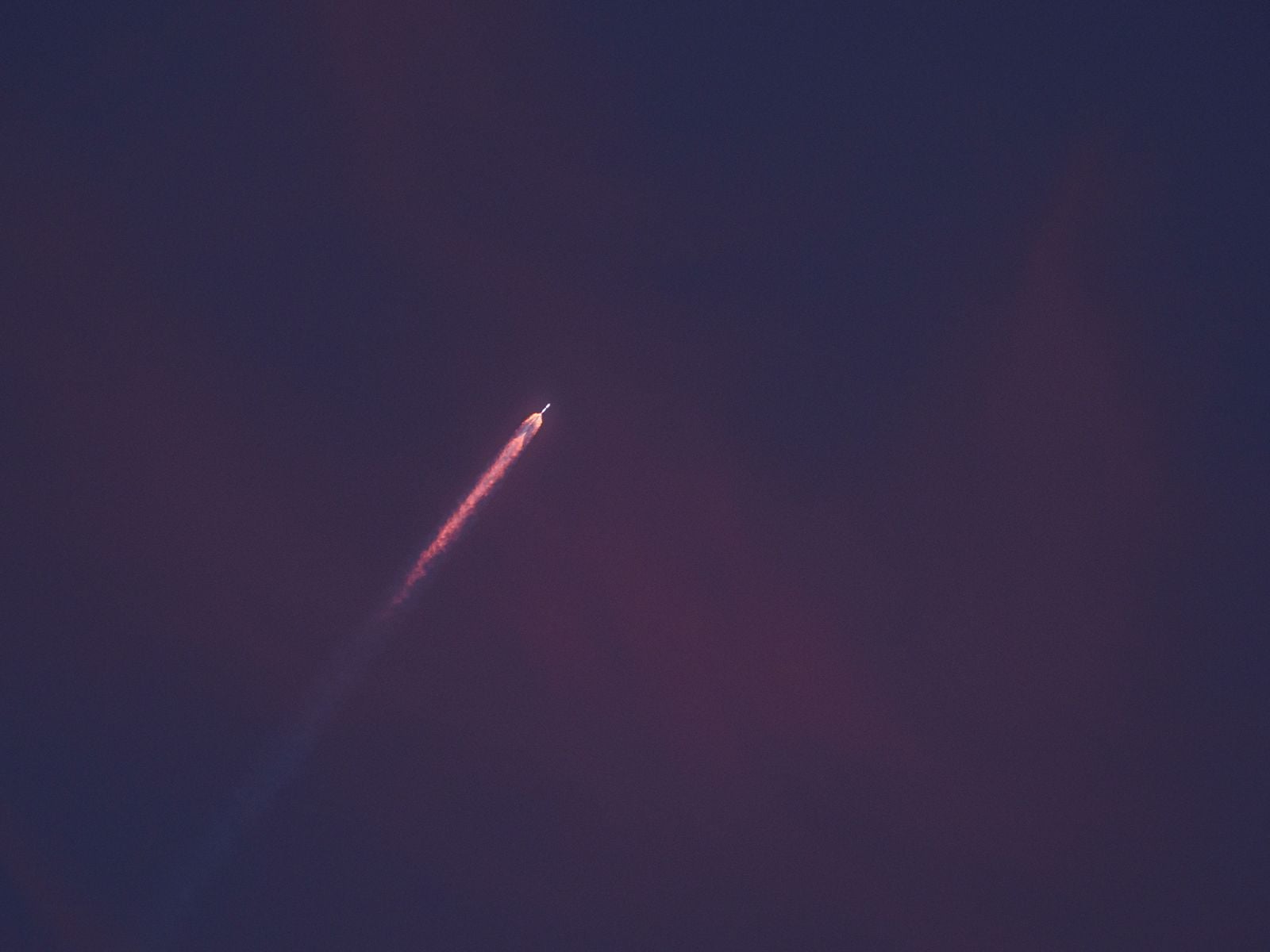

The Space Shuttle Challenger broke apart 73 seconds into its tenth flight, at an altitude of about 14,000 metres, killing all seven crew members. The immediate cause was not the explosion most viewers remember watching on television. It was a failure that had already happened on the launch pad, in the first second after ignition, in a joint that was never designed to seal a rocket in near-freezing weather.
The joint was on the right solid rocket booster. The seal was an O-ring — a loop of synthetic rubber, roughly 7.1 mm in cross-section diameter and about the diameter of a saucer at the joint, though the cross-section is the coin-sized part that matters. The Rogers Commission report, published in June 1986, traced the destruction of the orbiter back to that single component and to the decision to launch in weather it had never been qualified for.
What the joint was actually doing
Each solid rocket booster was not one continuous tube. It was assembled from four large steel segments, stacked and pinned together at what engineers called field joints. Inside each booster, when the propellant lit, pressure rose to around 6.9 megapascals — about sixty to seventy times atmospheric pressure — and the gases reached roughly 3,000°C. The job of the field joint was to hold that pressure inside the casing and keep the hot gas from cutting sideways through the wall.
Two O-rings sat in each joint, a primary and a secondary, seated in grooves machined into the steel. At ignition, the booster casing flexes outward slightly — a phenomenon called joint rotation. In that split second, the O-rings have to extrude into the widening gap and re-seal it before combustion gas reaches them. Rubber that is warm and pliable can do this in milliseconds. Rubber that has been chilled cannot.
What the cold did to the rubber
The O-rings were made of a fluoroelastomer called Viton. Like all elastomers, it loses resilience as it cools. Below a certain temperature it behaves less like a rubber band and more like a stiff washer.
Overnight into 28 January, temperatures at Kennedy Space Center fell to around -8°C in some locations, and ice formed on the launch structure. At the time of launch, the ambient temperature was near 2°C. The Rogers Commission calculated that the O-rings on the aft field joint of the right booster were closer to -2°C — colder than any previous launch and well outside the qualified range. The previous coldest launch had been at 12°C.
The physicist Richard Feynman, a member of the commission, demonstrated the mechanism during a televised hearing by clamping a piece of the O-ring material in a small C-clamp, dropping it into a glass of ice water, and showing that it did not spring back when released. In cold, the rubber could not follow the joint as it opened.
The 73 seconds
Post-flight film analysis, reconstructed frame by frame in the Rogers report, showed a puff of dark grey smoke escaping from the aft field joint of the right booster 0.678 seconds after ignition. There were eight more puffs over the next two seconds. The primary O-ring had failed almost immediately. The secondary had probably also failed. What sealed the joint, temporarily, was slag — molten aluminium oxide from the burning propellant, packed into the leak path.
For almost a minute the shuttle flew normally. Then, at around 58 seconds, the stack passed through the strongest wind shear of the ascent. The slag plug shifted or broke free.
A visible flame appeared on the side of the right booster at 58.788 seconds. Within a few seconds it was playing directly onto the external tank, which held liquid hydrogen and liquid oxygen at cryogenic temperatures. At 64.66 seconds, the flame changed shape as it burned into the hydrogen tank. At 72.20 seconds the lower strut holding the booster to the tank gave way, and the booster began to rotate into the tank. At 73.162 seconds the tank ruptured, the propellants mixed, and the vehicle disintegrated in the aerodynamic loads.
The crew compartment separated largely intact and fell for about two minutes and 45 seconds before hitting the Atlantic at roughly 333 kilometres per hour.
What the engineers knew the night before
The most difficult part of the record is not the physics. It is that the risk was flagged, in writing, before launch.
The boosters were built by Morton Thiokol in Utah. Its engineers had been tracking O-ring erosion on earlier flights for years. On the evening of 27 January, Thiokol engineers — including Roger Boisjoly and Arnie Thompson — held a teleconference with NASA managers and recommended against launching below 12°C. Their concern was specifically the effect of cold on O-ring resilience. In a written internal memo dated 31 July 1985, Boisjoly had warned that continued flight in the existing joint configuration risked “a catastrophe of the highest order — loss of human life”.
NASA managers pushed back on the recommendation. Thiokol management asked for a caucus, reversed the engineering position, and signed a launch recommendation. The Rogers Commission called the decision-making process “flawed” and found that the concerns of the engineers had not been adequately communicated to the senior NASA managers who gave the final go.
Feynman’s personal appendix to the report ended with a line that has been quoted often since: “For a successful technology, reality must take precedence over public relations, for nature cannot be fooled.”
What the record shows, and what it does not
The physical chain of events is well documented: cold rubber, failed primary seal, temporary slag plug, wind shear, restored leak, flame on the external tank, structural failure. The Rogers Commission had recovered booster hardware from the Atlantic and matched the burn-through location on the recovered segment to the smoke seen in the launch films.
What the record supports less cleanly is the popular telling in which a lone engineer begged NASA not to launch and was overruled by a single villain. The teleconference involved dozens of people across multiple sites. The reversal happened inside Thiokol’s own management, not by NASA order. And the O-ring problem was not a surprise discovered that night — it was a known, tracked, and repeatedly waived flight risk going back at least to 1977 test data on the joint design.
The commission’s structural recommendation was that the joint itself be redesigned. It was. The redesigned field joint, introduced for the return-to-flight mission STS-26 in September 1988, added a third O-ring, a captured feature that mechanically prevented the joint from rotating open, and heaters to keep the seals above 24°C regardless of ambient weather.
What survived into how large systems are run
Challenger became the case study taught in engineering ethics courses, in risk-management training, and in accident investigation. The sociologist Diane Vaughan’s 1996 book The Challenger Launch Decision introduced the term “normalisation of deviance” to describe how each successful flight with eroded O-rings made the next flight with eroded O-rings feel acceptable. The seal was doing something it was not designed to do, and the fact that it kept not-quite-failing was being read as evidence that it worked.
The Columbia Accident Investigation Board, reporting in 2003 after the loss of a second shuttle to a different but structurally similar management failure, cited Vaughan’s framework directly. The physical cause in 2003 was foam, not rubber. The organisational cause was recognisable.
Seven people died because a seal designed for warm Florida mornings was asked to close a joint on a cold one, and because the people who knew that were not the people making the call.