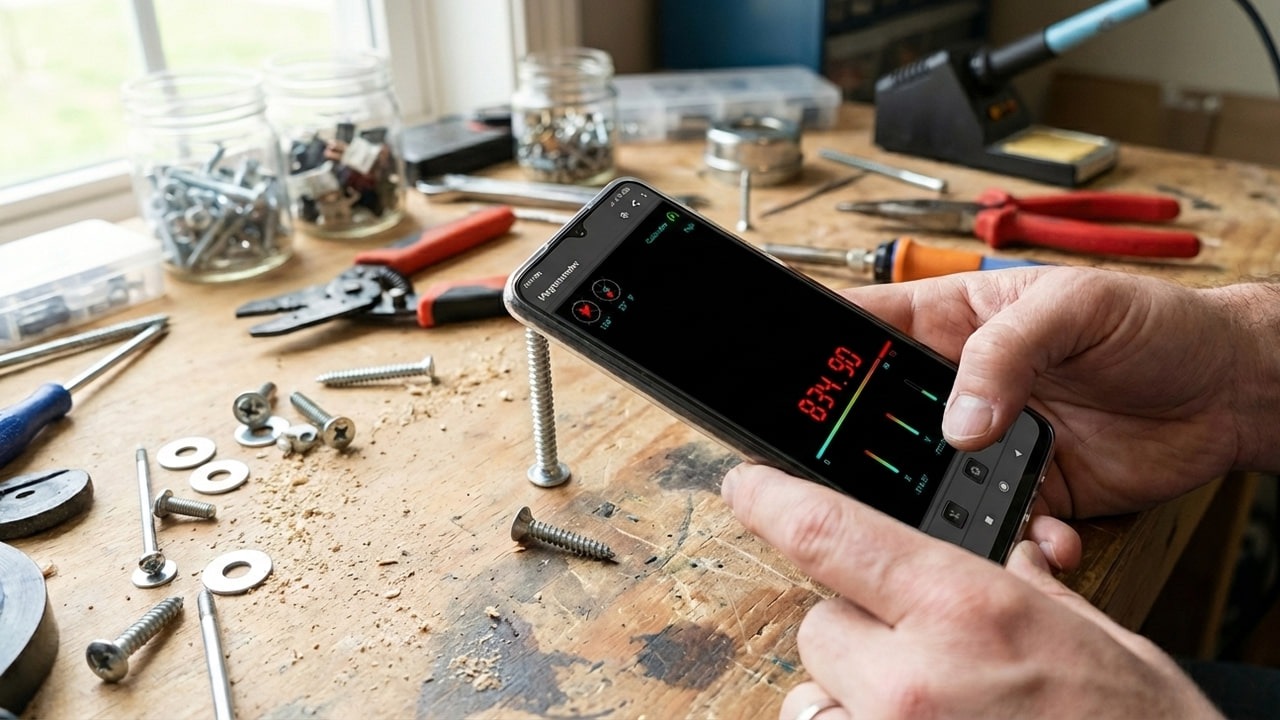
You don’t need to buy an expensive EMF or stud detector for basic magnetic field detection at home. Your Android phone’s built-in magnetometer can handle simple detection tasks at no cost. If you want to locate hidden metal or check for EMF interference, here is how to use your phone as a magnetic field detector.
How Your Phone Can Detect Magnetic Fields
Almost all phones today have a built-in magnetometer as it’s an integral part of the phone’s motion/IMU suite to detect phone position. The magnetometer works as a digital compass to detect Earth’s magnetic field to understand which way is north. It’s the sensor that tells your GPS apps exactly which way you are facing currently.
However, apart from detecting Earth’s magnetic fields, this sensor is also extremely sensitive to low-level magnetic fields generated by objects, like ferrous metals (like studs) or objects generating an electromagnetic field (current through wires). With the help of an app, you can visualize this interference to detect magnetic fields around you.
Of course, it’s not as powerful as a dedicated EMF detector or metal detector, but it’s sensitive enough to detect magnetic field changes if you can get your phone near the object.
Turn an Android Phone into a Magnetic Field Detector
While your Android phone does have a magnetometer, it’s mainly used for direction. To use it for detecting magnetic fields, you’ll have to get a dedicated app that can visualize it. I recommend the free Magnetometer app for this, as it’s very easy to use and comes with configurable alerts.
By default, the app shows you the Earth’s magnetic field at your location, which should be between 25-65μT (microteslas). Keep your phone away from objects and see where it stabilizes; you’ll use that as a base magnetic field. To confirm sensor location on the phone, use a ferrous object (like a nail) and move it over the top of the phone. The area with the highest magnetic field reading is your sensor’s location.
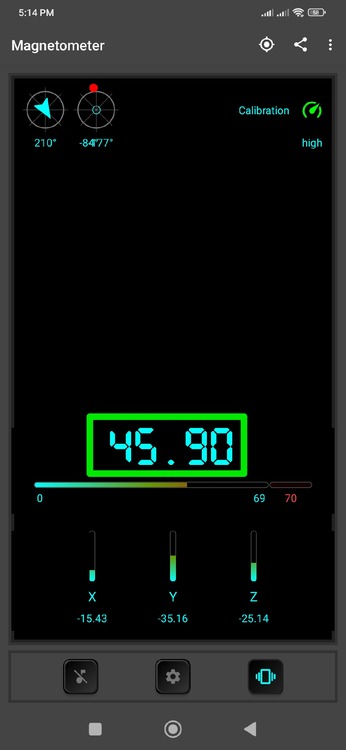
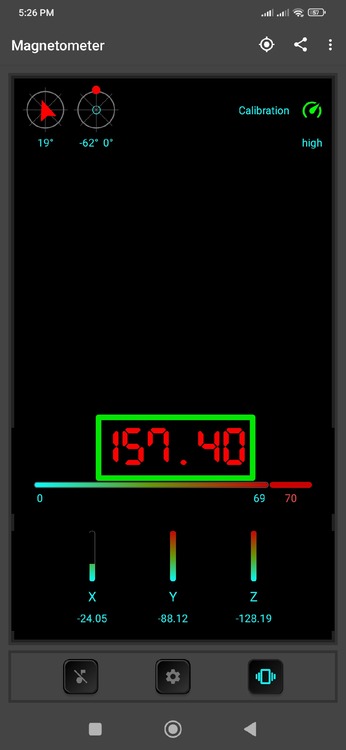
To find objects with measurable magnetic fields, just move your phone across the area and track the reading. The reading reaching the red zone is the obvious indicator for magnetic field. However, I also found slight changes in reading (like 15-20μT increase) a good indicator as well, especially for objects inside thin walls. You can also set tone and vibration alerts for finding objects without looking at the screen.
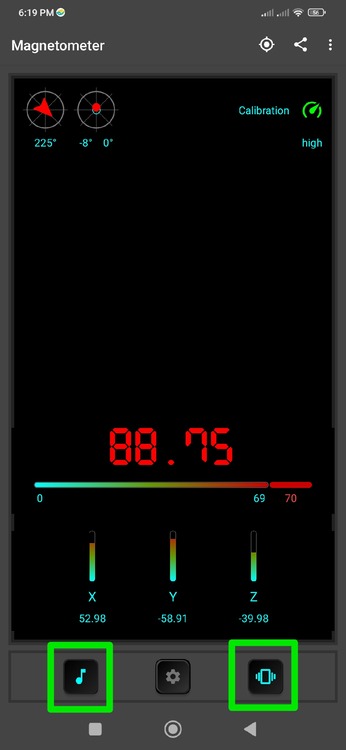
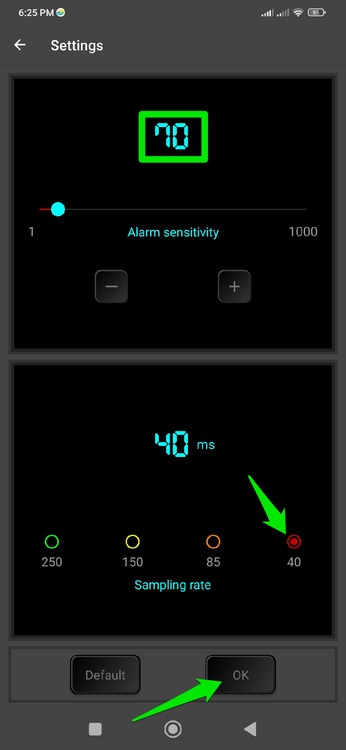
For more precision, I recommend you go into settings and set the Sample rate to 40ms. This will consume a bit more battery, but you’ll get faster readings, which is necessary when finding objects and quickly moving the phone. You should also set Alarm sensitivity to 25-30μT above your base value (like 70μT for me). In my experience, the default 90μT is too high to trigger an alarm in many positive cases.
What You Can Actually Do With a Phone Magnetic Field Detector
You won’t be using your phone to find buried treasure like a real metal detector. However, its magnetic field sensors are still useful for many tasks, like detecting smart glasses. Here are some practical ways to use your Android phone as a magnetic field detector in day-to-day use:
- Find lost small ferrous items: ferrous objects like nails, screws, pins, hooks, etc., can be easily found using your phone if they are lost in hard-to-reach spaces. Like losing the screws around the workbench or on a shag carpet. Use the alert tone/vibration for quick scanning.
- Detect wiring in walls: when current flows through wires, it generates enough electromagnetic field to be detected by the phone. You can use it to detect wires (current flowing) behind thin walls when drilling. The reading won’t be high (it was 70μT for me), but it should be a clear increase in the magnetic field.
- Find the magnetic interference source: some appliances and objects with high magnetic fields can interfere with Wi-Fi signals or Bluetooth. You can use your phone to detect high magnetic fields near your setup to detect the cause of interference.
- Detect hidden cameras or microphones: most cameras and microphones have components that generate a detectable magnetic field. You can use it detect hidden cameras or microphones in suspicious places, like when in a hotel.
- Detect ferrous and non-ferrous material: the phone magnetometer will only work on ferrous materials that have their own magnetic field. So you can use it to quickly differentiate between ferrous and non-ferrous material, like when buying cookware.
There are many other creative ways you can use your phone’s ability to detect magnetic fields. Just make sure you don’t keep it near high-power magnets, as it can damage the magnetometer. To unlock more hidden capabilities of your Android phone, learn how to use it as a webcam.