


For two decades Apache held sway over the web server market which is shrinking by the day. Not only has Nginx caught up with the oldest kid on the block, but it is currently the toast of many high traffic websites. Apache users might disagree here. That is why one should not jump to conclusions about which web server is better. The truth is that both form the core of complete web stacks, and the final choice boils down to individual needs.
For instance, people running Drupal websites often call on Apache, whereas WordPress users seem to favor Nginx as much if not more. Accordingly, our goal is to help you understand your own requirements better rather than providing a one-size recommendation. Having said that, the following comparison between the two gives an accurate picture.
Also read: 12 Best Open-Source Software to Try in 2021
1. Popularity
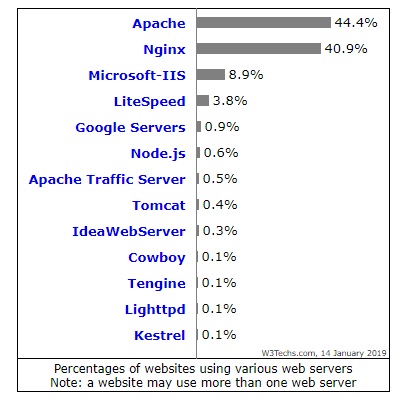
Up until 2012 more than 65% of websites were based on Apache, a popularity due in no small measure to its historical legacy. It was among the first software that pioneered the growth of the World Wide Web. However, times have changed. According to W3Tech.com, as of January 14, 2019, Apache (44.4%) is just slightly ahead of Nginx (40.9%) in terms of websites using their servers. Between them they dominate nearly 85% of the web server market.
When it comes to websites with high traffic, the following graph is interesting. Of course, Nginx is quite ahead of Apache but trails behind Google Servers which powers websites like YouTube, Gmail and Drive.
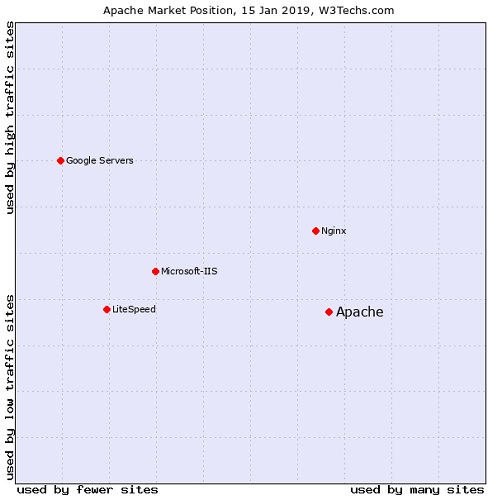
At some point a large number of websites (including this site) migrated from Apache to Nginx. Clearly, the latter is seen as a the latest, and a trendier web server. High traffic websites that are on Apache, e.g. Wikipedia and New York Times, are often using a front-end HTTP proxy like Varnish.
Score: The popularity gap between Apache and Nginx is closing very fast. But, as Apache is still ahead in absolute numbers, we will consider this round a tie.
2. Speed
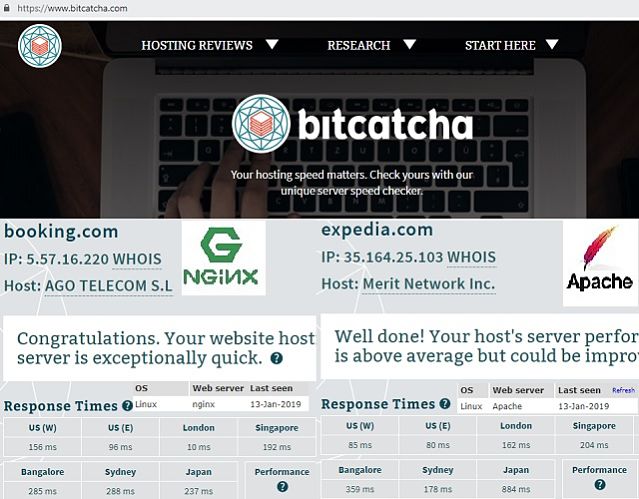
The main characteristic of a good web server is that it should run fast and easily respond to connections and traffic from anywhere. To measure the server speeds, we compared two popular travel websites based on Apache (Expedia.com) and Nginx (Booking.com). Using an online tool called Bitcatcha, the comparisons were made for multiple servers and measured against Google’s benchmark of 200 ms. Booking.com based on Nginx was rated “exceptionally quick.” In contrast, Expedia.com based on Apache was rated “above average and could be improved.”
Having used both travel websites so many times, I can personally vouch that Expedia feels slightly slower in returning results to my query than Booking does.
Here are comparisons between the two servers for a few other websites. Nginx does feel faster in all cases below except one.
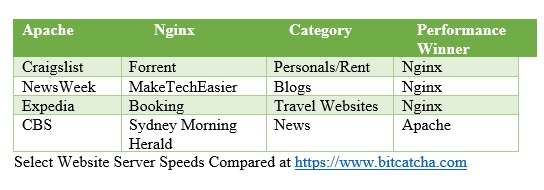
Score: Nginx wins the speed round.
Also read: How to Set Up “Let’s Encrypt” Free SSL Certificate in Nginx (Ubuntu)
3. Security
Both Nginx and Apache take security very seriously on their websites. There is no dearth of robust systems to deal with DDoS attacks, malware and phishing. Both periodically release security reports and advisories which ensure that the security is strengthened at every level.
Score: We will consider this round a tie.
4. Concurrency
There is a perception that Apache somehow does not measure up to Nginx’s sheer scale and capability. After all, Nginx was originally designed to accelerate speed issues with FastCGI and SCGI handlers. However, from Apache 2.4 onwards (which is the default version), there has been a drastic improvement in the number of simultaneous connections. How far this improvement has been made is worth finding out.
Based on stress tests at Loadimpact.com, we again compared Booking.com (Nginx) with Expedia.com (Apache). For 25 virtual users, the Nginx website was able to record 200 requests per second, which is 2.5 times higher than Apache’s 80 requests per second. Clearly, if you have a dedicated high-traffic website, Nginx is a safer bet.
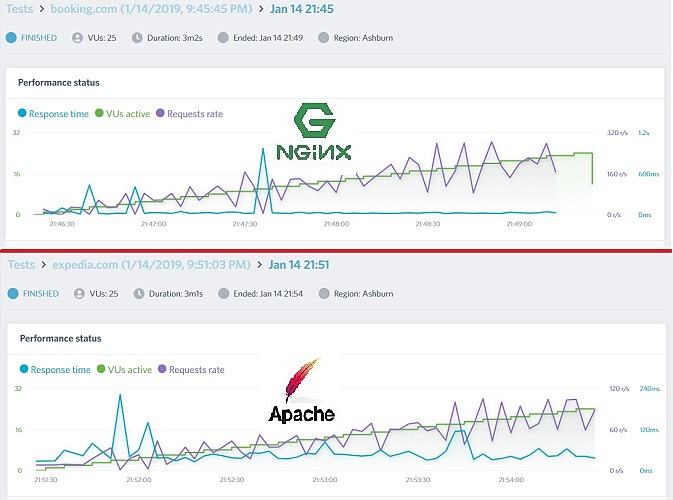
Score: Nginx wins the concurrency round.
5. Flexibility
A web server should be flexible enough to allow customizations. Apache does it quite well using .htaccess tools, which Nginx does not support. It allows decentralization of administrator duties. Third party and second-level admins can be prevented from accessing the main server. Moreover, Apache supports more than 60 modules which makes it highly extensible. There is a reason Apache is more popular with shared hosting providers.
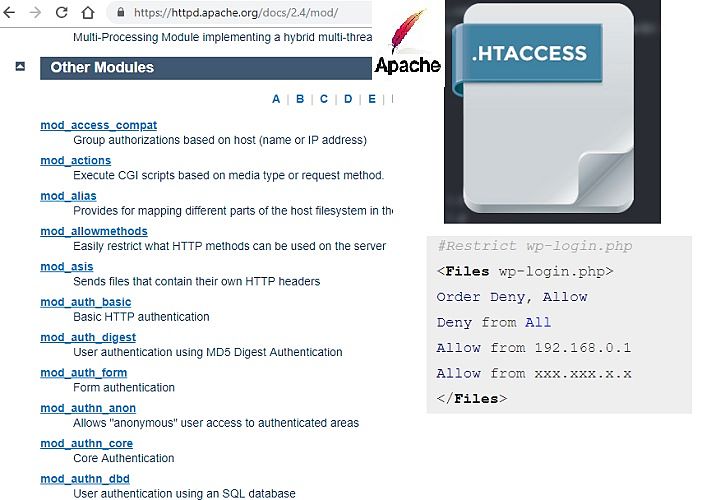
Score: Apache wins this round.
Other Parameters
In the past Nginx did not support Windows OS very well, unlike Apache. That is no longer the case. Also, Apache was considered weak for load balancing and reverse proxy which has changed now.
Final Result
Nginx narrowly wins this contest 2-1. Having said this, an objective comparison between Nginx and Apache on technical parameters does not give the complete picture. In the end, our verdict is that both web servers are useful in their own ways.
While Apache should be used with a front-ending server (Nginx itself is one option), Nginx can be better with more customizations and flexibility.