
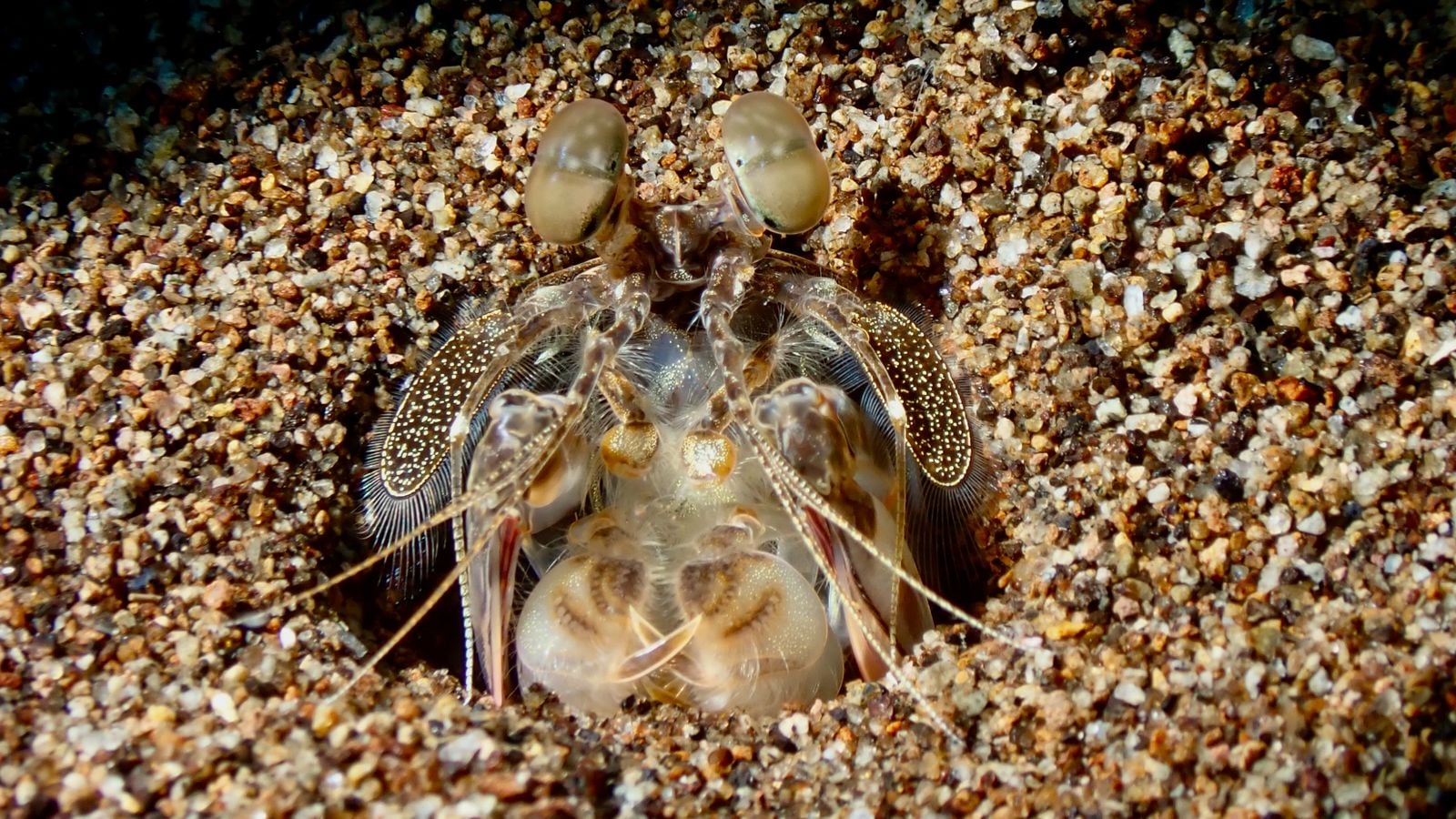
The stomatopod’s eye looks like a piece of alien optics grafted onto a shrimp. Each of the two stalked eyes swivels independently, is divided into three regions that all look at the same point in space at once, and carries, in a narrow band across its middle, up to sixteen distinct photoreceptor classes. Human retinas, by comparison, have three cone types tuned to roughly red, green and blue, plus a rod system for low light. On paper the mantis shrimp should perceive colour in a way no other animal on Earth can.
On paper. The actual experiments tell a stranger story.
Sixteen channels, and what they are looking at
The animal in question is a stomatopod crustacean, a group of aggressive predators best known for the peacock mantis shrimp, Odontodactylus scyllarus, which punches prey with a spring-loaded claw fast enough to briefly cavitate the water. Its eyes have been picked apart in detail by the visual ecologist Justin Marshall and colleagues at the University of Queensland, whose 2014 paper in Science — a behavioural study led by Hanne Thoen — is the source of most of what follows.
Across stomatopod species the retina contains twelve narrow-band colour receptors covering roughly 300 to 720 nanometres — from ultraviolet through to the red edge of what humans can see — plus additional receptors for polarised light, including circularly polarised light, which almost no other animal can detect at all. Adding those together gets you the often-quoted figure of sixteen photoreceptor classes. As many as six of the colour receptors sit in the ultraviolet alone, tuned to different UV wavelengths by pigment filters layered in front of them like sunglasses stacked in sequence.
The receptors are not scattered at random. Most of the spectral machinery sits in six parallel rows of enlarged ommatidia called the midband. The first four rows handle colour, the ultraviolet receptors among them; the last two rows are given over to polarisation. That split is where the twelve-plus-four arithmetic comes from, and it is why the “sixteen” headline number folds two very different jobs into one eye.
Compared with a human eye, this is baroque. Humans manage full colour vision with three cone opsins whose sensitivity curves overlap heavily; the brain compares their outputs to work out hue. Bees and most birds use four. Some butterflies push to five or six. Twelve dedicated colour channels is an outlier by an order of magnitude.
The obvious hypothesis, and why it failed
The intuitive prediction is that a twelve-channel eye should discriminate wavelengths that look identical to a trichromat. If a human can just barely tell 500 nm green from 510 nm green, a mantis shrimp with dedicated receptors at both wavelengths should find the difference obvious.
Thoen’s team tested this directly. Stomatopods were trained to associate a specific colour of light with a food reward — a piece of shrimp tucked behind the correct optical fibre. Once an individual reliably struck the trained colour, the researchers presented it alongside a second colour of slightly different wavelength, and gradually narrowed the gap until the animal could no longer tell them apart.
A human observer, tested the same way, can distinguish colours separated by about 1 to 5 nanometres across most of the visible spectrum. The mantis shrimp needed a gap of roughly 12 to 25 nanometres before it could reliably pick the trained wavelength. In the middle of the spectrum, where human vision is sharpest, it performed several times worse than a person doing the same task. A shrimp trained on 500 nm light struggled to distinguish it from 510 nm; a human finds that trivially easy. The result was surprising enough that the journal ran an accompanying commentary by Michael Land and Daniel Osorio spelling out how completely it upended the standard assumption.
The eye with sixteen receptor classes, in other words, is measurably worse at telling colours apart than the eye with three.
What the extra channels are actually for
Marshall’s proposal is that the mantis shrimp does not do colour vision the way vertebrates do. Human trichromacy works by opponency: the brain subtracts signals from one cone class from another and reads hue out of the ratio. It is a comparison process, slow but precise, and it needs cortical circuitry that a shrimp does not have.
The stomatopod appears to skip the comparison step. Instead of asking “how much red versus how much green is in this signal,” it asks each of its twelve narrow receptors “did you fire?” and takes the answer as a direct label for the colour. A hit on receptor seven means the wavelength that fits receptor seven, and the animal reacts. There is no downstream mixing, no ratio, no fine interpolation between channels. Which is why it cannot resolve differences within a channel’s bandwidth.
The paper adds one more ingredient: movement. Rather than holding still and comparing, the animal sweeps its eye so the image scans across the band of colour receptors, and the order in which those receptors light up encodes the colour as a temporal sequence. It is closer to running a barcode past a scanner than to mixing paint. Recognition, not discrimination.
The payoff is speed. A comparison-based system has to integrate several inputs before the brain commits to a colour identity. A labelled-line system commits the moment a single receptor fires. On a reef where a stomatopod may need to identify a rival, a mate or a fleeing prey item in a fraction of a second — and where its own strike is one of the fastest movements in the animal kingdom — the trade seems to favour reaction time. The eye is optimised for how fast you can name a colour, not how finely you can split one.
This also fits the reef’s visual environment. The animals that stomatopods most need to identify — other stomatopods, coloured coral, fluorescent signalling patches on their own bodies — occupy discrete, saturated bands of the spectrum. There is no strong survival premium on distinguishing 500 from 505 nm. There is a large premium on knowing, immediately, whether a smear of colour in a burrow entrance is a conspecific or something to punch.
The polarisation channels
The twelve colour receptors are only part of the story. The remaining receptor classes handle polarised light. Ordinary linear polarisation is picked up by many arthropods and used for navigation, but stomatopods are the only animals known to detect circular polarisation, in which the electric field of light corkscrews clockwise or anticlockwise as it travels. The 2008 discovery by Tsyr-Huei Chiou and colleagues, published in Current Biology, showed that certain stomatopod species also display circularly polarised patterns on their bodies, giving them a private communication channel invisible to predators. Later work established which species actually carry the sensory hardware for it.
Speed logic applies here too. A polarisation-sensitive receptor either fires or does not, depending on the axis and handedness of the incoming light. No comparison across channels is needed to read the signal. It is, again, a labelled line.
What this changes about “better” vision
The mantis shrimp gets held up online as the animal that sees colours humans cannot imagine, sometimes with claims of perceiving new primary colours or a wider palette. The behavioural data cut against this cleanly, a point made at length in the popular coverage of the study. A twelve-channel retina wired for speed does not open up a richer colour experience — if anything, it flattens the spectrum into a dozen crude bins, each labelled and acted on individually. Human colour vision, running three cones through an opponent-comparison network, extracts more discrimination per photon than the shrimp does.
What the mantis shrimp has is a different design brief. Its eye is a fast classifier for a small set of ecologically important signals, at the cost of everything a slower comparison-based system would give it. The comparison is a little like the difference between a lookup table and a calculation: the table returns an answer instantly but only for the entries it holds; the calculation is slower but works for anything in between.
Evolution, in this case, seems to have decided that the animal punching its lunch in under three milliseconds does not have time to interpolate. It just needs to know, right now, which bin the colour falls into. The sixteen receptors are not there to make the world look more beautiful. They are there to make the answer arrive sooner.
On the reef the eye keeps doing this in real time: two stalks swivelling on their own, the colour band sweeping across a burrow mouth, each of the sixteen receptors firing or staying dark, and the strike landing — cavitation bubble and all — in the low single milliseconds, before a slower and finer eye would have finished deciding what it was looking at.