
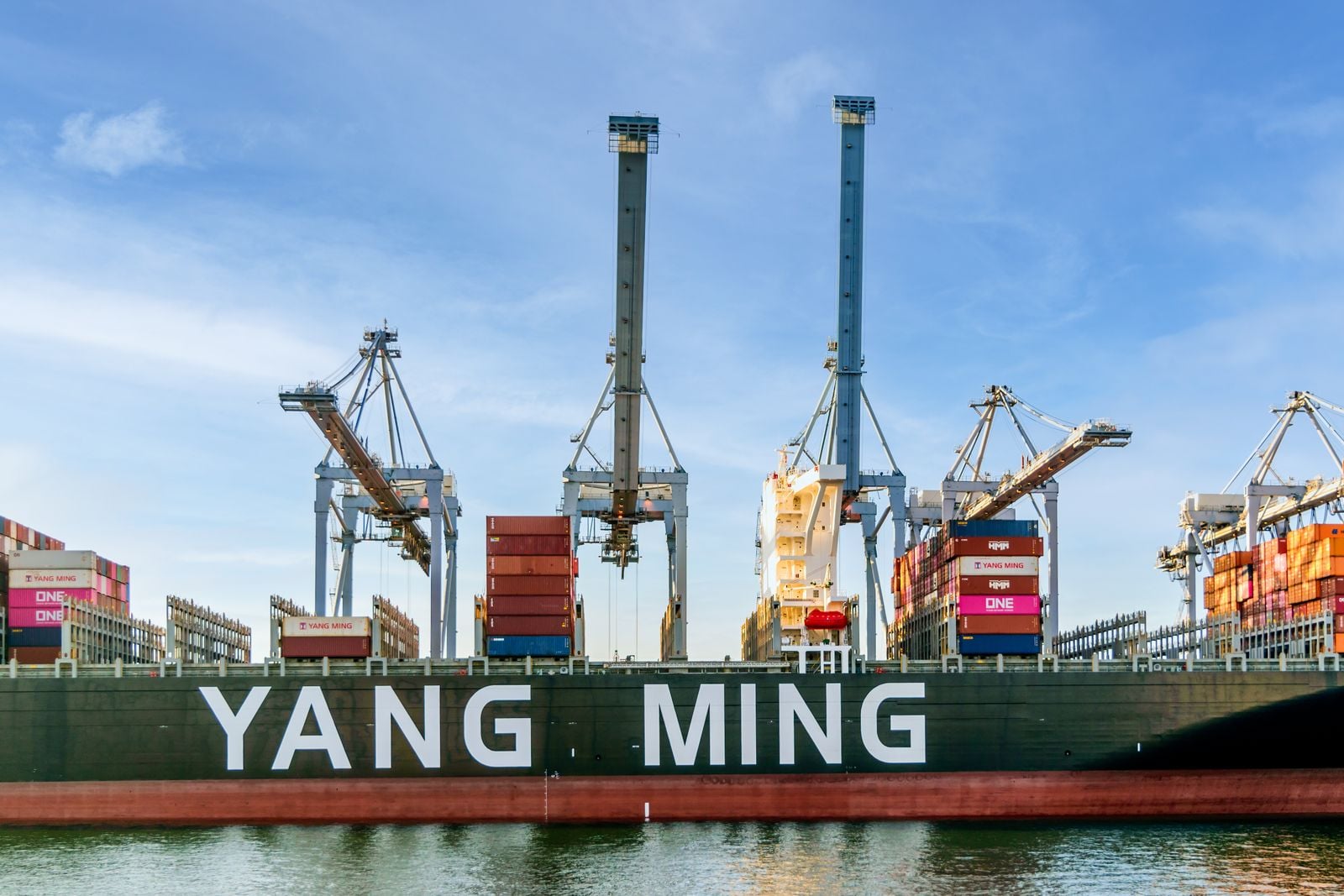

On 26 April 1956, Malcom McLean’s converted T-2 tanker Ideal X left Port Newark for Houston with 58 aluminium trailer bodies secured to a special spar deck. McLean’s containerisation system eliminated piece-by-piece transfer across the ship’s rail: the reported calculation for the 1956 operation put the loading cost at less than 16 cents per ton, against $5.83 per ton for conventional break-bulk, a reduction of about 97 per cent.
The boxes were not piled on top of one another. A Transportation Research Board history records that each detached trailer body was fixed in a longitudinal slot on a raised spar deck, then lifted off in Houston, placed on fresh running gear and delivered without its contents being handled at the port.
That distinction was the whole mechanism. McLean had sold his trucking business and acquired the Pan-Atlantic Steamship Company, but the breakthrough was not a radically new ship or a newly invented box. It was a transport system in which cargo could remain sealed inside one movable unit from shipper to consignee.
What break-bulk shipping actually cost
Before containerisation, most general cargo crossed a dock as break-bulk. Sacks of coffee, bales of cotton, barrels, cartons and crates arrived in separate lots, passed through a shed, rose in nets or on pallets, and were stowed by hand inside a ship’s hold.
The process consumed the asset that mattered most: the ship’s time. A conventional cargo vessel could spend as much time in port being loaded and unloaded as it spent at sea, while outbound goods might wait beside the berth for days or weeks.
Every handoff also created another chance for a crate to be dropped, soaked, miscounted or stolen. The shipowner paid for longshore labour and idle berth time; the cargo owner paid through delays, losses, insurance and stock sitting unproductively near the water.
McLean’s answer was to move the boundary of the port operation. Workers packed and sealed the cargo before it reached the quay, so the dock no longer had to handle hundreds or thousands of individual pieces. It had to move one box.
Why the saving came to 97 per cent
The arithmetic is direct. The comparison was $5.83 per ton for conventional loading and less than $0.16 per ton for the Ideal X method; using 15.8 cents produces a reduction of about 97.3 per cent.
That figure describes the loading operation, not the full price of moving goods from a factory to a distant buyer. It does not absorb the cost of building containers, modifying ships, installing cranes, buying chassis, paving terminals or carrying a box inland.
The original bodies were roughly 35 feet long, reflecting American road equipment of the period rather than a global standard. They were detached from their wheels for the voyage, then reunited with running gear at the other end, which preserved the cargo while discarding the space that complete trailers would waste aboard ship.
Interchangeability came later. ISO 668 specifies container classification, dimensions and ratings, while ISO 1161 specifies the corner and intermediate fittings that lifting and securing equipment engages. The corner fitting is part of the container; the twistlock is the device that turns inside it and holds the box to a crane, chassis, rail wagon or another container.
Why old ports lost the new trade
A break-bulk pier needed sheds and a strip of working space beside the ship. A container terminal needed broad paved yards where boxes could be sorted, stacked and transferred among ships, trucks and trains, plus heavy cranes and road or rail access able to cope with concentrated flows.
The old finger piers of Manhattan and Brooklyn could not easily provide that footprint. Port Newark could, and the Port Authority’s account of the first sailing traces how Ideal X was followed in 1957 by Gateway City, the cellular ship that stacked containers in purpose-built holds.
Containerisation therefore rearranged waterfront geography as well as cargo handling. A century earlier, the Great Eastern’s transatlantic cable had compressed the time needed to move information across an ocean; the container compressed the time physical goods spent stalled at its edge.
The labour consequences were severe. Fewer people were needed to load far more cargo, so unions and employers fought over job guarantees, retirement and compensation while the remaining work shifted toward crane operation, equipment maintenance and terminal control.
What the Vietnam route demonstrated
The system’s largest early trial came through military logistics. A US General Accounting Office review records that the Military Sealift Command negotiated Shipping Agreement 1029 with Sea-Land in March 1967 for container service to Vietnam.
The same review says containerisation relieved congestion in the supply pipeline, reduced damage and pilferage, and might have saved more than $800 million between 1965 and 1968 if used to the maximum extent. That is a broader estimate than the Ideal X loading calculation, but it measures the same advantage spreading through a complete logistics chain.
At Cam Ranh Bay, the change could be seen in the speed of a turn. In a 1970 US Army exit interview, the former support commander said Sea-Land could move 12,000 tons of cargo, backload the ship and complete the turn in as little as 36 hours.
Once regular container services crossed the Pacific, boxes that would otherwise return empty could carry commercial cargo on later legs. The gain did not come from the rectangle alone; it came from enough ships, terminals, chassis, standards and customers forming a network around it.
The scale is now measured in twenty-foot equivalent units, or TEU. UNCTAD’s Review of Maritime Transport 2023 reports global container-port throughput above 800 million TEU in 2022, while the MSC Irina, delivered in March 2023, has a stated capacity of 24,346 TEU.
What McLean invented, and what he did not
Reusable freight boxes existed before McLean, and railways, coastal operators and armed forces had all experimented with them. As Marc Levinson’s history of the project explains, McLean’s achievement was to assemble the boxes, detachable chassis, cranes, modified ships and operating rights into a viable intermodal service.
Nor was Ideal X a modern cellular container ship. Its boxes were individually secured to a platform; Gateway City introduced the below-deck racks and vertical stacks that made much denser loading possible in 1957.
The 97 per cent figure is genuine, but its narrow denominator matters. Containerisation’s larger economic effect arrived gradually as compatible equipment spread, ships grew, port calls shortened and sealed cargo could move among sea, road and rail without being unpacked at every boundary.
Once the physical format became common, identification and tracking became the next layer of the system. The later history of machine-readable logistics, from barcodes to the QR code, follows the same logic: an object moves more smoothly when every participant can read the same identifier.
At a modern terminal, steel boxes rise in walls above the harbour while gantry cranes lift them in steady cycles. On the wet April morning when Ideal X left Newark there were 58, each fixed separately to a tanker deck; a vessel delivered in 2023 can carry the equivalent of 24,346 twenty-foot boxes in purpose-built stacks.