
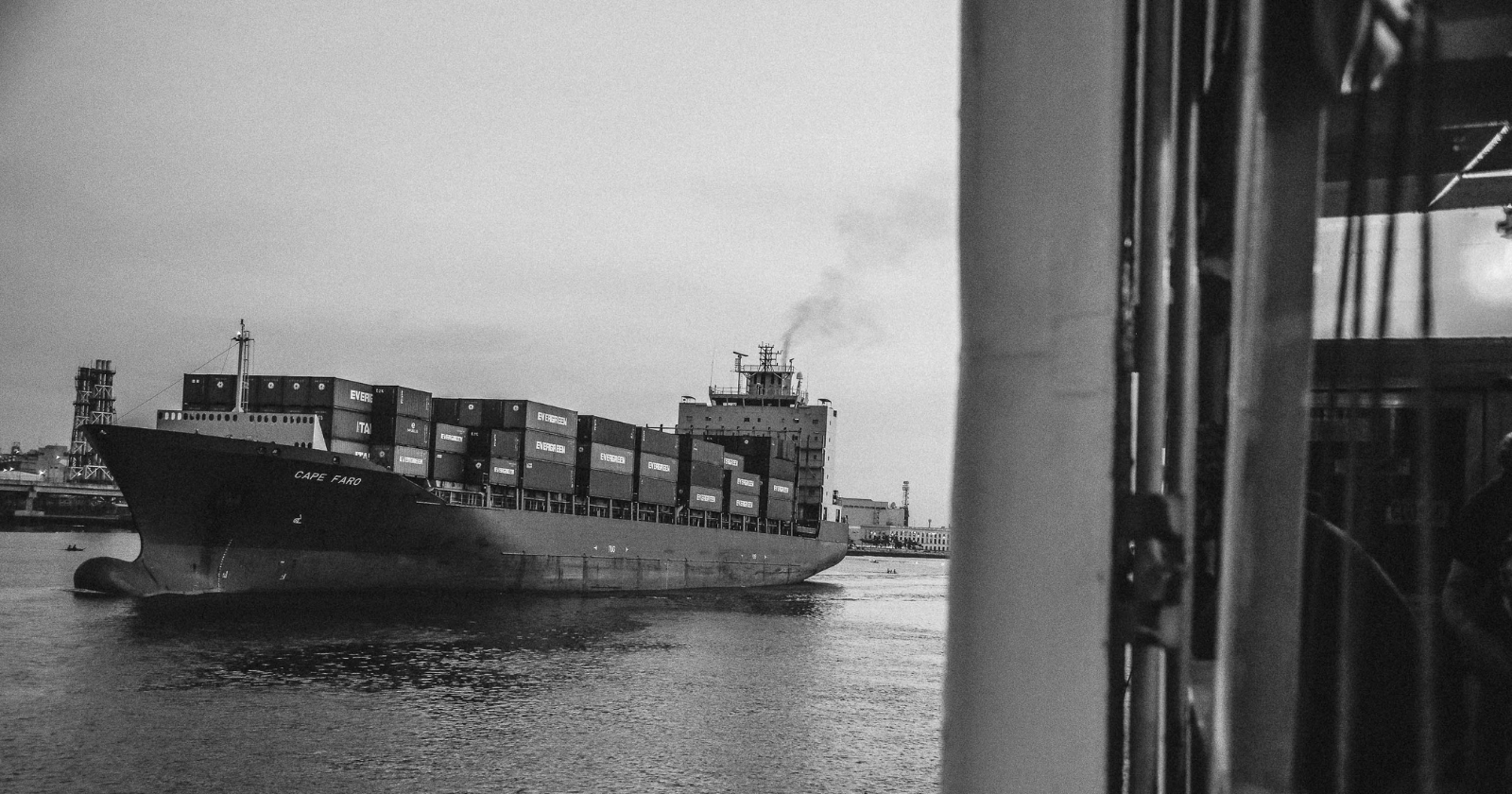
On 26 April 1956, a converted Second World War tanker called the Ideal-X pulled out of Port Newark, New Jersey, with 58 metal boxes bolted to a reinforced deck. Five days later it reached Houston, where 58 waiting trucks drove the boxes away. The man behind it was Malcom McLean, a North Carolina trucking magnate, and the boxes were the first commercial shipping containers. The numbers from that voyage are the reason the industry still talks about it: loading loose “break-bulk” cargo by hand cost about $5.83 a tonne in the mid-1950s, while loading the same weight in one of McLean’s containers came in at roughly 16 cents. A single design decision had cut a core cost of world trade by more than thirty-six times.
The design itself was almost mundane: a plain metal box, 8 feet wide, 8 feet high and 35 feet long on that first voyage, later pared down and standardised by international agreement into the familiar unit the trade still counts in — the “twenty-foot equivalent unit”, or TEU. What made it revolutionary was not the box but everything that had to change around it.
A trucker’s problem, not a shipowner’s
Malcom McLean did not come from shipping. He ran McLean Trucking, one of the largest road-freight companies in the United States, and his frustration was with the docks, not the sea. As economic historian Marc Levinson recounts in The Box, McLean had spent years watching drivers idle away entire days in dockside queues while longshoremen unloaded trucks piece by piece into ships’ holds.
The obsession went back two decades. In 1937, so the story goes, McLean sat in his truck for hours at a New Jersey pier waiting to unload cotton bales, watching gangs carry cargo aboard sack by sack, and wondered why the trailer could not simply be lifted onto the ship whole.
Turning that idea into a business meant colliding with the rules of the day. Federal regulators would not let a single company own both a trucking line and a shipping line, so in 1955 McLean sold McLean Trucking and bought Pan-Atlantic Steamship, a coastwise shipping company with docking rights along the eastern seaboard. His plan was simple: put the truck’s cargo, minus its wheels, straight onto the boat.
The Ideal-X was the crude first draft — a tanker with a strengthened deck, still carrying oil below while the boxes rode on top. By October 1957 McLean’s company, still called Pan-Atlantic and not renamed Sea-Land Service until 1960, was running the Gateway City: a Second World War C-2 cargo ship gutted and rebuilt as the first fully cellular container vessel, its hold fitted with steel “cell guides” that let a crane drop each box into an exact slot.
The change in tempo was staggering. A longshore gang hand-stowing loose cargo might move only a handful of tonnes an hour; a crane working sealed boxes into cell guides could move many times that, and keep going without a break. Turnaround times once measured in days began to be measured in hours.
Where the thirty-six-fold saving actually came from
The 16-cent figure is not magic. It comes from stripping out labour, time and theft, in roughly that order. A traditional break-bulk ship spent, on average, more than half its working life tied up in port rather than at sea.
Dockers physically carried bags of coffee, drums of chemicals and crates of machinery down gangplanks and stacked them by hand in the hold, where everything had to be lashed so it would not shift at sea. A mid-sized freighter might need 200 men working several days to turn around. Pilferage on the New York waterfront was so routine in the 1950s that insurers simply priced it into their premiums.
The waste had been quantified even before McLean acted. A 1954 study of the freighter Warrior, tracing a single shipload of cargo from Brooklyn to Bremerhaven, found that most of the total bill went on getting goods on and off the ship rather than on the ocean crossing itself.
A container closes all of that off. Cargo is packed once, at the factory or warehouse, and sealed. The box is craned onto a truck, driven to the port, craned onto the ship, craned off at the far end and driven to its destination — often without a single human hand touching what is inside.
The UN Conference on Trade and Development has tracked where that leads. A modern vessel carrying tens of thousands of containers can be worked by a handful of gantry cranes and a crew of a few dozen, discharging and reloading in a day or two what once took an army of men the better part of a fortnight.
The standardisation fight
McLean’s first boxes were not the boxes the world uses now. Sea-Land built 35-footers to match the longest trailers allowed on American highways. Its main US rival, Matson Navigation, used 24-footers sized for Hawaiian sugar runs. European and Japanese lines had dimensions of their own.
Without agreement, a container packed in Rotterdam might not fit a crane in Yokohama, and the whole promise of a seamless global box collapsed before it began.
Between 1961 and 1970 the International Organization for Standardization’s technical committee TC104 hammered out a compromise. The resulting ISO 668 standard fixed the external dimensions — 8 feet wide, 8 feet 6 inches high (later 9 feet 6 inches for “high-cube” boxes) and 20 or 40 feet long — and, crucially, set the exact position of the steel corner castings so that any crane, ship, chassis or rail wagon in the world could handle any box.
The final piece was a small one. Sea-Land held the patent on the twist-lock and corner-fitting system — the coupling that lets a crane grab a box and lets stacked containers lock to one another — and released it royalty-free so it could become the world standard. Giving away that mechanism arguably did more for global trade than any single steel box.
What the box actually rebuilt
Once loading costs collapsed, the geography of manufacturing rearranged itself. If moving a tonne of goods from Shanghai to Los Angeles costs pennies rather than dollars, it becomes rational to make almost anything almost anywhere.
UNCTAD reckons that sea transport now carries more than 80 per cent of world merchandise trade by volume; bulk carriers full of oil, ore and grain account for much of that tonnage, but it is the container that carries almost all the world’s manufactured goods. Global container ports handled more than 800 million TEU a year before the pandemic.
The physical footprint of trade changed too. New York’s Manhattan and Brooklyn piers, which had employed tens of thousands of longshoremen, could not fit the enormous gantry cranes or the acres of stacking yard that containers demanded.
Traffic migrated across the harbour to Port Elizabeth, New Jersey, which had the space. London’s docks emptied and moved downstream to Felixstowe; San Francisco’s waterfront shifted across the bay to Oakland. In each case the old dock districts became something else — housing, offices, tourist quays — while the real work of moving cargo relocated to places most city-dwellers never see.
The container also quietly created the conditions for the internet-era supply chain. A modern smartphone carries parts from dozens of countries, and the assumption behind that arrangement — that intercontinental freight is essentially free next to the value of what is shipped — is a direct inheritance of McLean’s 16-cent number. It sits alongside the roughly 550 undersea cables that carry about 99 per cent of international internet traffic as one of two physical systems that make globalisation work: one moves atoms, the other moves bits, and both are all but invisible to the people whose lives depend on them.
What the container did not fix
Honesty matters here. The container did not so much eliminate cost as move it. Ports became enormously capital-intensive: a single ship-to-shore gantry crane now runs to more than $10 million, and a modern terminal is a multi-billion-dollar civil-engineering project.
Dockwork collapsed as a way of life. The International Longshore and Warehouse Union watched its US west-coast membership shrink through the 1960s and 1970s as machines did what gangs once had, and the political fights over automation on the docks have never really stopped.
The environmental bill is real as well. Shipping accounts for roughly 3 per cent of global carbon-dioxide emissions — a share that exists at all only because moving things across oceans became so cheap that the world chose to do vastly more of it.
McLean himself did not end well in business. Sea-Land was sold to R.J. Reynolds in 1969; a later venture, United States Lines, went bankrupt in 1986 after he bet on a fleet of fuel-efficient but slow ships just as oil prices fell. He died in 2001. The industry marked his passing by sounding container-ship horns in ports around the world — a low, layered blast rolling across harbours he had emptied of men and filled with steel, for a trucker who never much wanted to be a shipowner and rebuilt the plumbing of the modern economy anyway.