

Facebook probably isn’t on the top of your list of companies that you would trust to issue a secure, private cryptocurrency, but that’s exactly what they’re proposing to do in 2020 with Libra, a stable, asset-backed token that will be tradeable via their Calibra wallet (to be built into Messenger and WhatsApp) and other apps.
With more than 2 billion monthly active users, Facebook’s foray into finance is undoubtedly going to make some waves, so it’s worth it to understand exactly what they plan to do and how it works. If you understand Bitcoin, it may be tempting to apply that knowledge to Libra and call it a day, but aside from both being based on blockchain technology, they’re extremely different beasts.
Also read: 6 Strategies for Safe Cryptocurrency Trading
What is Libra?
Currently, Libra is a whitepaper and a bunch of code being developed by Facebook (though you can check out the testnet if you want). In 2020, though, it will be a fully-functional, stable cryptocurrency that you can buy with real-world money and send to other people online.
They’re aiming to make it accessible to the hundreds of millions of people around the world who have access to the Internet but no access to financial services, making sending money as easy as sending a text message. It can be transferred with basically no fees (just a small one to deter spammers), which may be a big shake-up in the financial services world.
But that’s really no different than thousands of other cryptocurrencies that are trying to streamline payments, make international money transfers easier, and bank the unbanked. Honestly, it’s pretty much reinventing a wheel that’s already been reinvented many times. So what’s generating all the buzz?
The basics
For the crypto-savvy, here’s the short version, taken from the official Libra whitepaper:
- It’s a stablecoin tied to the value of a basket of low-volatility fiat currencies and fully backed by cash reserves.
- At first, only certain large, trusted companies (the Libra Association) will be allowed to run validator nodes, but this will eventually be open to the public (proof-of-stake).
- Facebook will only be one of dozens of voting members in the Libra Association governing the blockchain.
- It’s pseudonymous and doesn’t necessarily require real-world identity verification to use.
- Transactions are not connected to your Facebook data.
- It uses the new Move programming language, specifically developed for writing blockchains and smart contracts.
- It will be open source and available to third-party developers, though the official Calibra wallet will be integrated into Messenger and WhatsApp.
Let’s break some of those down.
Also read: Cryptocurrency vs. Blockchain – What’s the Difference?
It’s a stablecoin backed by real-world assets
A stablecoin is pretty much just what it sounds like: a cryptocurrency that stays very close to the value of a real-world asset (like the U.S dollar), meaning it’s not risky to keep your money there for a while since you can be relatively sure that your buying power won’t change much. The Libra isn’t tied to the U.S dollar, though. Instead, it gets its value from a “basket” of several different currencies that are known for being stable (dollar, euro, yen, Swiss franc, etc.).
The technical financial details for how this will work are a little more complex, but all you really need to know is that whenever you buy a Libra, the blockchain will mint a Libra to give to you. When you sell your Libra for currency, that Libra is then “burned” (destroyed), meaning there will never be more Libra than real money in the system. This is pretty much the same as other popular stablecoins like TrueUSD; Libra’s cash reserves will likely be monitored and audited by neutral third-party firms.
Facebook is giving control to the Libra Association
The Libra Association, headquartered in Geneva, Switzerland, is Facebook’s answer to the trust issues it has inspired in many of its users. By distributing the control of Libra among many other companies, the project can stay separate from Facebook’s main operations and be relatively free from direct interference by any one entity. The association might have up to a hundred members by 2020, with big names like Uber, Visa, and Andreessen Horowitz currently participating as investors, decision-makers, and, most importantly, transaction-validators on the network.
Each participating company gets a vote, meaning Facebook can’t make unilateral decisions. It does have two votes, though, since it is participating both as Facebook and as Calibra, the subsidiary company Facebook has formed to be its main Libra service provider. (It will do things like run wallets, provide support, and design new Libra-based products.)
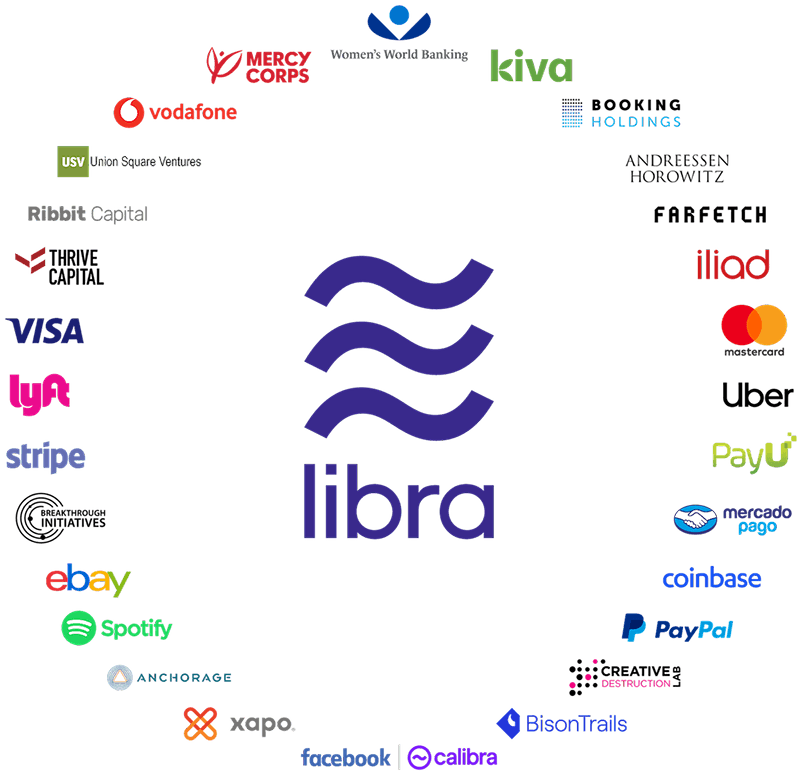
Seasoned cryptocurrency veterans will recognize this as a “permissioned” blockchain, meaning only certain trusted entities are allowed to do the actual work of running it. This means it’s not decentralized (one of the major differences between Libra and many other cryptos), but as long as you collectively trust some of the biggest companies in the world, you can be pretty sure that nobody is maliciously controlling the network. Again, though, Facebook knows it has a trust problem, and in order to make this whole thing more palatable, they say they will eventually allow anyone to participate as a validator on the blockchain, creating a more decentralized “permissionless” system.
Also read: 5 Up-and-Coming Cryptocurrencies to Look Out For
Facebook says it won’t look at your spending
This is the first concern that crops up for most people. Facebook isn’t exactly known for its hands-off policy when it comes to user data, so it makes sense that a Facebook-created cryptocurrency with Messenger and WhatsApp integration would be just another opportunity for them to serve you ads, right? That’s a fair concern, but Facebook’s answer is: “We promise we won’t look!”
Your Libra spending will be pseudonymous, meaning your transactions will be publicly visible (that’s just how blockchains work, usually), but they won’t be connected to your identifying information, including your social media profiles. This definitely doesn’t mean complete anonymity, since you’ll still have to sign up for a wallet and probably go through some identity verification to get it, but they promise strong encryption and privacy protections, so you can at least be reasonably sure that Facebook won’t know what you do with your Libra. You’ll actually be able to use Libra without connecting it to a Facebook or WhatsApp account at all – just sign up for Calibra or one of the third-party wallets that will be developed.
What does Libra really have going for it?
Aside from an interesting new programming language, the biggest force behind Libra is the massive resources and scale of the company behind it. Facebook is a juggernaut, and when they integrate payments directly into Messenger and their other apps, it won’t matter at all that it’s crypto-powered. People will use it to send money and buy things, and it will probably be very useful.
For those who care about that sort of thing, the move towards decentralization and the general promises of privacy are nice bonuses, but Libra will probably take quite a bit of business away from other stablecoins and cryptos that are focused on international transfers and the like. We’ll have to wait for it to come out to see just how much it lives up to the hype, but given that Facebook regularly interacts with about one-third of the world’s population, Libra has a pretty good chance of becoming a popular currency worldwide (as long as it doesn’t get into too much trouble with central banks and governments). And let’s be honest: it’s probably better to have this as a universal currency than something like WeChat Pay.
Image credits: Libra.org