

If you love to read, you know how expensive it can be to feed your literary habit. Prime Reading is included with an Amazon Prime membership and offers numerous books for you to read every month.
[mte_toc]What Is Prime Reading?
Prime Reading is one of the many benefits of an Amazon Prime membership. It’s not the same as Kindle Unlimited. Instead, it’s a smaller selection that works much like a library. Read as much as you want from a rotating selection. You don’t have to pay anything extra.
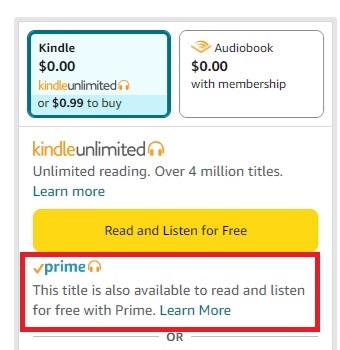
The library includes ebooks, audiobooks, comic books, and magazines. And, there are no limits. Want to read 100 books in a month? Go for it. Simply look for titles that say This title is also available to read and listen to for free with Prime.
How Large Is the Prime Reading Library?
Currently, you’ll find several thousand titles available. But titles rotate in and out, so if you’re looking for something specific, keep checking back. You’ll find a mix of new bestsellers, classics, self-published, and everything in between.
If you’re on the fence about whether this benefit is worth it, check out the current selection of titles by browsing the Amazon books section and filtering by Prime Reading. You can also see some of the most popular titles on Amazon’s Prime Reading page. (Buying through this link may earn us a commission, at no extra cost to you.)
How Often Are New Titles Added?
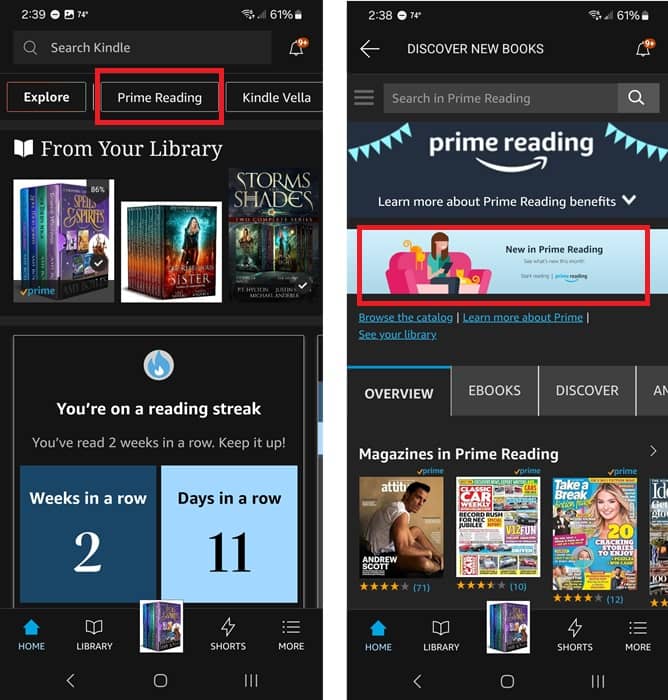
New titles are added each month. Of course, that also means some are removed. I highly recommend checking back frequently to see the new titles that are available. Each month, check the Prime Reading section on Amazon’s desktop site or open the Kindle app and tap Prime Reading near the top. Tap New in Prime Reading to view the latest additions, including editors’ picks.
Another often overlooked benefit is the free monthly book. Each month, Amazon’s editors choose a selection of First Reads. If you’re a member, you get to pick one book to download and keep for free. They’re usually discounted to $1.99. Sometimes you will get two for free. A new selection is available monthly, and the genres vary.
How Many Books Can I Check Out at the Same Time?
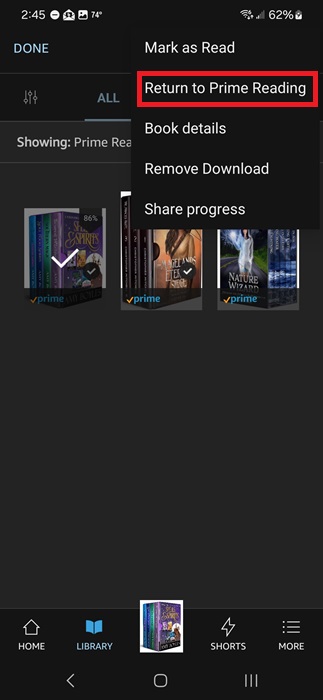
While you’re free to read as much as you want, you can only check out 10 items at the same time. As soon as you finish a title, the Kindle app prompts you to return it. Or, long-tap the title in your Kindle library, and select Return to Prime Reading.
Your 10-book limit applies to all items in the library, so if you have two magazines, three comics, and five ebooks, you’ll have to return at least one title to borrow anything else.
Where Can I Find All My Prime Books?
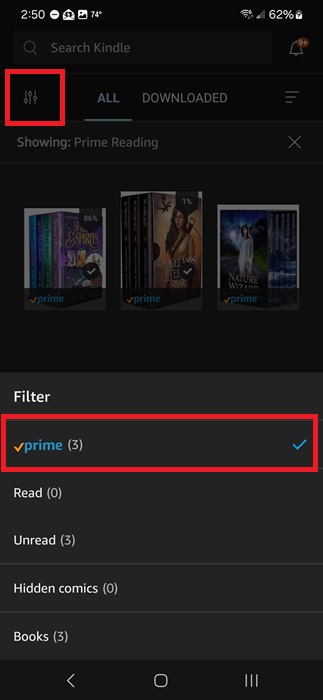
If you’re like me, you could borrow several books, get busy, then forget about them. Quickly check what you’ve borrowed by opening the Kindle app and tapping Library at the bottom. Use the Filter button just under the search box, and select Prime. Only Amazon Prime Reading titles show.
How Long Can I Keep a Prime Reading Book?
This is my favorite part about the Prime Reading benefit. Once you borrow a book, keep it as long as you want to finish reading it. Even if the title is removed from Prime Reading after you borrowed it, it’ll remain available to you indefinitely.
However, if a title is removed from Amazon completely, it will disappear from your library. That applies even if you’re using Kindle Unlimited.
For example, I borrowed a box set with 10 novels from a single series. This only counted as a single title since it was a box set. I also borrowed several other titles the same month. It took me three months to finish the box set, even though the title was removed from Prime Reading at the end of the first month. So, there’s no rush to finish.
I recommend grabbing a few extra titles if you see something you really like, just in case you can’t find as many great options the next month.
Is Prime Reading Better Than Kindle Unlimited?
It all depends on what you like to read. Kindle Unlimited is a separate subscription with over four million titles, while Prime only has thousands. It costs $11.99/month. If you don’t really use any of the other Prime benefits, it’s cheaper to subscribe to Kindle Unlimited, since Prime itself is $14.99/month.
If you don’t mind a smaller library and enjoy other Prime benefits like free shipping and Prime Video, I’d recommend Prime Reading. Personally, I use most of the benefits, even though Prime Video has ads now.
Remember, though, Kindle Unlimited and Prime Reading aren’t your only options for unlimited monthly reading. Try these Kindle Unlimited alternatives for even more choices.
Which Devices Are Compatible With Prime Reading?
Easily access all Prime Reading titles from any device that supports the free Kindle app, including iOS, Android, Windows, macOS, and most web browsers, with the Kindle Cloud Reader. You don’t have to have a Kindle device.
If you can download the Kindle app on your PC, tablet, smartphone, etc., you can access all Kindle titles. Plus, the app is completely free.
Prime Reading might have a smaller library, but it’s included with Prime and even gives you a free book every month. If you’re a Prime member, start reading immediately. If you’re not, this could be the benefit that makes Prime worth it.
Image credit: Unsplash. All screenshots by Crystal Crowder.