Ideally, you should do your own research and find out why a fact exists or not. Now, there are situations you may need to supplement the research you’ve started, or need a starting point or skeleton to work with. ChatGPT and Gemini are powerful, but if you’re doing academic work, checking facts, or writing a paper, asking the right AI tools matters. These AI tools weren’t built for rigorous research. That’s why I turned to Consensus AI, and I’ve found it more reliable for evidence-backed facts.
Why You Shouldn’t Use ChatGPT or Gemini for Research
Tools like ChatGPT and Gemini rely on language models trained on massive internet data. They’re great at generating easy-to-understand summaries, essay drafts, and even answering general questions. But they’re not designed to validate facts or cite real studies.
From my experience, when you ask ChatGPT a question, it usually provides an answer with no way to verify its authenticity, and for me, this is important. If you’re not entirely doing the research, you should know where the information is gotten from, at least.
Even when the answer is correct, telling ChatGPT it is wrong can make it accept that false correction. This becomes a big problem when you need to validate the facts it presents to you.
What Makes Consensus Different
Unlike general-purpose chatbots and generative AI, Consensus was built from the ground up for research backed by evidence found and based on millions of research papers. Consensus doesn’t predict; it provides users with direct citations and summaries from those sources.
Most of its capabilities are in finding research papers and then summarizing the various studies to garner the consensus on a particular topic.
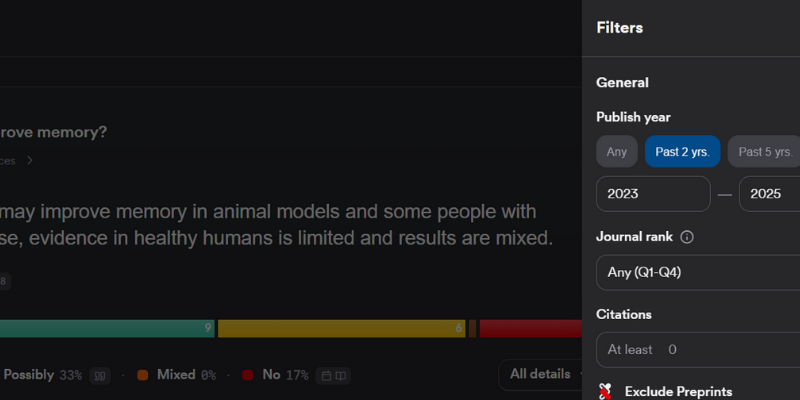
For example, if you ask Consensus, “Does coconut oil improve memory?”
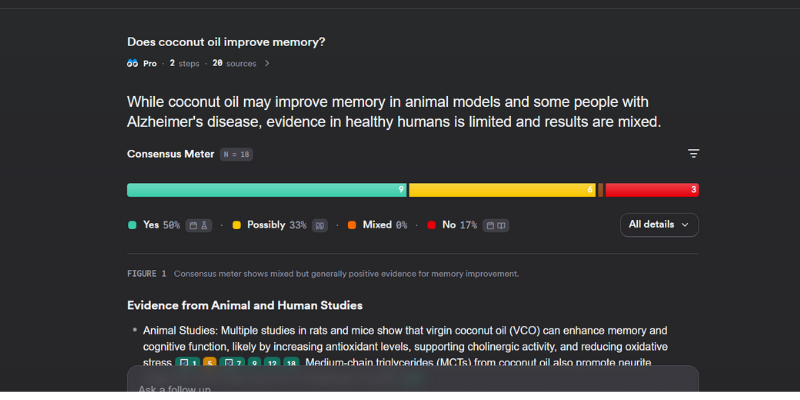
It doesn’t give you a yes or no immediately, but rather the consensus of what various studies have found.
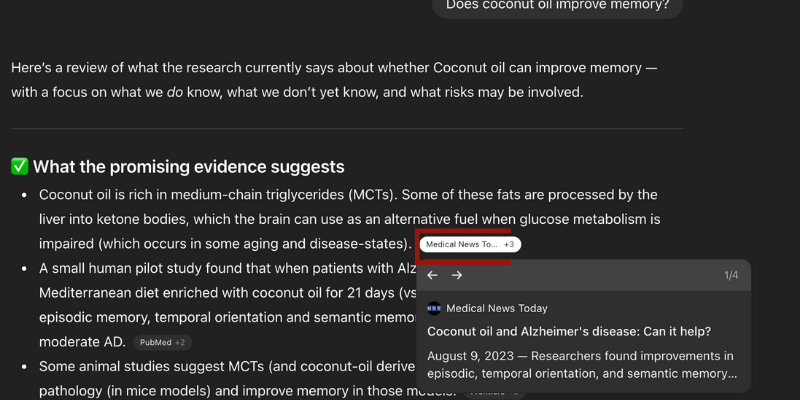
ChatGPT, on the other hand, gives you a rundown of the situation, but where it got that information from is unknown, as it seldom includes links without proper prompting. The same goes for Gemini.
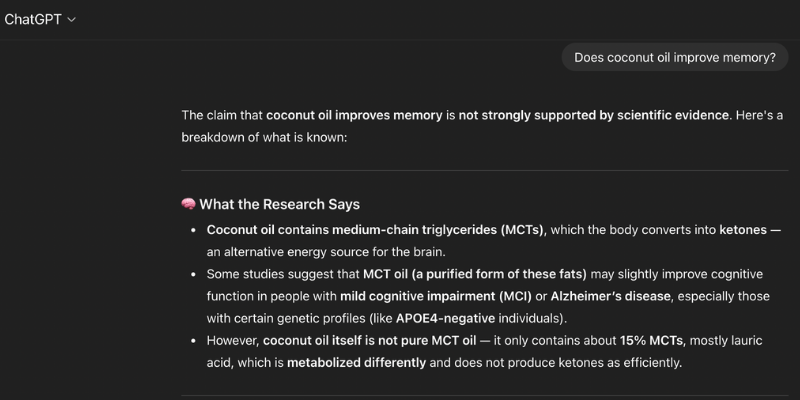
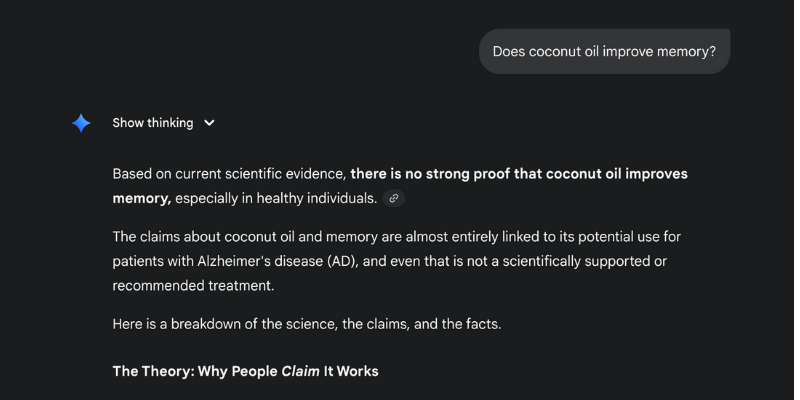
Even if you try to research using ChatGPT Plus, you don’t get a consensus result. While sometimes it gives you a result with a link, this isn’t consistent. If you ask a similar research question, there’s a chance no research links will be waiting for you.
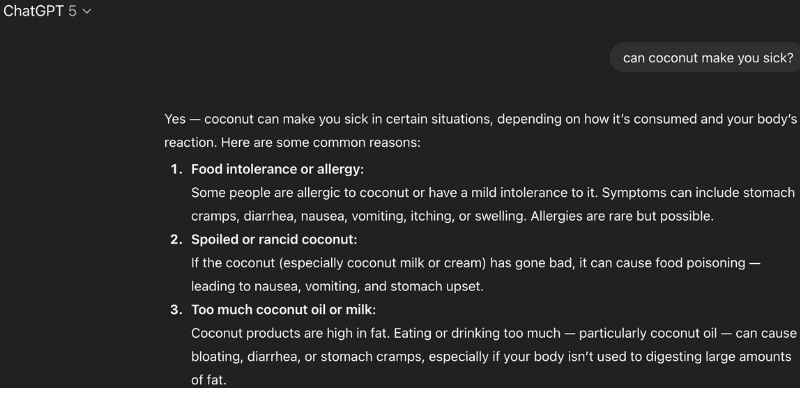
Now, unlike ChatGPT and Gemini, which may often give you outdated information, Consensus AI allows you to filter out your research question to more recent years, which I find incredibly helpful when researching in fast-growing fields.
Quick Tip: When using Consensus AI, combine keywords with Boolean operators like AND, OR, and NOT to narrow your search results. For example, instead of searching “Does coconut oil improve memory?”, try: “coconut oil” AND “memory” AND “clinical trial.”
When to Use Consensus
When it comes to exploring concepts, brainstorming ideas, writing, or discussing open-ended topics that don’t rely on hard data, ChatGPT, Gemini, and similar models are the go-to tools. You can’t ask Consensus AI what to eat for breakfast, whether now is the best time to read a certain book, or to draft a learning guide for a new skill, as those still fall within ChatGPT and Gemini’s territory.
However, if you want to confirm information from those models using peer-reviewed and evidence-backed papers, you should use Consensus AI. It serves as a better tool for academic projects, professional reports, and verifying claims.
A nice hack would be to start with ChatGPT for outlining or generating the concept, then switching to Consensus AI to confirm whether the claims hold up scientifically.
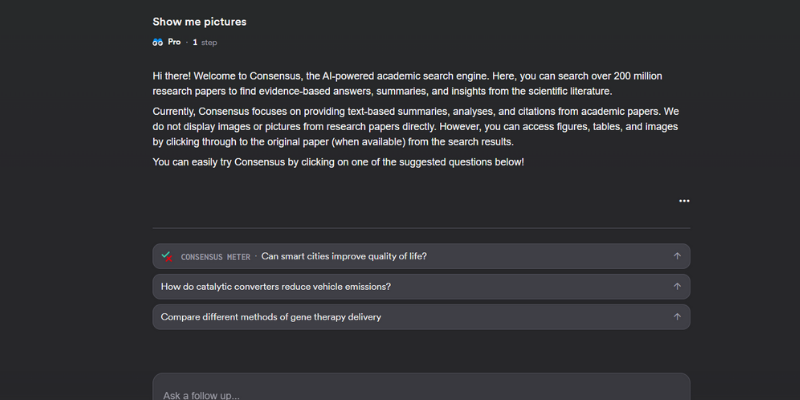
Consensus AI also has a few missing features you’d normally see in other generative AI, even ones focused on text, due to its highly specific nature. It can’t generate pictures, and when you give it a command, it cannot execute; it responds by telling what it can do.
Pricing and Subscription Plans
Consensus AI has three pricing plans, and for most students or solo researchers who don’t need hundreds of deep literature reviews a month, the free plan already gives a lot of value.
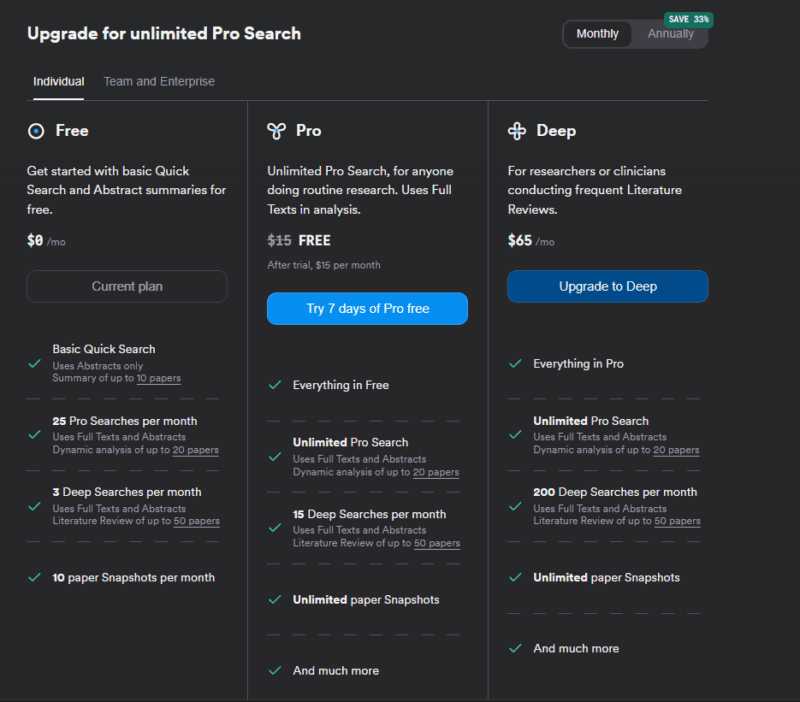
However, if you do begin to have regular research needs, like writing multiple papers, working on a thesis, or compiling various citations, then the pro plan is likely the sweet spot, as it balances cost and ability.
Very few people would need the Deep or Team plans, as they’re more geared towards heavy users, like labs, clinicians, systematic reviewers, or commercial researchers. If you fit into this category, the high limits become worth it.
For students, if you need this urgently for a paper, and your pockets don’t run deep, I’d recommend you Try 7 days of Pro for Free. However, make sure you remove your card on or before the 7 days elapse, or you could wake up to an unplanned debit.
Consensus is a great AI for research, but education search engines for academic research can also help you find peer-reviewed and evidence-backed resources. If you want to explore the latest AI models for free and discover tools like Consensus, this platform offers a good starting point.