
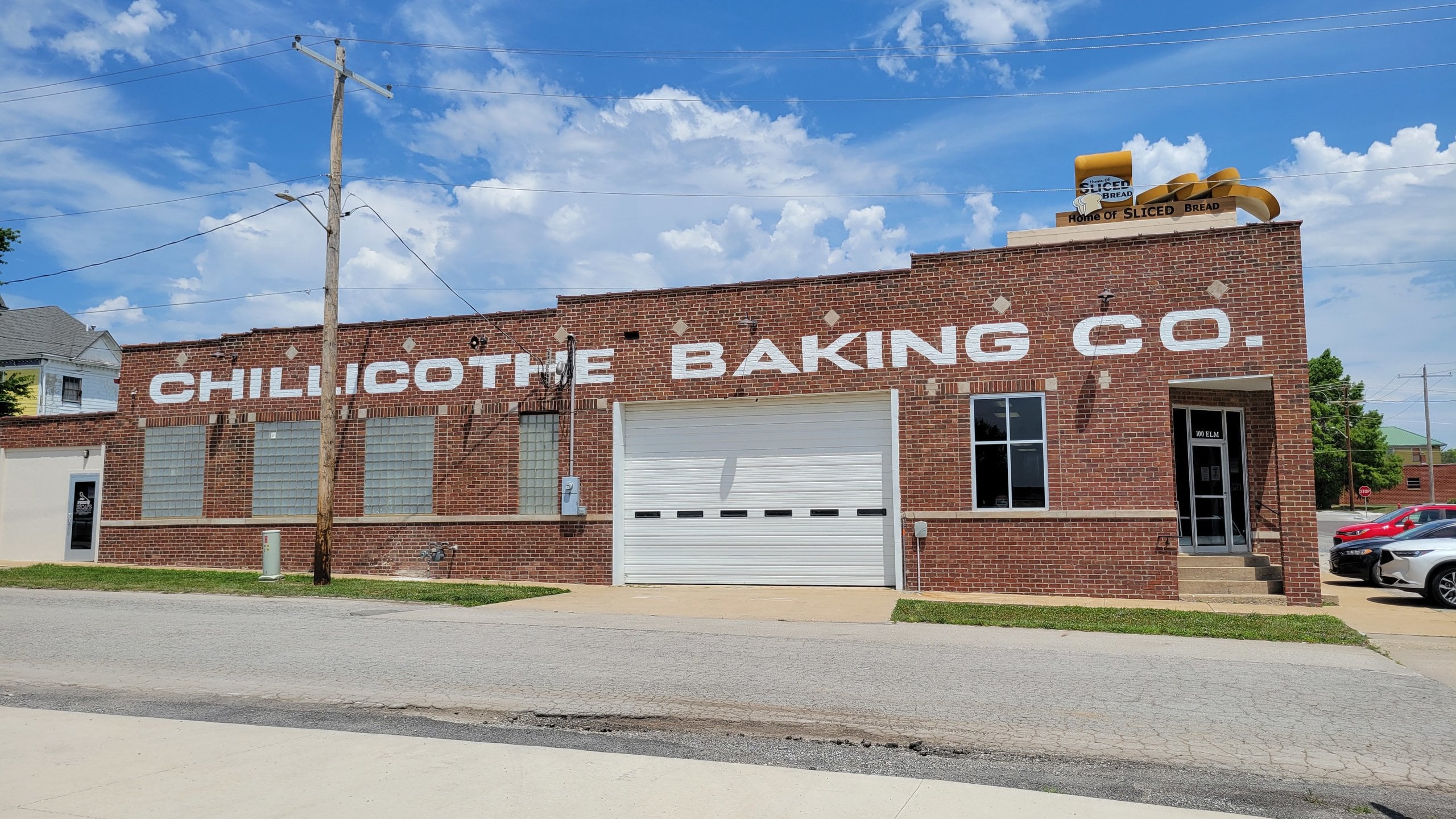


On 7 July 1928 the Chillicothe Baking Company in Chillicothe, Missouri sold its first loaf of sliced bread, cut by Otto Rohwedder’s machine and sold under the name Kleen Maid Sliced Bread, according to the Lemelson-MIT Program.
The machine that cut that first loaf lasted about six months.
The Smithsonian’s National Museum of American History says Rohwedder’s first automatic slicer fell apart after about six months of heavy use at Bench’s Bakery in Chillicothe. Bench’s Bakery and the Chillicothe Baking Company were the same business. Frank Bench, an old friend of Rohwedder, ran it, KCUR reported in 2022.
Bench and Rohwedder had worked together before on a bread display rack. Bench agreed to try the slicer after other bakers turned it down. “Bakers scoffed at the idea,” Catherine Stortz Ripley, a former editor of the Chillicothe Constitution-Tribune, told KCUR.
The Chillicothe Baking Co. placed an advert in the Constitution-Tribune on 6 July 1928, the day before the first loaf went on sale. “The idea of sliced bread may be startling to some people,” the advert said, according to the text KCUR published.
Ripley told KCUR that the bakery’s sales rose 2,000 per cent within two weeks.
Rohwedder had been working on the idea since about 1912. One early prototype held the sliced loaf together with metal pins. In late 1917 a fire destroyed his blueprints at a factory in Monmouth, Illinois that had agreed to build his first slicers. By 1927 he had a machine that both sliced and wrapped the bread.
The second machine
The machine the Smithsonian holds is Rohwedder’s second automatic slicer, made in 1928.
The Micro Machine Company of Bettendorf, Iowa built it for Rohwedder’s Mac-Roh Sales and Manufacturing Company in Davenport, Iowa. Korn’s Bakery in Davenport, his home town, used it to slice fresh loaves from late 1928. The machine is made of steel and measures 57 by 38 by 72 inches.
Within a year of the Chillicothe launch, Rohwedder was struggling to keep up with requests from bakeries for his machines.
The patent and Wonder Bread
The Great Depression hit in 1929 as Mac-Roh was getting started, and Rohwedder sold the rights to his invention to Micro-Westco Co. of Bettendorf, which hired him as a vice president and sales manager in its Rohwedder Bakery Machine Division. By 1930 the Continental Baking Company was selling sliced bread under the Wonder Bread label.
Rohwedder wrote in the June 1930 issue of the trade journal New South Baker that “the real possibilities of Sliced Bread have scarcely been scratched.” US patent 1,867,377 for the slicing and wrapping device was issued to him on 12 July 1932. By 1933 bakeries were selling more sliced bread than unsliced.
Bench lost his bakery during the Depression, KCUR reported.
Rohwedder was born in Des Moines on 6 July 1880 and died in Concord, Michigan on 8 November 1960. The museum’s record says his daughter, Margaret R. Steinhauer of Albion, Michigan, donated the second machine to the museum in 1974.
Sources:
- Lemelson-MIT Program, Otto Rohwedder: https://lemelson.mit.edu/resources/otto-rohwedder
- Smithsonian National Museum of American History, Bread-slicing Machine: https://americanhistory.si.edu/collections/object/nmah_1317263
- KCUR, 6 July 2022: https://www.kcur.org/history/2022-07-06/chillicothe-missouri-sliced-bread