

Since its introduction, fiber optic Internet has been lauded as an innovation that would push broadband speeds forward significantly. Years later, we find this prophecy fulfilled, with Internet connections equaling 100 Mbps in downstream speeds, many of them reaching speeds much higher than that (i.e. 1-10 Gbps). What most people don’t understand, however, is why these speeds are achievable in fiber but not necessarily practical in the old copper infrastructures we relied on for decades. Perhaps this is something we need to discuss in order to fully understand why fiber optic Internet is so beneficial to consumers and businesses.
How They Work
I can’t just go out and tell you why fiber optic connections are faster than whatever copper can provide without giving you the details of how each one works. Both of them have one important thing in common: They send signals across a particular distance. However, the way they send this signal is different.
Optical Fiber
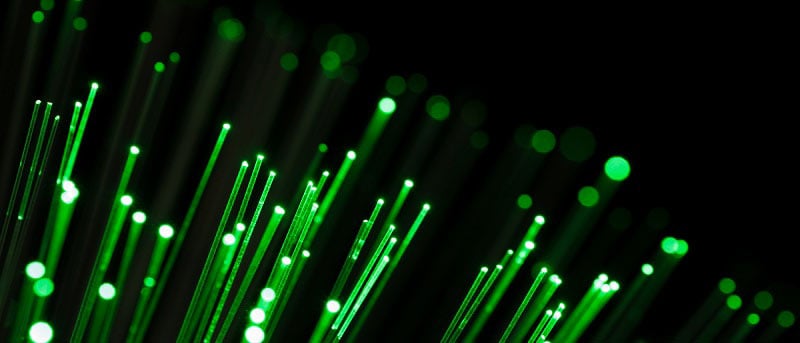
Have you ever seen those lamps used at parties that have strands of glossy “hair”? When you turn on the lamp, the ends of each strand lights up, yet everything that’s not the end remains unlit.

That’s mostly why fiber optics is used in communications. It conserves the data being sent by not allowing light to stop around the middle, which can be highly beneficial when you’re trying to transfer data over long distances. If you plug in to the Internet through a fiber optic cable, there’s a little light show going on in there. This is what a fiber optic cable looks like:

Copper
Copper communication works by sending electrical pulses through a copper wire. It’s that simple. The power of the signal dictates how much of it will be retained by the time it reaches its destination. At the destination (e.g. the router), the wire’s electromagnetic field is constantly monitored for changes. As the field gets stronger, the destination registers a “1.” If it dips below a certain measurement, a “0” is registered.
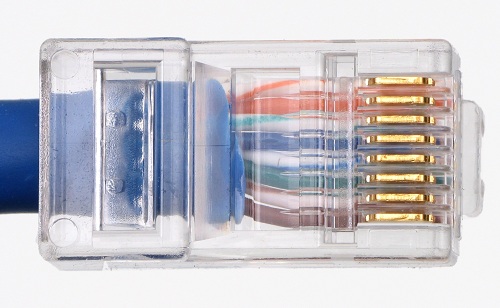
Copper cables must have several wires built in to accommodate the mechanisms that allow Ethernet routers to properly process signals.
Why Fiber Is Faster
Copper suffers from a significant signal-loss issue. To accurately read a signal, you have to know the exact moment the signal has stopped and the exact moment it began. As a signal is forced to travel farther, the difference between a start and a stop (zero and one) gets very fuzzy. Copper is best used for maintaining a continuous electrical current since it’s a great conductor. However, for signalling, it remains a very poor material. It’s still great for local networks, but not necessarily something we should be using for global communication infrastructure, considering that Cat6a copper cables can lose 94 percent of their signal at 100 meters distance (this is the industrial maximum for signal loss through copper).
Researchers have recently been able to send data at 10 Gbps through copper, but at distances no larger than 30 meters.
Fiber, on the other hand, can theoretically send terabytes per second of data without so much as a 3-percent data loss over 100 meters. Two things are at play here: the signal retention and signal clarity. Not only do you absolutely know when the signal began and ended, but you receive a very strong signal across the wire. This allows communication at dizzying speeds so fast that most routing technologies still can’t process them fast enough.
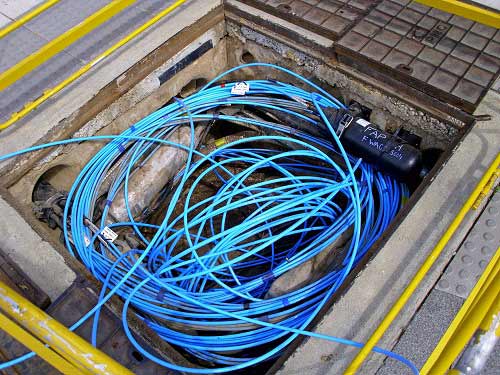
Through the signal’s lifecycle, fiber does another very important thing: It protects the signal from any electromagnetic interference. EM fields can influence how copper transfers data, but since optical fiber is made of extruded silica, it’s magnetically neutral. If you would have a perfect cable (there’s no such thing yet), you could theoretically send a signal across the United States without making any stops along the way.
Conclusion
Fiber is cheap, plentiful, easy to upgrade, and very reliable. There’s really not much to say against it. Copper no longer represents a worthwhile investment and should be retired. If you still have questions about fiber vs. copper, please leave a comment below!