
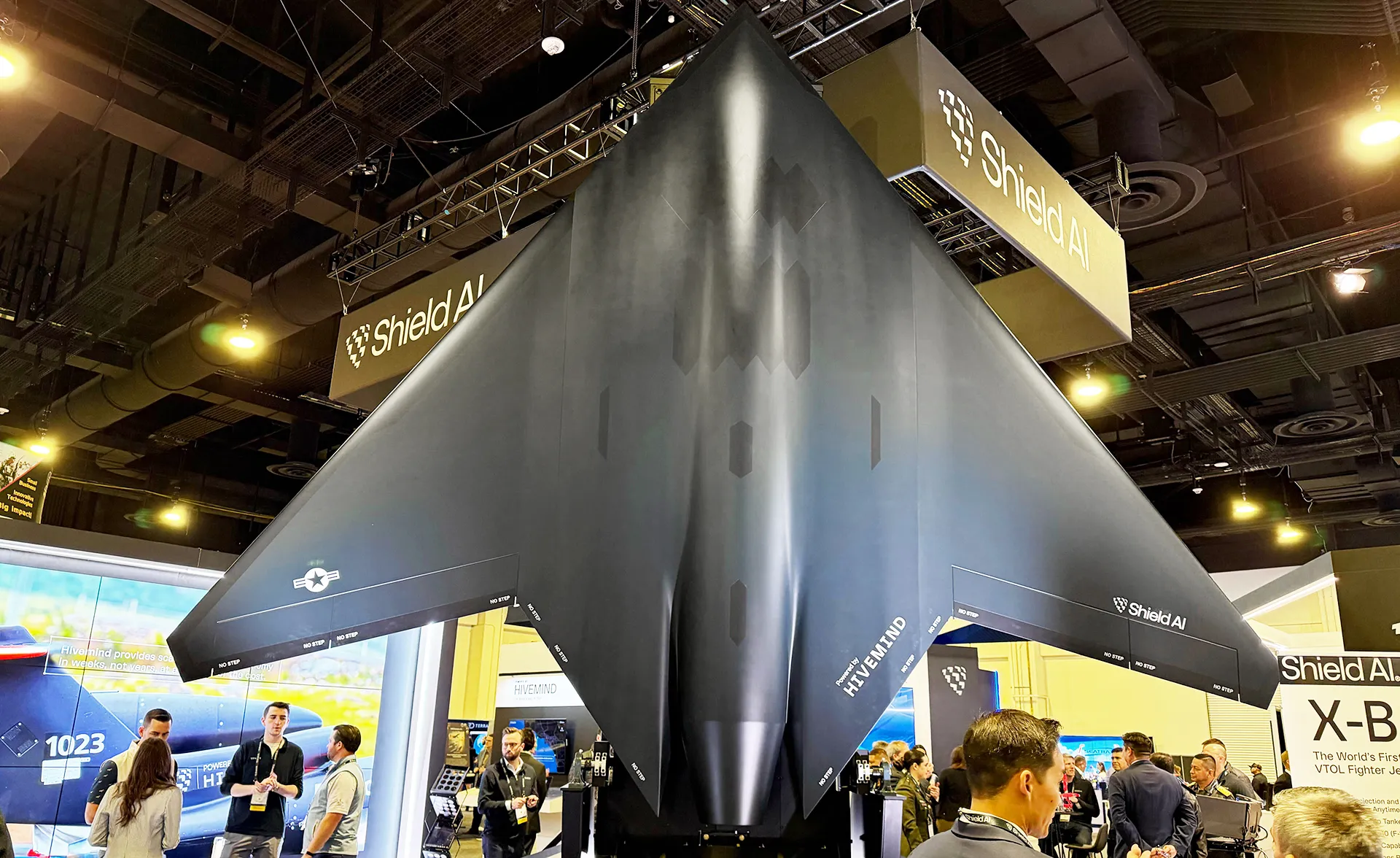


Shield AI says it has completed the first full-scale prototype of X-BAT, the autonomous vertical take-off and landing strike fighter whose design it made public a year ago, and that the aircraft will be suspended from a crane for testing before it flies untethered, according to a 4 November post by Armor Harris, the company’s senior vice-president of aircraft engineering.
“Next, we suspend the aircraft from a crane for testing before moving to untethered flights,” Harris wrote. “The crane is only for testing. It exists purely as a safety mechanism to hang the vehicle from, so if we have an engine stall or other issue, we don’t crash the vehicle.”
A prototype Shield AI says took a year
The company shared its design and vision for X-BAT a year ago, describing it as the world’s first autonomous VTOL strike fighter. Harris wrote that the first full-scale prototype is now complete, and that the build represents “a year of sustained effort and discipline from a team that committed to an ambitious design and build schedule and delivered”.
Shield AI says the past year of work with US government subject matter experts included wind tunnel testing, engine testing and thermal testing to address major technical risks. Harris wrote that working through those risks together “gives us the confidence to build and test the aircraft at the speed America and its allies need”.
Harris gave the company’s reason for the schedule: “a capability is only useful if it arrives in time to matter.” Shield AI cannot take decades to develop an aircraft “when the need is already here”, he wrote, and that urgency has shaped the engineering work and how the company works with partners in the US government.
Shield AI says the same reasoning shaped the design. Harris wrote that no one can predict what the fight will look like 10 or 20 years from now, so the company is developing an aircraft for today’s operational needs while giving it the versatility to stay useful as those needs change. Shield AI says X-BAT was sized as a multi-role aircraft, big enough to carry strike weapons internally and externally and able to execute air-to-air, electronic warfare and other mission sets.
What the crane is for
Harris set out four stages in the test campaign, in the order Shield AI plans to run them:
- “The test campaign starts with the vehicle horizontal, sitting on the launch and recovery vehicle, running the engine.”
- “Then we bring it up vertical and run the engine and the vehicle vertically.”
- The aircraft suspended from a crane for testing.
- Untethered flights.
The crane step comes before any untethered flight. Shield AI says the crane is only for testing, and that its purpose is to hold the vehicle so an engine stall or other issue during a test does not crash it.
Launch and recovery first
Harris wrote that the current work is “focused on launch and recovery and making the envelope for that as wide as possible”. Shield AI says the phase the prototype is entering is meant to prove out the vertical take-off and landing technology, which the company says gives commanders more places to operate from and makes the aircraft harder to find and destroy.
The company’s case for that design rests on the exposure of parked aircraft. Shield AI says adversaries have invested in long-range missiles that put aircraft at risk when they are on the ground, and that aircraft are hard to shoot down in the air and easy to destroy on the ground. Shield AI says an X-BAT could operate from a ship in the middle of the ocean, from an island in the first island chain or from another theatre, forcing an adversary to spend time and energy looking for X-BATs rather than watching known airbases.
Harris closed the post on the testing still to come: “We’ve built the first aircraft. Now it’s time to go prove what it can do.”
Image: X-BAT display model at Eurosatory 2026, by Silkoreo, licensed under CC BY-SA 4.0 via Wikimedia Commons. The photograph is a stand-in and shows a display model, not prototype X-BAT 001. Reuse must carry the same credit and licence, and derivatives stay under the same licence.