


If you’re streaming content from services like Netflix and Hulu, you may have seen a prompt to install Google Widevine. Depending on your device and browser, it may already be built in by default. Either way, many users want to know exactly what it is and what it does. The good news is it isn’t a virus and it’s safe. It’s also required to view certain streaming content.
Also read: What Is Web DRM and How Does It Affect You?
What Is Google Widevine DRM?
Google Widevine is a digital rights management (DRM) service used to help protect online content from piracy. It’s used by a wide variety of popular streaming services to prevent users from downloading or copying their TV shows and movies.

While some services support other types of DRM tools, some only support Widevine. It’s built in to many Android devices and Chromium-based browsers, meaning it’s already installed. You may be prompted to enable it the first time you try to watch a streaming service that requires it. If you don’t, you’ll receive an error that the content can’t be played.
Widevine is required in order to watch streaming services such as Netflix, Disney+, Hulu, Amazon Prime Video, and many more. Since the content is protected by Widevine, there’s no other option.
The reason you have to install the tool is because the content protection processing occurs on the user’s device. This aids in preventing any outside tampering.
Device Compatibility
One thing you need to know about Google Widevine DRM is it’s not compatible with all devices. However, it’s such a trusted service by so many major video content providers that you’ll find it’s compatible with most devices. Most Android devices released since 2017 are compatible, though some lower-end devices may have issues. You can check your Android device’s DRM support by using the DRM Info app. Widevine is available for iOS 6.0 and up.

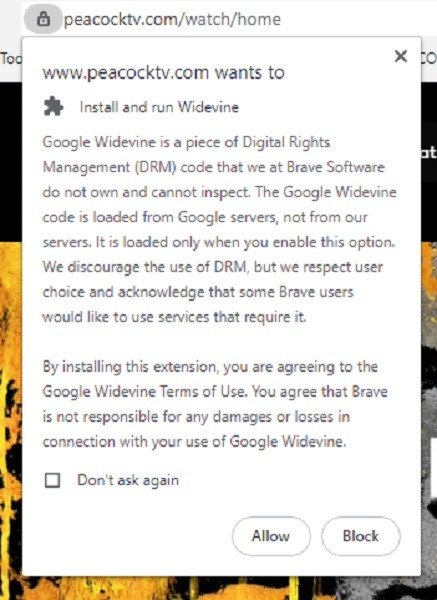
As mentioned before, Widevine is a part of Chromium-based browsers. However, you may still be asked to enable or install the extension. For instance, I was prompted to install the extension when using Brave, which is Chromium-based, but focused more on security.
Many smart TVs and streaming devices support Widevine to allow access to streaming apps. If an app is listed as supported by the device, then it also has Widevine built in. There are also ways to view streaming services on Linux as well.
Video Quality Issues
If you notice your device is restricted to only streaming at a certain quality, this may be due to the security level your device supports. Any Google Widevine supported devices must support L1, L2, or L3 security, with L3 being the highest security level.

To stream full HD-quality, your device has to be L3 certified. However, many are only L1 certified, which is easier to achieve. The protections in place aren’t as good, which is why streaming services don’t allow these devices to stream the higher video quality.
Also, check your streaming app’s settings to ensure the quality level isn’t set automatically to a lower quality. For instance, on Android, a streaming app may set the quality lower when streaming over cellular data to help save on data usage. But, you can change this if your device is L2 or L3 certified. The DRM Info app shows you the security level of your Android device.
Adding or Removing Google Widevine
For devices where Google Widevine is built in, usually it can’t be removed. In fact, you may not even see it listed in the available apps or extensions.
If you’ve installed the extension or plugin when prompted, open your browser’s settings and open the Extensions, Add-Ons, or Plugins section. Locate Widevine and remove or uninstall it. Depending on your browser or device, it can be called different things, such as Widevine CDM (content decryption module) or Widevine Media Optimizer (typically when Widevine is both the protection and content player).
It may also be installed like any other app or program, especially on a desktop. You can uninstall Widevine the same way you uninstall any other software, such as going to Add/Remove Programs on Windows.
If you need to install it, try to view content on a protected service. This prompts you to install Widevine. Or, you can search directly for Widevine in your browser’s extension, add-on, or plugin store.
Trying to find the perfect streaming service for you? Use these handy tools to figure out what to use.