
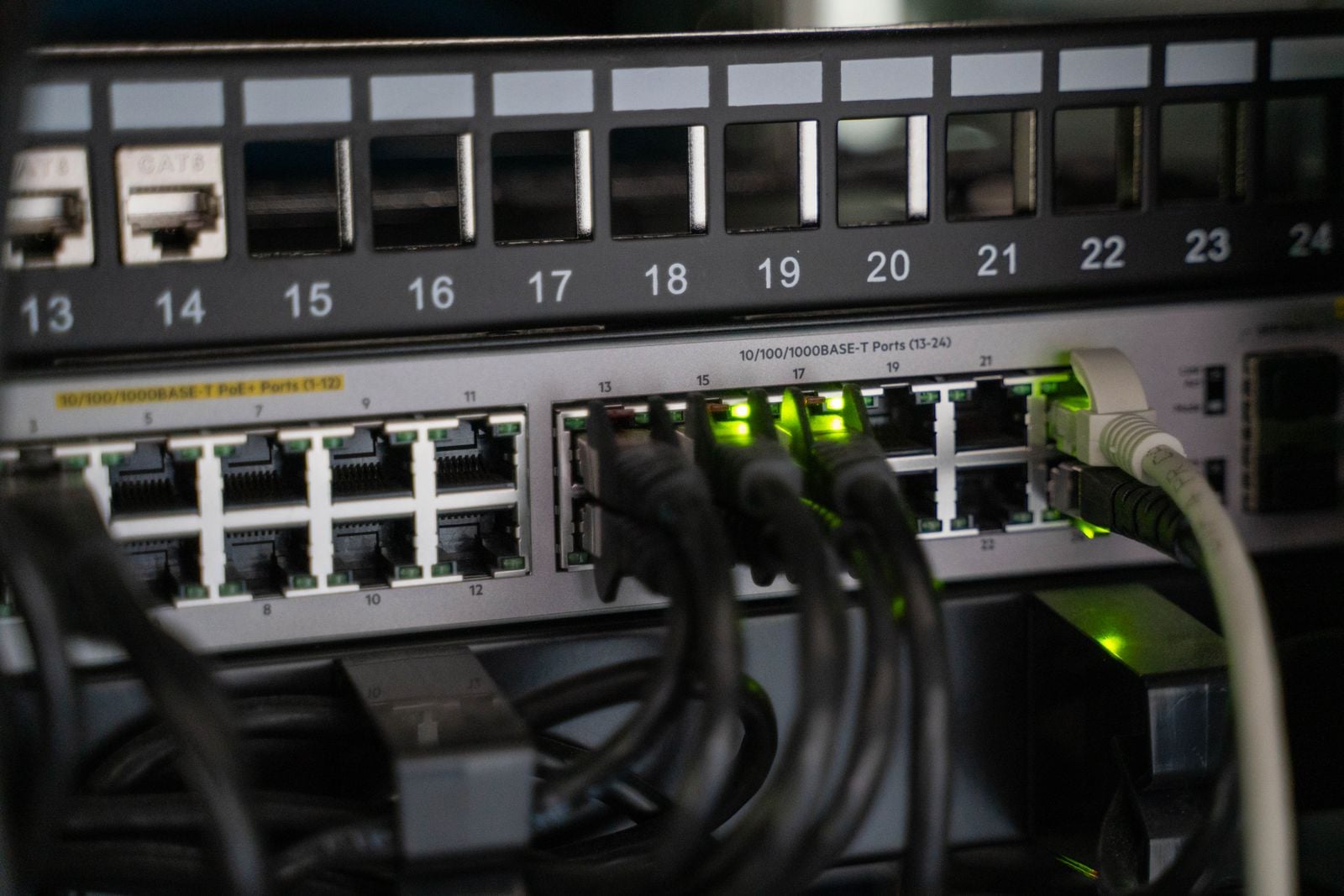

The router in the hallway looks like it should punch through anything. It doesn’t. Move it two rooms away, behind a wet plaster wall and a bathroom, and a 90 Mbps stream collapses into buffering.
The usual explanation is that walls are thick and concrete is dense. That is part of the story, but not the interesting part.
The interesting part is that 2.4 GHz — the frequency your Wi-Fi has used since the late 1990s and the frequency your microwave oven uses to reheat leftovers — happens to be close to a band where liquid water absorbs radio energy efficiently. The plaster in your walls, the timber studs, the human body sitting on the sofa, are all mostly water by mass. To a 2.4 GHz wave, a damp wall is not a solid obstacle so much as a shallow pond.
The overlap is not a coincidence. It is a licensing decision made decades before Wi-Fi existed, and it shaped everything from the range of your home network to why Bluetooth earbuds occasionally stutter when someone opens the microwave.
Where the 2.4 GHz band came from
In 1947, the International Telecommunication Union set aside a slice of spectrum around 2.45 GHz as an Industrial, Scientific and Medical band — the ISM band. The idea was to reserve room for equipment that emitted radio energy as a by-product rather than as communication: diathermy machines, industrial heaters, and, later, microwave ovens. Because the band was expected to be noisy, it was left unlicensed. Anything transmitting there had to tolerate interference from anything else.
That “junk band” status is what made it available for consumer wireless. When the IEEE published the first version of 802.11 in 1997, it used the 2.4 GHz ISM band precisely because no licence was required to build a radio there. Bluetooth, cordless phones, baby monitors, garage-door openers and Zigbee all followed, for the same reason.
The microwave oven arrived at the same frequency by a different route. Percy Spencer’s 1945 patent at Raytheon settled on centimetre-scale wavelengths that would penetrate food a useful distance and be absorbed efficiently once inside. Domestic ovens converged on 2.45 GHz because the ISM allocation gave manufacturers a legally clean frequency at roughly the right wavelength, and the magnetrons to generate it were already being mass-produced for wartime radar.
Why water absorbs 2.4 GHz
A common shorthand says 2.45 GHz is the “resonant frequency of water”. That is the folk explanation, and it is wrong. Water molecules do have rotational and vibrational resonances, but the strongest of them sit far higher, in the infrared, which is why sunlight warms a pond and hot food glows in a thermal camera.
What actually happens at 2.45 GHz is dielectric loss. A water molecule is polar: the oxygen end carries a slight negative charge, the hydrogen end a slight positive one. In an oscillating electric field, the molecule tries to flip back and forth to align with the field. In liquid water, that flipping is dragged on by neighbouring molecules, and the lag between the field and the molecule’s response turns some of the electromagnetic energy into heat.
The loss is broad, not sharp. It rises through the low gigahertz, peaks somewhere around 10 to 20 GHz depending on temperature, and falls off again in the infrared. 2.45 GHz sits well below the peak. Engineers did not choose 2.45 GHz because it was the maximum; they chose it because it was absorbed enough to cook food evenly in a domestic-sized cavity without depositing all the energy in the first few millimetres of the surface. Higher frequencies would brown the outside and leave the middle cold. Lower ones would pass through with barely any heating at all.
That “absorbed, but not too much” profile is exactly what makes 2.4 GHz mediocre at travelling through the walls of a house.
What your walls actually do to the signal
A microwave oven pumps roughly 700 to 1,100 watts of 2.45 GHz energy into a metal box the size of a shoebox. A Wi-Fi router in most countries is capped at 100 milliwatts of equivalent isotropic radiated power under ETSI EN 300 328 and equivalent FCC rules. Ten thousand times less. The physics of absorption is the same in both cases; only the power budget differs.
Dry materials — glass, dry timber, drywall in good condition — attenuate a 2.4 GHz signal by only a few decibels. A wet material is a different problem. Freshly poured concrete can attenuate 2.4 GHz by more than 20 dB, most of it from the water still bound in the mix. Old plaster in a Victorian terrace does something similar on humid days. Reinforced concrete adds another mechanism entirely: the steel mesh acts as a partial Faraday cage, reflecting rather than absorbing.
The human body, which is around 60 per cent water, is a surprisingly effective 2.4 GHz absorber. A room full of people at a conference measurably degrades a Wi-Fi network, and not only because they are all trying to use it. Each body is a soft, wet obstacle sitting in the path of the beam.
Fish tanks are worse than they look. So are potted plants along a hallway. So is the bathroom wall behind the router, if there is a shower running on the other side.
Why 5 GHz and 6 GHz are faster but shorter
Modern routers advertise a 5 GHz band, and Wi-Fi 6E and Wi-Fi 7 add a 6 GHz band on top. Both are faster in open air, and both fall off more sharply through walls. The dielectric loss in water keeps rising past 2.4 GHz, and free-space path loss — the geometric spreading of the wavefront — also increases with frequency. A 5 GHz signal starts with roughly 6 dB more path loss than 2.4 GHz over the same distance, before any wall gets involved.
The trade-off is deliberate. 2.4 GHz has only three non-overlapping 20 MHz channels in most regions and is crowded with every device from wireless doorbells to old cordless phones. 5 GHz and 6 GHz have far more channels and cleaner spectrum, at the cost of range. A router that automatically steers devices between bands is trying to balance these two problems in real time.
None of this is a failure of engineering. It is the compromise baked in when the standard reused a band designed for cooking.
What the physics does not explain
Attenuation by water is only one of several things happening to a Wi-Fi signal in a house. Reflection off metal surfaces creates multipath: the same signal arrives at the receiver twice, slightly out of step, and the copies interfere. Diffraction bends the wavefront around door frames. Other 2.4 GHz devices — a neighbour’s router, a Bluetooth speaker, a poorly shielded microwave leaking a fraction of a per cent of its output — sit inside the same band and compete for airtime.
The FDA’s limit on microwave-oven leakage — enforced by the agency’s Center for Devices and Radiological Health, not the FCC, which only assigns the frequency the ovens operate on — is 5 milliwatts per square centimeter at 5 cm from the surface, which is safe for humans but still enough, at close range, to jam a Wi-Fi channel while the popcorn is going. If a video call stutters at exactly the moment someone reheats coffee, that is not superstition. It is two devices sharing a band that was set aside in 1947 for equipment that was expected to be noisy.
The overlap between Wi-Fi and microwave ovens is often told as an accident or a curiosity. It is closer to a consequence. A regulator drew a rectangle on the spectrum chart, engineers built ovens inside it because water absorbed the frequency usefully, and half a century later engineers built wireless networks inside the same rectangle because it was the only place they were allowed to. The wet wall in the hallway was there the whole time.
The router just has to shout through it on a tenth of a watt.