

-15)_in_November_2014_(05).JPG)
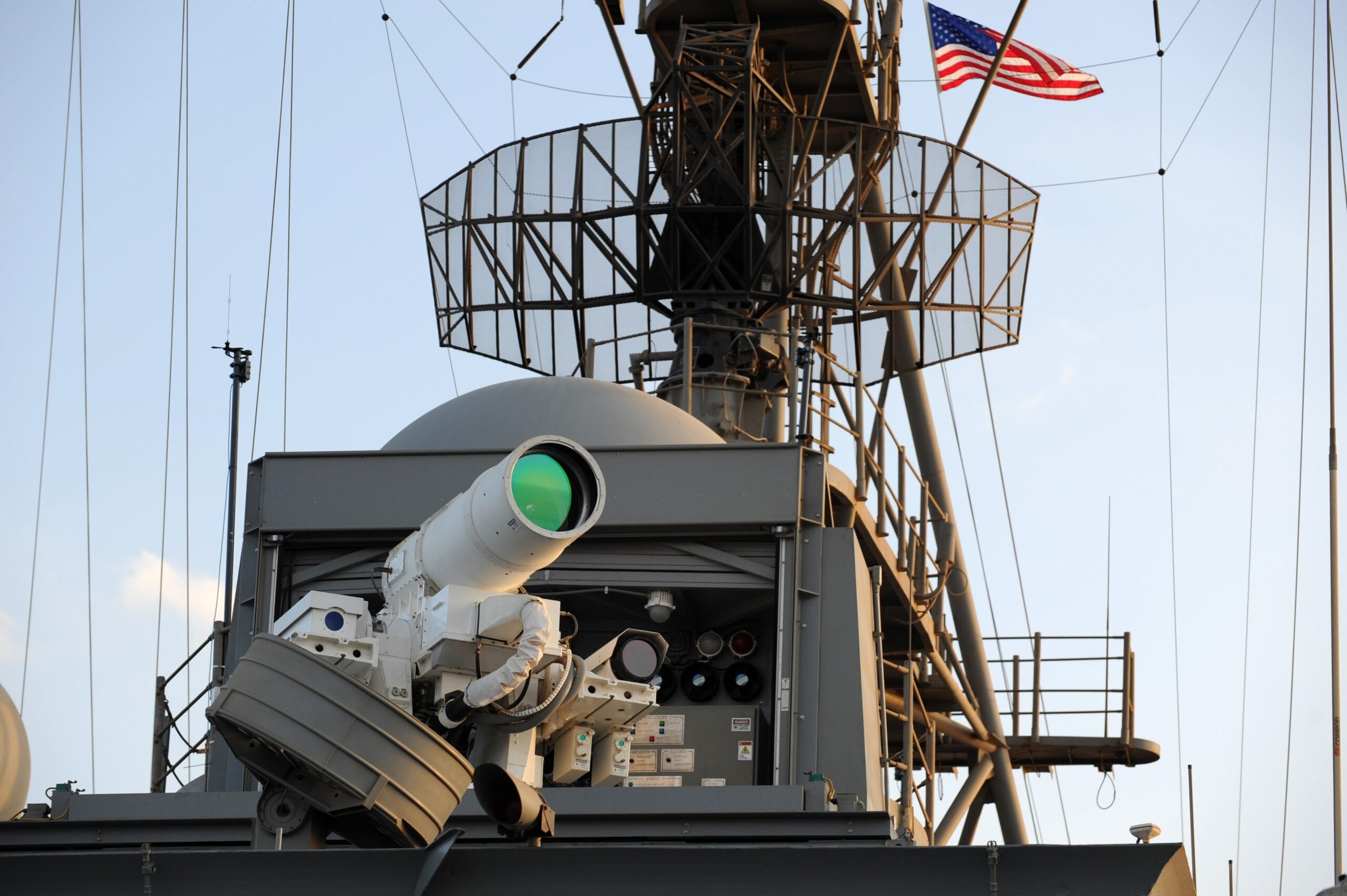
In December 2014, the US Navy announced that a laser weapon had spent the fall destroying test targets from the deck of USS Ponce, a 1971 amphibious ship stationed in the Persian Gulf. It was a 30-kilowatt prototype called the Laser Weapon System, or LaWS, and the Navy said it was operated by a “video-game like controller.”
The detail that traveled furthest was the price. Rear Adm. Matthew Klunder, then the chief of naval research, put it at about 59 cents a shot. The figure is real, but it measures one narrow thing.
What was on the ship
LaWS was installed on Ponce in August 2014 and ran its operational demonstrations from September to November. According to the Navy, it hit targets mounted on a speeding small boat, shot a ScanEagle drone out of the sky and destroyed other moving targets at sea.
The hardware was less exotic than it sounds. LaWS used six commercial fiber lasers whose beams stayed separate and converged on the same spot on the target. Together they made a weapon generally described as 30-kilowatt class.
A beam that size does not blow things up on contact. It heats a small spot until something fails. In footage the Navy released, it burned out a small drone’s electronics in about two seconds and set off a rocket-propelled grenade mounted on a distant boat.
The operator could also turn it down. The Navy described a range of options, from dazzling a target’s sensors, to disabling it, to destroying it. The laser’s optics doubled as a powerful telescope, which gave the ship a long-range surveillance camera whether or not it fired.
How sailors controlled the laser
Before the deployment, the Navy described a single control console, manned by a surface warfare weapons officer, from which one person could run every function of the laser and fire it if ordered. The handheld controller was how that sailor aimed the beam and set its power.
Klunder did not hide who it was designed for. “Any of you who can use X-Box or PS4, you can do this,” he told reporters when the results were announced.
Navy photographs from November 2014 show Chief Fire Controlman Brett Richmond and Lt. j.g. Katie Woodard at the control station, working in front of a bank of screens.
-15)_in_November_2014_(02).JPG)
The idea did not end with Ponce. Four years later, the Navy gave sailors on the attack submarine USS Colorado an Xbox controller to steer its camera masts. In both cases it picked an interface its youngest sailors already knew.
Where 59 cents comes from
A laser has no shell, propellant or missile to use up. It runs on electricity, and the Navy’s point was that it can keep firing as long as the ship has power. Klunder’s 59 cents is a marginal cost: roughly what it takes to generate the electricity for one shot. The official press release rounded it to less than a dollar.
The potential saving becomes clear when a laser can replace a missile against a suitable target. A Congressional Research Service report says Navy air-defense missiles cost from several hundred thousand dollars to a few million dollars each. The same report puts the marginal cost of a shipboard laser shot at $1 to less than $10, depending on power, with much of that going on fuel to generate the electricity.
What 59 cents leaves out is everything else. Klunder said the prototype cost about $40 million to develop and install. A missile’s price includes the missile. A laser’s price per shot does not include the laser.
What a cheap shot cannot do
The price also assumes the beam can reach its target. Speaking to reporters on December 10, 2014, Klunder said LaWS had worked well in the Gulf’s humidity and in heavy seas, but that it had not been tested in a sandstorm. Another Navy officer, Rear Adm. Bryant Fuller, acknowledged it could not be used in all weather. The Navy declined to say how far it could reach.
The limits are built into the physics. The Congressional Research Service lists them. A laser travels in a straight line, so it cannot hit anything over the horizon or hidden behind a wave. Water vapor, dust, salt and smoke all weaken the beam. And it may struggle against many attackers arriving at once.
That is why LaWS was aimed at drones and small boats at close range. They are cheap threats that are expensive to answer with a missile. US Central Command authorized Ponce’s commander to use the laser to defend the ship if needed.
What happened to it
Ponce came home in September 2017 after more than five years in the Middle East and was decommissioned that October. The laser did not move to its replacement, USS Lewis B. Puller. It was removed and earmarked as a land-based test asset for HELIOS, a later laser built for destroyers.
The Navy’s own verdict was modest. Ponce, it said, had given it some early experience of keeping a laser working in harsh conditions at sea. Bigger weapons followed. In the fall of 2019, the amphibious ship USS Portland was fitted with a 150-kilowatt laser, five times the rated power of the one on Ponce.
Ponce showed that sailors could operate a laser weapon at sea. Its low energy cost helped explain the appeal. Its limitations explained why it would complement the ship’s other defenses.