
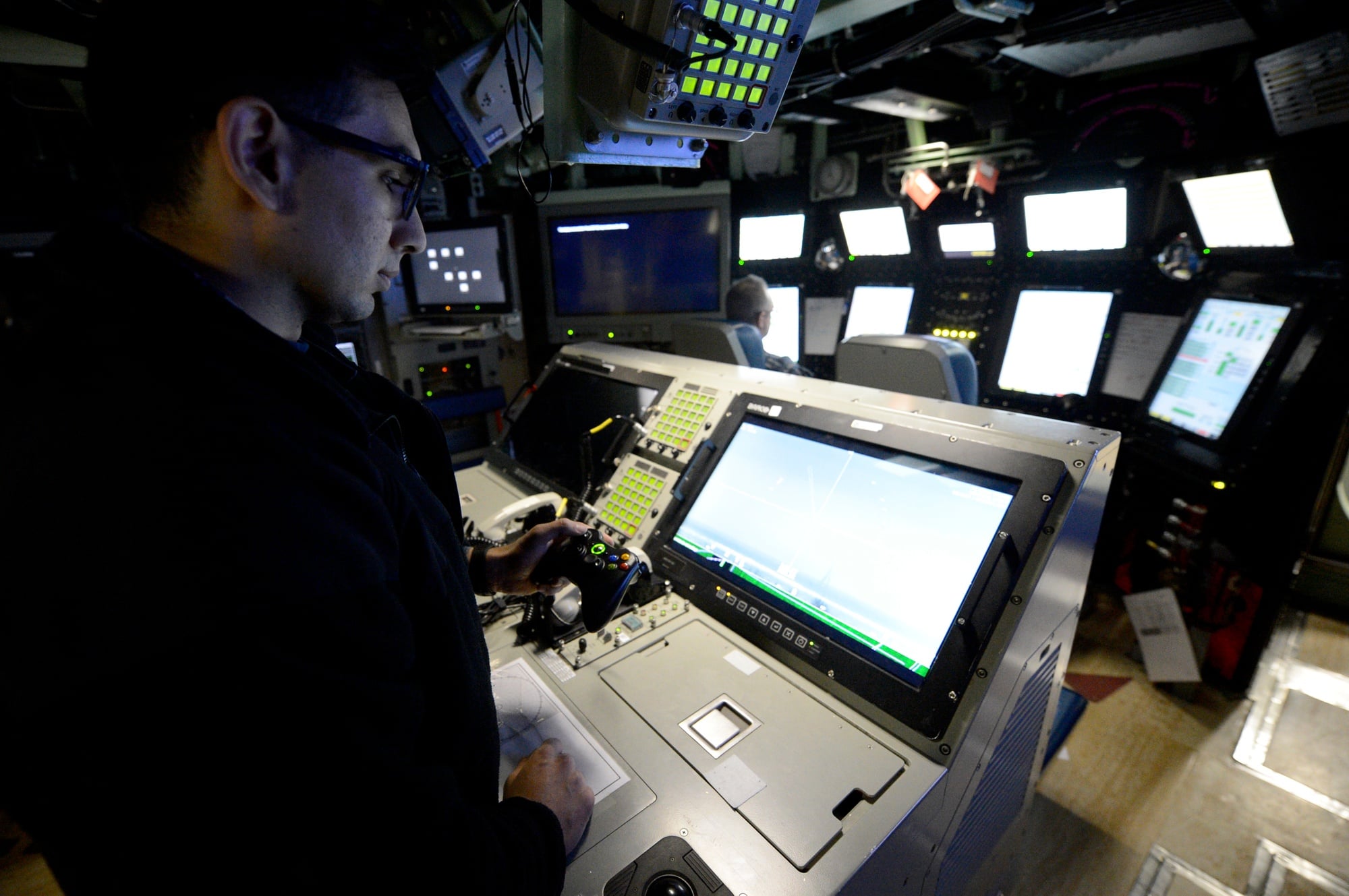

In January 2018, a Navy photograph showed Lt. Anthony Matus holding an Xbox controller at a console aboard the future USS Colorado. He was using it to aim the submarine’s camera mast. Two months later, the 7,800-ton nuclear-powered attack submarine entered service with a familiar gaming accessory among its controls.
The Navy commissioned USS Colorado (SSN 788) at Naval Submarine Base New London on March 17, 2018. Colorado was built with two camera-bearing photonics masts in place of traditional optical periscopes, and the Navy’s announcement noted that they were “maneuvered by a Xbox controller.” The move to cameras belongs to the Virginia-class design. The Xbox controller was a later change to how sailors operate them.
What a camera mast actually does
A traditional submarine periscope is an optical instrument. Light enters at the top, travels down a long tube through lenses and prisms, and reaches an eyepiece in the control room. Because the tube has to reach the person looking through it, the periscope penetrated the hull and sat in the middle of the control room, taking up space on a crowded deck. A 1999 Government Accountability Office report put it bluntly: a conventional periscope’s location “virtually dictates the design and placement of the control and other rooms.”
Virginia-class boats use photonics masts instead. As General Dynamics described them, these are “non-hull-penetrating masts that do not extend physically into the control room.” Cameras in the mast record the scene digitally, the signal travels into the submarine over fiber optics, and onboard processors turn it into images for the crew. Each mast carries a high-definition color camera, an infrared camera and a laser rangefinder.
In other words, the “periscope” became a camera feed. The person operating it no longer presses their face to an eyepiece and walks the tube around. They aim a remote camera while watching a screen, much like moving the view in a video game or a drone app. That’s an analogy for the kind of task, not a description of the Navy’s button assignments.
| Traditional optical periscope | Photonics mast | |
|---|---|---|
| How the view reaches the crew | Light travels down a tube to an eyepiece | Cameras record digitally and send the signal over fiber optics to onboard processors |
| Hull | Penetrates the hull into the control room | Does not penetrate the hull or extend into the control room |
| Effect on layout | Its position largely dictates where the control room goes | Lets designers place the control room where it works best |
| Sensors | A direct optical view | High-definition color camera, infrared camera and laser rangefinder |
| Viewing the image | Direct viewing at an eyepiece; versions fitted with video cameras can also record images | Output can go to workstations and be networked throughout the submarine |
Why the original controls got in the way
Moving to cameras solved a space and design problem. It didn’t automatically produce good controls. According to a January 2016 Lockheed Martin feature, the original mast handgrips were based on helicopter joysticks and were “expensive, heavy and cumbersome to operate,” requiring hours of training.
The fix came out of a mock submarine control room near Washington, D.C. that Lockheed engineers nicknamed “Area 51,” where Navy and industry teams tested how off-the-shelf hardware and software, from touch tables to Kinect, could be applied to submarine systems. Lockheed says that, based on sailors’ familiarity with gaming, its engineers programmed an Xbox controller to work with the imaging control panel, and that sailors who tried it could “intuitively control the periscope within minutes without any training.”
Those are the manufacturer’s own observations, and they deserve a narrow reading. Learning to move a camera in minutes is not the same as learning to use a periscope well. Knowing what to look for and how to operate safely are separate skills no controller teaches. What a familiar device removes is one layer of difficulty: the operator isn’t also learning unusual hardware while learning the job.
That still matters. Every unfamiliar control adds training time and competes for attention that should be on the screen. A gamepad is light, built for long sessions and designed for the kind of thumb-driven movement that aiming a camera involves.
A familiar controller still needed integration
The most important detail in Lockheed’s account is easy to skim past: engineers “programmed an Xbox controller to interface more seamlessly with the imaging control panel.” The controller didn’t arrive knowing anything about submarine masts. Software sitting between the gamepad and the imaging system decided what each stick and button would do.
The same mouse selects text in a word processor and pans the map in a game, because the application, not the hardware, decides what each input means. That separation is what made the swap possible.
Because the mast was already a digital system, a different input device could be mapped onto it in software. The sources reviewed here do not establish the button assignments, connection method or backup arrangements. The trackball and button banks in the Navy photo are a reminder that the gamepad sits within a larger console.
What the $38,000 figure does and doesn’t tell you
Lockheed’s feature says the Navy was replacing “the photonic mast handgrip and imaging control panel (approx. $38,000) with an Xbox 360 controller.” That figure is often repeated alongside the retail price of a gamepad to produce a dramatic percentage saving.
That comparison needs caution. The $38,000 covers the handgrip and imaging control panel, not the camera mast itself. And the source gives no accounting of the engineering, software and testing work needed to make a consumer controller fit for this job. The cheaper part is real. The sources reviewed here don’t show the total cost of the change.
The gamepad supplied a familiar way to aim the cameras. The mast, imaging software and surrounding console supplied the capability. Using a familiar controller changed how sailors interacted with that system.