


With over 1 billion users, Facebook is definitely the undisputed king of social networks today, making a whopping $3 billion in revenues in a single quarter. If you analyse it, Facebook’s business model is completely dependent on its users and the content they generate – but with the information and data you share on your profiles, what you get in return is nothing.
A new invite-only social network dubbed Tsu aims to solve the problem by paying users for actively posting on the platform as well as inviting their friends to join the network. In this article, we will discuss Tsu’s business model, features, and more.
What Tsu claims
Tsu’s philosophy is simple: users, or content generators, should be rewarded for their content. The startup claims it keeps only a ten percent cut of the advertisement revenue generated from a post in a given twenty-four-hour period, and passes the remaining ninety percent to users. From this amount, fifty percent goes to the owner of the content, while the remaining fifty percent is distributed using the “rule of infinite thirds.” The person who recruited the content owner gets one-third, the one who recruited that person gets one-ninth, and so on.
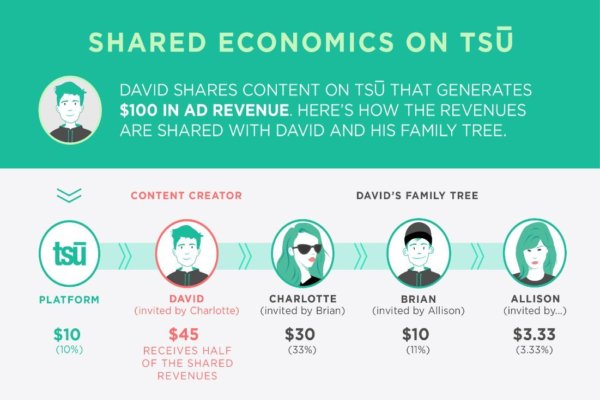
Obviously, you’ll need to have a good number of followers and your posts need to be engaging in order to earn better. You also get paid when someone you invited actually joins Tsu. An important point worth noting is that Tsu also pays you for content hosted on other platforms. For example, if you already monetize your videos on Youtube, you can share them on Tsu and earn more. Once the accumulated amount in your Tsu account hits the $100 mark, you can cash it out.
Aside from earning from your content, Tsu also lets you control and build your social network, something which you can do by passing around your personal shortcode to the ones you want to invite to the platform who can then follow you. This makes Tsu an invite only platform, although it isn’t hard to get on-board, as you’ll see a lot of Tsu members sharing their personal shortcodes online in a bid to attract more followers (if you want to register, you can use my shortcode: http://www.tsu.co/himanshuz)
Features
After you register and visit your profile page, you’ll realize that Tsu broadly resembles Facebook, except that it has a green theme rather than Facebook’s blue. It has all the basic features that a social network should have, plus some extra ones.
For example, you can officially connect your Tsu account with your Facebook and Twitter accounts, so that you can use Tsu to post directly on these social networks – a feature that’ll help people spend more time on Tsu while staying connected to their existing social network accounts.
Tsu also allows you to send money to other users or merchants, although it charges a 3 percent fee for the service.
What do we think
At present, Tsu looks like a content monetization platform dressed up as a social network. It has definitely generated some buzz through its business model, which is uncommon but not new – Bubblews followed the same path.
A category of users who’ll benefit the most from this business model are celebrities who usually have millions of followers, but we’ll have to wait and watch if it is enough to lure ordinary users. As far as Tsu’s competition with Facebook is concerned, it might offer a breath of fresh air, but it definitely has a long, long way to go.