


To do nearly anything on your mobile device or computer, you need to be on the Internet. And really, that’s a sore spot for many people. While you most likely have Wi-Fi in your home and office, it’s a different story in your car, while you’re on a walk, while you’re out to dinner, or on a pleasure or business trip. T-Mobile recognizes this and is providing users with two new Internet plans: for home and on the go.
Two New T-Mobile Internet Plan
No matter what your lifestyle is, T-Mobile has an Internet plan for you, whether you need options for when you’re at home or options for when you’re away. Calling itself the “Un-carrier,” T-Mobile explained that it gave users 5G Home Internet three years ago, providing an alternative to traditional broadband. Now they’re keeping up with demands and providing their nearly 5 million customers with two plans to help them stay connected wherever they are.
“T-Mobile is doing what we do best, listening to customers and offering new plans to meet their needs,” said Allan Samson, Chief Broadband Officer, T-Mobile. “Customers are demanding better choices and innovative connectivity, and these new plans deliver.” The company is introducing “Home Internet Plus” and “Away.”
T-Mobile Home Internet Plus
Noting that 95% of U.S. adults use the Internet now, compared to a little over 75% 14 years ago, T-Mobile combined that with a growth in smart devices in the home. This led them to create the Home Internet Plus plan.
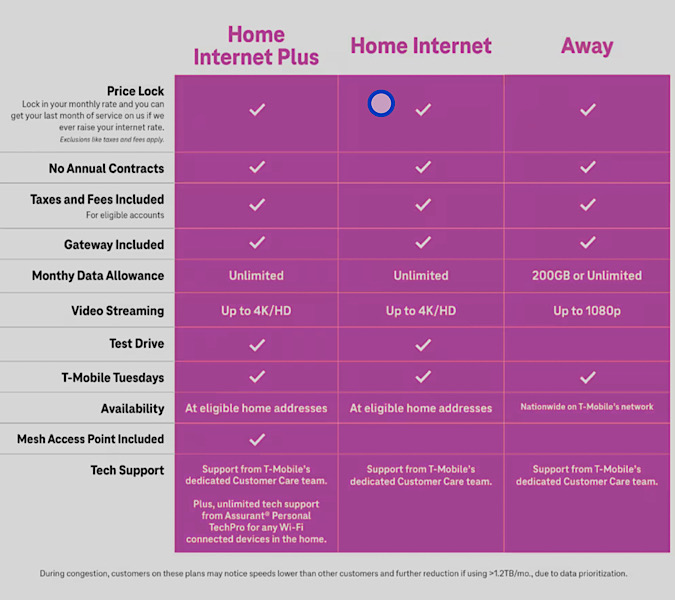
This plan includes a 5G gateway and Wi-Fi Mesh Access Point. This allows users to expand Wi-Fi throughout their home, even in places that were hard to reach before. It brings up to 2,200 square feet of additional coverage. The mesh intelligently provides coverage where it’s needed most – even simultaneously. You can even extend the signal outside for your security cameras or watch movies outside on a warm summer night.
Additionally, users get 24/7 tech support for any of their Wi-Fi or smart devices. They’ll get phone, chat, and screen-sharing support with setup, connecting, and troubleshooting. Whether you’re having trouble getting the Wi-Fi to your new Ring camera or can’t figure out how to transfer data from one device to the next. Price Lock is included too. It has availability in 50 million homes. It will be available at the end of the month: $70/monthly or $50/monthly with the addition of a voice line.
T-Mobile Away Plan
If you do frequent road trips, you may struggle to find adequate Internet. There may not be nearby cell towers, and not all campgrounds have coverage. Yet, camping and RVing really picked up during the pandemic, with people just desperate to get out of their homes. Many campers even bring their work with them.

The T-Mobile Away plan will help those frequent travelers. It will help them stay connected across the United States, at least anywhere that the T-Mobile 5G network reaches, which the company claims is more than AT&T and Verizon combined.
As with Home Internet Plus, the Away plan also includes a 5G gateway. It has security features and can connect up to 64 devices simultaneously. This is double what you would get from a typical hotspot and six times more than smartphone tethering.
The plan provides unlimited data, allowing you to not get cut off by local plans while traveling. You won’t have to deal with a complicated setup while you’re traveling, either, as it’s a matter of plugging in the gateway and downloading the app. Lock in a monthly rate, and if T-Mobile raises the rate, you’ll get your last month free. Currently, unlimited data will cost $160/month, and 200 GB of data costs $110/month.
You can check to see if these T-Mobile Internet plans are available in your area. If you’re unsure how fast your home Internet carrier is, there are several testing sites that can help you out. We can also show you how to optimize your network connection for speed and stability in Windows.
Image credit: Unsplash. Screenshot by Laura Tucker.