

Surprising News that Popular Apps Use Location Data for Advertising

Surprising News that Popular Apps Use Location Data for Advertising Featured Image

Can you stand yet another article on the way personal data is being misused? If you can, it’s important to know – all of it is. This time the news is reporting that third-party apps, even popular ones, are using your location data, even when they don’t disclose that. And it’s extremely precise data, too, able to detect where you are within a couple of yards.

The Data Grab

The New York Times reported that at least 75 companies take advantage of “anonymous” app location data from about 200 million smartphones. Sometimes the data is collected as much as 14,000 times in a day.

The reporters were able to track people to within a couple yards of where they actually were. They found that companies had location data from businesses including hospitals, schools, stores, and homes. The location data of people in emergency rooms is targeted even and shared with personal injury lawyers.

news-apps-location-data-arrow-pointing

Sure, the location data is anonymous and not associated with a certain phone or person, yet reporters found it easy to identify individuals based on their daily routine gleaned from the location data, such as where they sleep every night, their daily commute, or their frequent hangouts.

Of the twenty popular apps that were tested, seventeen sent the exact location coordinates to seventy businesses. Three of the iOS apps and only one Android app explained to users that the data could be used for advertising.

Again, these are popular third-party apps, including WeatherBug, the Weather Channel, theScore, GasBuddy, DC Metro and Bus, Tube Map – London Underground, Perfect365, SnipSnap Coupon App, and Masha and the Bear: Free Animal Games for Kids.
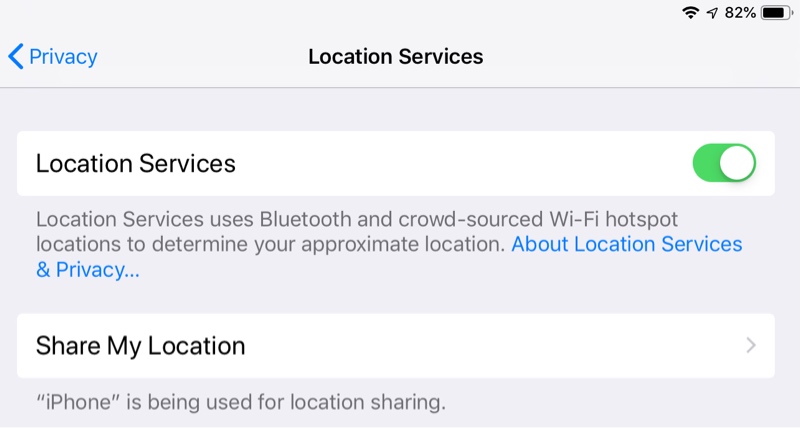
news-apps-location-data-ios

Some of these apps gather location data for purposes that are necessary for the app functions, yet they don’t disclose to users that the data is used for other purposes as well. The Weather Channel app is owned by an IBM subsidiary, and it analyzes user data for hedge funds, although the app only states that the data is used for “personalized local weather data, alerts, and forecasts.”

Furthermore

What is frustrating is that to use certain functions of these apps, we need to allow them to access location data. However, there are some that collect location data that don’t need it, so it’s a good idea to go through your apps periodically to see which ones you are allowing access to your location data and if it’s necessary.

Yes, we all knew that location data was being used, but did you realize yours was most likely being used to this extent, even from popular apps? Leave your thoughts and concerns in the comments below and tell us how you feel about third-party apps using your location data against your knowledge.

Subscribe to our newsletter!

Our latest tutorials delivered straight to your inbox

Laura Tucker Avatar

Read next

Octopuses possess roughly 500 million neurons distributed across their body, with two-thirds located in their arms rather than their central brain, meaning each arm can taste, problem-solve, and react to stimuli independently of whatever the octopus is otherwise paying attention to.
The Roman aqueduct at Segovia, built around the first century AD without mortar, still carried water into the 1970s, its 167 granite arches held together by nothing but the precise weight distribution of stones cut to fit each other within fractions of a millimeter.
When the SS Great Eastern laid the first working transatlantic telegraph cable in 1866, a message that had taken ten days by steamship suddenly crossed the ocean in minutes, and the financial markets of London and New York were forced, within a single trading week, to invent the modern concept of synchronised global price.
The Big Ear telescope was scanning at 1420.4056 megahertz on the night of 15 August 1977, the exact frequency at which hydrogen atoms vibrate across the universe, because Giuseppe Cocconi and Philip Morrison had argued years earlier that any species trying to be found would broadcast on that channel — and then, for 72 seconds, something did.
In 2016, archaeologists dated two rings of snapped stalagmites in France’s Bruniquel Cave to 176,500 years ago, evidence that Neanderthals had walked 336 metres into darkness with fire and built architecture deep underground long before modern humans reached Europe
Otto von Bismarck was 74 when Germany adopted the world’s first national old-age social insurance program in 1889, setting the pension age at 70 after years of fighting socialists with bans, laws, and a promise few workers would live long enough to use
When cosmonaut Valeri Polyakov stepped out of his Soyuz capsule in March 1995 after 437 consecutive days aboard Mir, doctors recorded him at several centimetres above his pre-flight height, and his spine had become so unaccustomed to gravity that the recovery team carried him to a chair rather than risk the compression of letting him walk.
When Bell Labs engineer Karl Jansky pointed a rotating antenna at the sky in 1932 looking for sources of transatlantic radio static, he kept picking up a faint hiss that peaked every 23 hours and 56 minutes, and he eventually realized he had become the first human to hear the center of the Milky Way.