
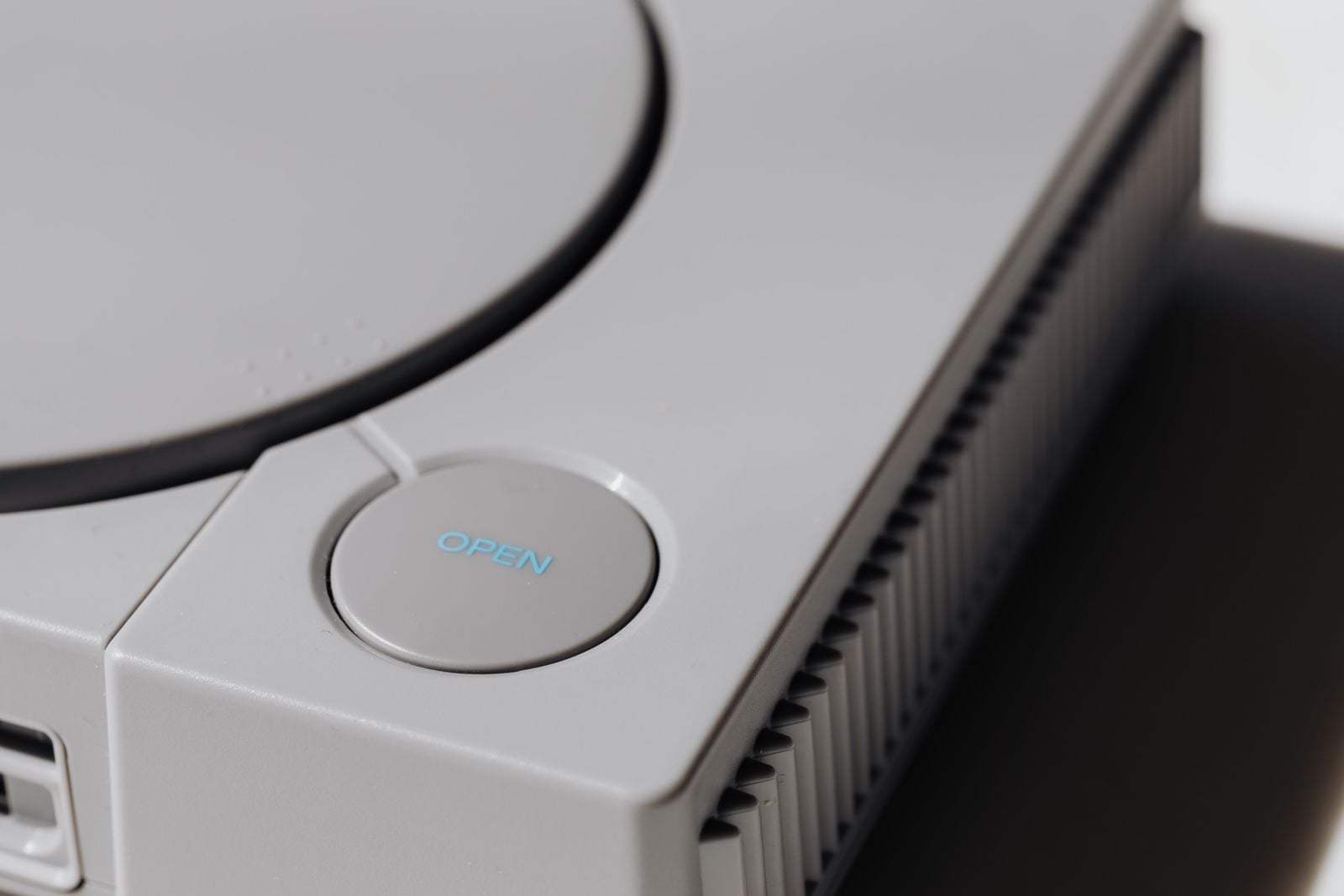

The firm was Sony, the console was the PlayStation, and the thing that decided the decade was not the hardware. It was the disc — and the publisher terms that came with it. Sony pressed games onto CDs that cost cents to manufacture, let publishers reorder in days instead of committing cash to cartridge runs months ahead, and shipped more than 100 million consoles over the machine’s life. The Nintendo 64 sold 32.93 million. The Sega Saturn sold roughly nine million. The two other entrants of that generation, the 3DO and the Atari Jaguar, were off the market before the decade ended.
All of it started with a public humiliation.
In June 1991, at the Consumer Electronics Show in Chicago, Sony announced a Nintendo-branded CD-ROM add-on for the Super Famicom called the Play Station. Hours later, on the same show floor, Nintendo announced it was doing the deal with Philips instead. The sequence is documented in Game Informer’s oral history of the PlayStation, told by the people who were standing there.
What happened next is usually told as a revenge story. The record is more interesting than that.
The deal that collapsed on stage
Nintendo and Sony had signed a contract in 1988 to co-develop a CD-ROM peripheral for the forthcoming Super Famicom. Sony’s side was led by Ken Kutaragi, an engineer who had already pushed the company into the console business once by designing the SPC700 sound chip inside the Super Famicom — over the objections of Sony’s own executives, and with the personal backing of then-president Norio Ohga.
The contract gave Sony extensive rights over software published on the CD format. Nintendo’s president Hiroshi Yamauchi read the terms, decided they were unacceptable, and instructed his American lieutenant Howard Lincoln to negotiate a rival deal with Philips. The Chicago announcement was the reveal.
Sony’s board wanted to walk away. Ohga told Kutaragi to build a console anyway. The project that survived that decision became the PlayStation, released in Japan on 3 December 1994 and in North America on 9 September 1995.
Why Sony was not actually a games company
Sony was not near bankruptcy in these years. It was one of the largest electronics manufacturers on earth, and its financial trouble in the period came from Hollywood, not hardware: in November 1994 it wrote down approximately $2.7 billion of goodwill tied to its Columbia Pictures acquisition, one of the largest write-offs in Japanese corporate history to that point.
The games division was the fragile thing. It was internally unpopular and repeatedly close to being shut down. “Everyone told us we would fail,” Kutaragi told AFP in a 2024 interview, adding that most of Sony’s executives were fiercely opposed, fearing for the company’s reputation as a maker of high-end electronics.
Kutaragi was moved off Sony’s main campus to Sony Music, a subsidiary with experience manufacturing CDs, partly to keep the project out of reach of the people who wanted it killed.
The consequence mattered. Sony Music understood optical disc manufacturing, licensing, and negotiating royalty terms with external creative partners. Nintendo, by contrast, ran its cartridge business as a tightly controlled supply chain. The Federal Circuit described that arrangement plainly in Atari Games Corp. v. Nintendo of America: under licence, Nintendo took the developer’s game, placed it in cartridges containing its own lockout chip, and sold those cartridges back to the developer.
Sony’s pitch inverted almost every element of that model.
What the disc actually changed
The technical case was straightforward. A Super Nintendo cartridge shipped with somewhere between 4 and 32 megabits of ROM — roughly 0.5 to 4 megabytes. A single CD-ROM held 650 megabytes. That is not a modest improvement; it is more than two orders of magnitude.
The economic case was sharper. Pressing a CD cost cents. Manufacturing a mask ROM cartridge cost several dollars per unit and required committing to a production run months in advance. A developer who guessed demand wrong on a cartridge lost real money and sat on the inventory. A developer who guessed wrong on a CD title pressed more discs in days.
The tradeoff was seek time. The PlayStation’s double-speed CD drive read at 300 KB per second, with seek latency measured in hundreds of milliseconds, against the effectively instant random access of a cartridge. Games were designed around that limitation — hence the long, decorative loading screens that became a signature of the era.
Kutaragi’s hardware team built the rest of the system around 3D. The console shipped with a dedicated Geometry Transformation Engine rated, in Sony’s published specifications at the time, at around 360,000 flat-shaded polygons per second.
The Sega Saturn had beaten it to the Japanese market by eleven days, launching on 22 November 1994. It had been designed primarily for 2D sprite work, and Sega bolted 3D capability onto an architecture built around two Hitachi SH-2 CPUs — a combination developers complained publicly was difficult to program.
The developer terms nobody talks about
Hardware alone does not explain the gap that followed. Sony’s own filings show how fast it opened: worldwide production shipments of PlayStation hardware reached 19.37 million units in the fiscal year to March 1998 alone, against 9.2 million the year before, for a cumulative 32.82 million. Nintendo’s own sales data records the Nintendo 64, launched in Japan in June 1996, finishing at 32.93 million units for its entire lifetime.
Licensing was the quiet decider. Publishers could produce PlayStation discs cheaply, reorder on short lead times, and pay Sony a royalty per disc sold rather than financing a cartridge order up front. The risk moved off the publisher’s balance sheet.
Squaresoft’s decision to move Final Fantasy VII from the Nintendo 64 to the PlayStation, announced in January 1996, is the most-cited example. Square’s stated reasoning was explicit: the game it wanted to make would not fit on a cartridge, and cartridge economics did not work at the scale it had planned.
Final Fantasy VII shipped in Japan on 31 January 1997. The PlayStation version had sold roughly 9.8 million copies worldwide by the end of 2005, and the 1997 game has since passed 15 million across all its later platforms. It is the title most often credited with settling the generation.
The marketing that ignored children
Sony Computer Entertainment America, run at launch by Steve Race, made an unusual decision for the 1990s: it marketed the PlayStation to adults. Print advertising ran in music and style magazines rather than on children’s television.
The moment that fixed the shape of the American market lasted about a second. At E3 in Los Angeles on 11 May 1995, Sega of America’s Tom Kalinske announced the Saturn at US$399, available immediately at four retailers. Hours later, Race walked to the Sony podium, said “299,” and walked off. Kalinske’s own account, given years afterwards to Time Extension, is that Sega had been certain the PlayStation would land at $399 and was not making money at that price itself.
Nintendo stayed with cartridges for the Nintendo 64 and kept its family-friendly positioning. The N64 had genuine technical strengths, particularly in 3D rendering and four-controller multiplayer, and its exclusive library included some of the most-praised games of the decade. But cartridge economics limited how many third-party publishers could afford to support it, and the library stayed smaller.
What the story is often shortened into
The popular telling compresses all of this into “Sony got revenge on Nintendo”. The record supports something narrower. Sony had a working CD-ROM engineering team it did not want to disband, an executive willing to protect an unpopular project, a subsidiary that understood optical disc manufacturing and creative licensing, and publisher terms more attractive than the incumbent’s. The 1991 humiliation created the conditions; it did not create the console.
The parts that are legend rather than record include the specific words Ohga reportedly used to Kutaragi, and the notion that the 1991 Super Famicom-compatible prototype was ever close to production. Roughly 200 pre-production units of the Nintendo-Sony hybrid were built; one surfaced at Heritage Auctions in March 2020 and sold for US$360,000 after 57 bids, with the auction house noting the vast differences between it and the console Sony actually shipped in 1994.
Whoever controls the manufacturing bottleneck sets the terms — a pattern that keeps recurring in the infrastructure underneath everything since, from undersea cable ownership to the platforms that host modern video.
Nintendo returned to optical disc with the GameCube in 2001. By then the market had already decided.