


When you move to a new house, it’s not unusual to find that your current mobile provider doesn’t have a good signal at your new location. You scout online for a new provider and manage to find one with cheaper prices than your current service. You order a SIM card, add it into the appropriate slot, and find that your signal is pretty much identical to your previous network provider! What gives?
If this has happened to you, you might be surprised to learn that you were using the exact same network as you were before. There’s a high chance the provider you swapped to used the same infrastructure as the one you just left. This is the case of “piggybacking” mobile networks, where you may have less choice with coverage than you may first think.
What Is Piggybacking?
Mobile Network Operators

Let’s say a country has three competing mobile companies, creatively named Alpha, Beta, and Charlie. Each of these companies has their own mobile network infrastructure setup, with antennas dotted around the country to provide signal to their customers. These companies are known as Mobile Network Operators (MNO).
MNOs want their infrastructure to handle every user on the network without fault. To ensure this, their service has extra capacity so they never “fill up.” This, in turn, does mean that MNOs tend to have extra capacity that simply doesn’t get used. Instead of losing money over maintaining wireless capacity that goes unutilised, MNOs sell off space to other businesses who want it.
Mobile Virtual Network Operators

Let’s say that a new company, Delta, wants to set up a mobile networking company. However, they’d rather not start from scratch, build their own antennas, and go toe-to-toe with the big three who are already established. Alpha has an infrastructure with a lot of space that’s going unused and making them no money, and Delta is looking for space without having to build an infrastructure. The two get together, and Alpha decides to let Delta buy its excess storage for a bulk price. Delta is now “piggybacking” on Alpha’s network.
A business that buys up storage from an MNO is called a Mobile Virtual Network Operator (MVNO). These companies have a lot more financial freedom than an MNO – while the big companies have a lot of expenditure from network infrastructure maintenance and expansion costs, MVNO companies just have to worry about buying up the capacity from an MNO. This results in MVNO providers having cheaper plans compared to their bigger brothers, while also having more funds to pour into marketing and getting their name out to the public.
Which companies are MNO and which ones are MVNO?
This knowledge is very useful when choosing a network provider. If your signal is weak, it’s worth looking into which mobile provider has a stronger signal in your area. Then, you can swap to either them or an MVNO that uses the same host network. If you’re currently using an MNO’s data plan, you could save money by swapping to an MVNO on the same host network without sacrificing signal strength.
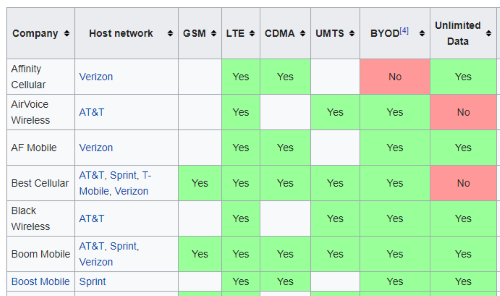
So how do you find these companies? Of course, it depends on the country you’re from! Wikipedia has some decent lists for MVNO companies in the United States and the United Kingdom. When you’re itching to move to a different provider, do a little research to see if they’re using their own network or someone else’s. If you like your old provider’s coverage, try to find someone using the same MNO network. If your old provider’s signal strength is weak, avoid the MNO network it uses at all costs!
You can search your network coverage via Sensorly, while the UK can do the same via Ofcom. There’s also OpenSignal that monitors signal strength and makes a map out of everyone else’s results.
Learning How to Network
If you’re thinking about changing mobile providers due to a low reception, be careful who you pick! You may just be going back into the same network you’re trying to leave. In this article you have learned what a piggybacking operator is, why piggybacking is done, and how to check for piggybacking operators.
If you’re with a main mobile network operator, are you considering transferring to a virtual one for a cheaper price? Let us know below.