

Wearables is one of the top markets in tech right now, mostly with fitness trackers and smartwatches. There is a larger and larger pull for them to track vital signs. If you’re finding wearables to be too expensive, perhaps they don’t have to be. Some researchers recently discovered that it’s possible to use pencil and paper to act as a wearable and track those same vital signs.
Discovery with Pencil and Paper
Especially with a global health crisis going on, many people want to track their vital signs: heart rate, blood oxygen level, respiratory rate, etc. Many wearables are tracking these things, and there’s a push to get them to track even more.
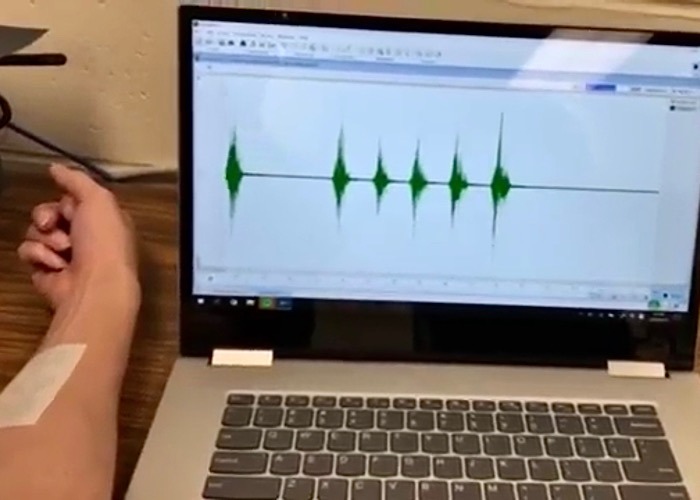
Researchers from the University of Missouri worked on a study that was published in “Proceedings of the National Academy of Sciences.” This showed pencil and paper can track the same biological data that a wearable can. Granted, it also needs a little help from a computer and a couple of cables.
The study out of Missouri detailed how a standard pencil and white copy paper can monitor biological data such as heart rate, respiratory rate, glucose levels, body temperature, and sweat composition. The pencil was not used to jot down these metrics. Instead, the graphite, which is used in pencils as well as batteries and solar panels, was used to pick up the electrical and chemical impulses underneath the skin.
Electrodes were created by drawing sketches on the paper using the same designs that typical metal electrodes use. And adhesive was sprayed onto the paper, then flipped so the graphic would come in contact with the skin. Cables then connected the electrodes and a computer to record the impulses.
Several different types of pencils were tried by the researchers. Ultimately, they found that the pencils that had 93 percent graphite, while being common and cheap, were also the most effective in their study. The standard type of pencil that is commonly used in schools contain more clay and wax.
Another benefit to this system of measuring biomedical data is that there is less waste, making it better for the environment. Paper decomposes quickly, certainly more so than wearables.
“It’s a really clever concept,” said Northwestern University professor John Rogers, a wearable technology researcher. He believes this study will set a foundation for developing systems that can be used on patients.
Next Up
The researchers are already finding other ways to apply the technology. “If we can convert ambient humidity to electricity, that will reduce the amount of electricity needed to operate the sensors,” said graduate student Yadong Xu, the lead author of the study. “Even though this is the very early stages of development, we might be able to combine this technology into one single system.”
The researchers also designed a rough model of an antenna, as they are hoping that eventually, it could be used to transmit the biomedical data recordings wirelessly to a mobile device or computer so that both health-care workers and patients can view the data live.
Rogers believes wearable technology will be an integral tool of doctors in the future. Xu continues to see how it will become easier for people to monitor their own vitals at home.
“You won’t need to go to the hospital to monitor your body systems,” he supposed. “Home-centered human health care is a very emergent. research area right now.”
Not that everyone is going to be sitting, hooked up to their computer with electrodes on their arm that were drawn with pencil and paper – but it certainly shows the process can be much simpler than what a wearable provides.
Read further to learn how Google and Verily can detect heart disease by using an AI algorithm and your eyes.
Image Credit: Embedded Video Screenshot