
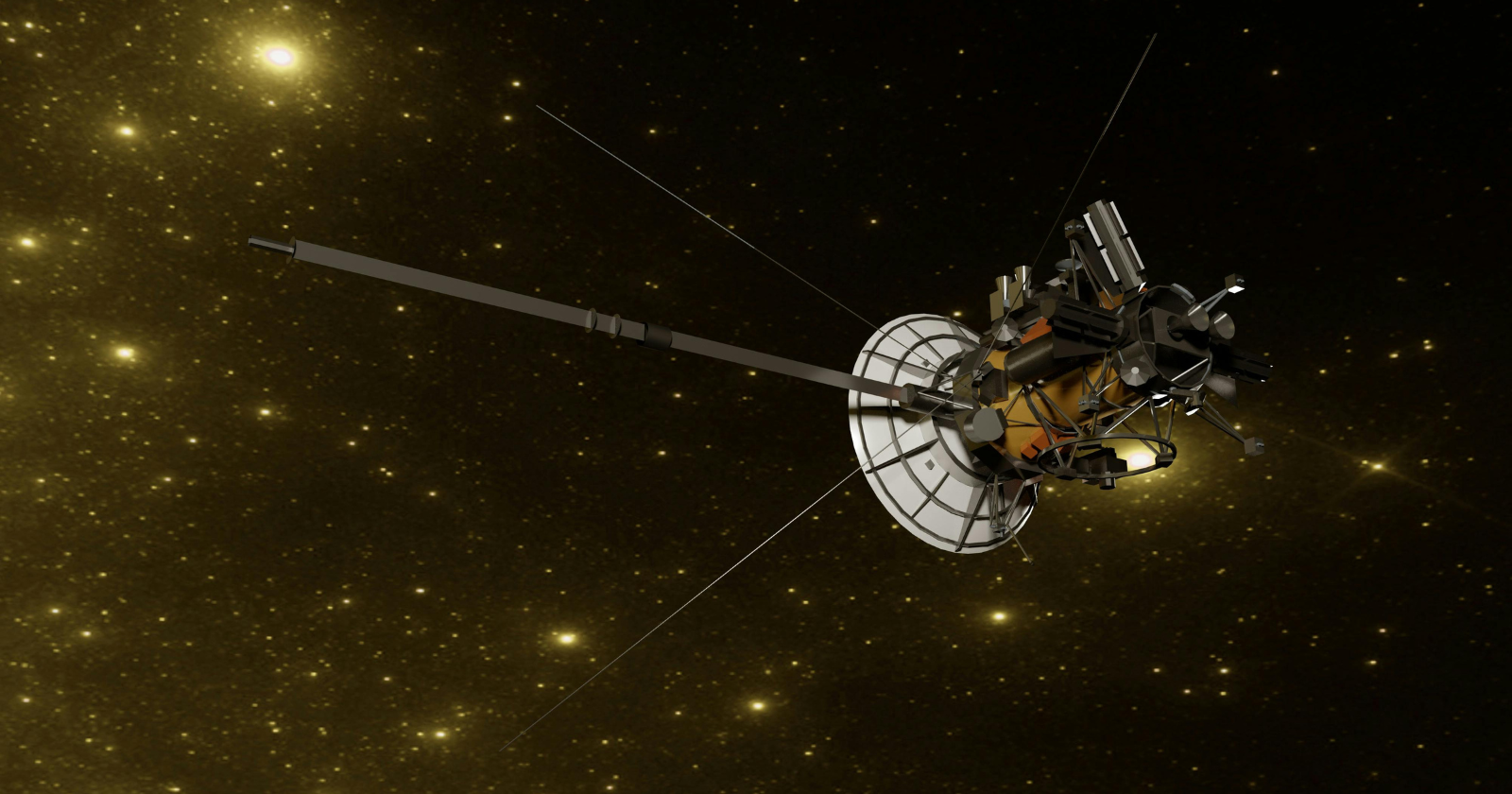

The popular version of the story sounds almost too perfect: NASA is still flying the Voyager spacecraft with code written in a 1970s-era programming language that barely anyone understands anymore, kept alive by a few elderly engineers who remember how it all works.
Like many great space stories, the truth is a little messier — and in some ways even more impressive.
The twin Voyager spacecraft launched in 1977, built for a mission that was originally meant to study Jupiter and Saturn. Nearly five decades later, they are still operating. NASA describes Voyager 1 and Voyager 2 as the only spacecraft ever to operate outside the heliosphere, the protective bubble of particles and magnetic fields created by the Sun. Voyager 1 crossed into interstellar space in 2012. Voyager 2 followed in 2018.
That part is extraordinary enough. But the deeper marvel is that these spacecraft are still being operated, patched, and coaxed along using computer systems from another technological age.
A spacecraft with less memory than a small image file
The computers aboard Voyager are almost absurdly small by modern standards. Wired reported that each Voyager probe has only 69.63 kilobytes of memory in total. That is less than many ordinary image files today.
NASA’s own comparison is just as stark. According to NASA’s Voyager FAQ, the spacecraft’s computers process about 8,000 instructions per second. A modern smartphone can process billions.
Yet this tiny system has flown past Jupiter, Saturn, Uranus and Neptune, returned some of the most important images in planetary science, crossed into interstellar space, and continued sending back data long after most of its designers expected it to fall silent.
The reason it has survived is not because it is powerful. It has survived because it was built carefully, redundantly, and with a level of engineering discipline that now looks almost mythic.
The Fortran story is real, but often overstated
This is where the programming-language claim needs some care.
It is often said that Voyager “runs on Fortran.” That is not quite right. Wired’s account says Voyager’s original control and analysis software on the ground was written in Fortran 5 and later ported to Fortran 77, with some parts still in Fortran and others moved to C.
But the spacecraft’s onboard systems are not simply running a neat block of Fortran code like an old university program. Voyager’s flight systems involve extremely specialized 1970s hardware and low-level assembly-language programming. When people say NASA still has to maintain ancient Voyager code, that is the more accurate picture: a mixture of old ground software, old command systems, old documentation, and spacecraft-specific assembly-language logic designed for machines that no longer exist anywhere else in normal use.
That makes the challenge harder than simply finding someone who knows an old language. Fortran itself is not dead. It is still used in scientific computing. Assembly language is also still taught and used in specialized areas. But Voyager is not just “old code.” It is old code written for a unique machine, in a unique mission environment, with assumptions and design choices made by engineers in the 1970s.
Knowing the language is only part of the problem. The real skill is knowing what the code is connected to, what a command will do inside the spacecraft, and what might go wrong if a change interacts with some forgotten detail from decades earlier.
The engineers who built it are mostly gone
The human part of the story is just as important as the technical one.
In 2015, Popular Mechanics reported on the retirement of Larry Zottarelli, the last original Voyager engineer still working on the project. He was 80 years old. The article noted that keeping Voyager alive required knowledge of old languages and systems, including assembly language and Fortran.
That is where some of the “engineers in their 80s” framing comes from. But it should not be read too literally today. NASA is not simply relying on a few 80-year-old engineers sitting in a room remembering everything from 1977. The current Voyager team includes engineers who inherited the mission long after launch.
The problem is institutional memory. The original designers are retired, elderly, or gone. Much of the documentation was created on paper. Some of it has been scanned. Some of it has been lost. Some things were probably never written down in the level of detail later engineers would want.
That means today’s team is not only operating a spacecraft. They are interpreting a historical artifact.
Software archaeology in interstellar space
The difficulty became clear during Voyager 1’s major communications problem in late 2023 and early 2024.
In November 2023, Voyager 1 stopped sending readable science and engineering data, even though the spacecraft was still receiving commands and otherwise appeared to be operating. In April 2024, NASA’s Jet Propulsion Laboratory explained that the issue had been traced to the flight data subsystem, one of the spacecraft’s three onboard computers.
A single chip responsible for storing part of the subsystem’s memory had stopped working. That damaged part of the software code needed to package data for transmission back to Earth.
No one could replace the chip. Voyager 1 was more than 15 billion miles away. So engineers did something far stranger: they moved the affected code elsewhere in memory.
But there was not one empty space large enough to hold the whole section. The team had to split the code into pieces, store those pieces in different locations, and adjust the rest of the software so those pieces would still function together.
That is an astonishing repair. It is not like updating an app. It is more like repairing a watch by radio signal, from billions of miles away, using a manual written before the personal computer era.
Even the communication delay adds drama. At the time of the repair, a radio signal took about 22 and a half hours to reach Voyager 1, and another 22 and a half hours for a reply to return to Earth. Every change required patience. Every command carried risk.
There is no playbook anymore
Voyager’s age now affects everything.
In 2023, NASA reported that engineers were uploading a software patch to prevent the recurrence of a glitch that had appeared on Voyager 1. The same update also discussed another problem: residue building up inside tiny thruster tubes used to keep the spacecraft’s antenna pointed toward Earth.
Those thrusters matter because Voyager can only communicate if its antenna remains aimed at our planet. If the spacecraft can no longer point home, it may still be alive, but we will no longer hear it.
In 2025, NASA announced that engineers had revived a set of Voyager 1 backup thrusters that had been considered inoperable since 2004. The team wanted them available before a key Earth-based antenna went offline for upgrades.
That gives a sense of what Voyager operations have become. The mission is no longer just about collecting data. It is about keeping an aging machine alive with shrinking power, old hardware, fragile memory, fading documentation, and a tiny stream of commands sent across interstellar space.
Linda Spilker, Voyager’s project scientist, put it well in NASA’s 2023 update: this far into the mission, engineers face challenges “for which we just don’t have a playbook.”
The real story is better than the myth
So, is NASA still maintaining Voyager code from a programming era almost nobody fully understands anymore?
Yes — with qualifications.
The spacecraft are not simply running a modernized system that anyone at JPL could easily rewrite. They depend on old software, old hardware, and mission-specific knowledge from the 1970s. Fortran was part of Voyager’s ground-side control and analysis history. Assembly-language programming and unique onboard computers are central to the spacecraft itself. And the original generation of engineers who built and deeply understood these systems has mostly disappeared from the mission.
But the more dramatic claim — that only a handful of engineers in their 80s understand Voyager — is now too simplistic. The current team is younger than that and has successfully inherited the mission. What they are fighting is not just age. They are fighting distance, lost context, limited memory, ancient hardware, and the slow disappearance of the human knowledge that once surrounded the spacecraft.
That is what makes Voyager so remarkable.
It is not merely a probe flying through interstellar space. It is a working piece of 1970s computing, still responding to Earth, still being patched, still being understood one careful command at a time.
Nearly half a century after launch, Voyager is still out there, moving through the dark between stars. And somewhere on Earth, engineers are still speaking to it in the language of a vanished machine age.